Press Release

David Zwirner is pleased to announce an exhibition by American artist Merrill Wagner at the gallery’sHong Kong location. Showcasing compositions from throughout Wagner’s career—executed on avariety of conventional and unconventional supports, ranging from canvas, paper, slate, and stone toplexiglass and steel—Nature will bring together a group of works that explore Wagner’s ongoinginterest in process, chance, and the transformational effects of time. This will be Wagner’s secondsolo presentation with the gallery since the announcement of her representation in 2021, and her firstin Greater China in nearly fifteen years.

In its emphasis on the materiality and mutability of paint, Wagner’s inventive work elides traditionalcategories of painting, relief, sculpture, and installation. Emerging in the 1960s, at a time whenminimalism and post-minimalism had superseded abstract expressionism as the dominant aestheticidioms, Wagner both eschewed and embraced their primary concerns, creating rigorous, hard-edgedabstract compositions that subtly referenced landscape. By the mid-1970s, Wagner largely movedaway from canvas and looked to nontraditional supports as surfaces for colour. These alternativemedia interested Wagner because of not only their textural appearance but also their allusions to thenatural world—resonating with her upbringing in the Pacific Northwest—as well as their inherentconnection to process and chance. By integrating the support within the compositional logic of herworks, ordering and joining fragments by adding exquisitely considered painted elements—first ingeometric formations and later in colourful, allover compositions—Wagner poetically mediatesbetween the natural and the constructed. As curator Tiffany Bell describes, ‘Wagner’s art sets up anopposition between the arbitrary and the ordered. On the one hand, she presents unconventional artmaterials that have withstood the effects of time, either from human use or exposure to naturalprocesses. On the other, she applies carefully considered, often geometric configurations to imposea simple yet elegant order.’

Working in both abstract and figurative registers, the artist moves seamlessly between these differentmodes of expression that for her are linked in both form and content to the natural world, each inturn informing the other. Among the earliest works in the exhibition, a monochromatic hard-edgepainting from 1966 features a large circle delineated with a thin, curving line set against a uniformground. This composition can be read simultaneously as a study in colour and form and also a waningmoon, introducing from the outset the coexisting dualities that would come to characterise Wagner’soeuvre. A few years later, in the mid-1970s, the artist began to look to other materials such as tape,which she had previously employed in some works, to guide her compositions. Rendered onplexiglass or paper, and enhanced with pencil, oil paint, or pastel that lends her compositions anatmospheric feel, the tape works on view retain Wagner’s earlier emphasis on form but represent animportant evolution in her practice wherein process and form become intrinsically linked and thetransient nature of her material is revealed. In works such as Untitled (1979), the tape iscomplemented by an abstract field of lightly applied oil paint that conjures Turner-esqueatmospheric conditions.

The exhibition will also explore Wagner’s investigation into the creative possibilities of using foundand nontraditional materials—a practice that was further spurred when she received a large quantityof slate chalkboards and fragments that had been removed during the renovation of P.S. 1Contemporary Art Center in Long Island City, New York. While the artist had previously used slate asa support for her paintings, with this donation it became Wagner’s primary focus during this period.In Steilacoom (1979), an abstract composition of lightly applied strokes of oil, pastel, and crayonalludes to the shores of the Puget Sound in the Washington town for which the work is named.

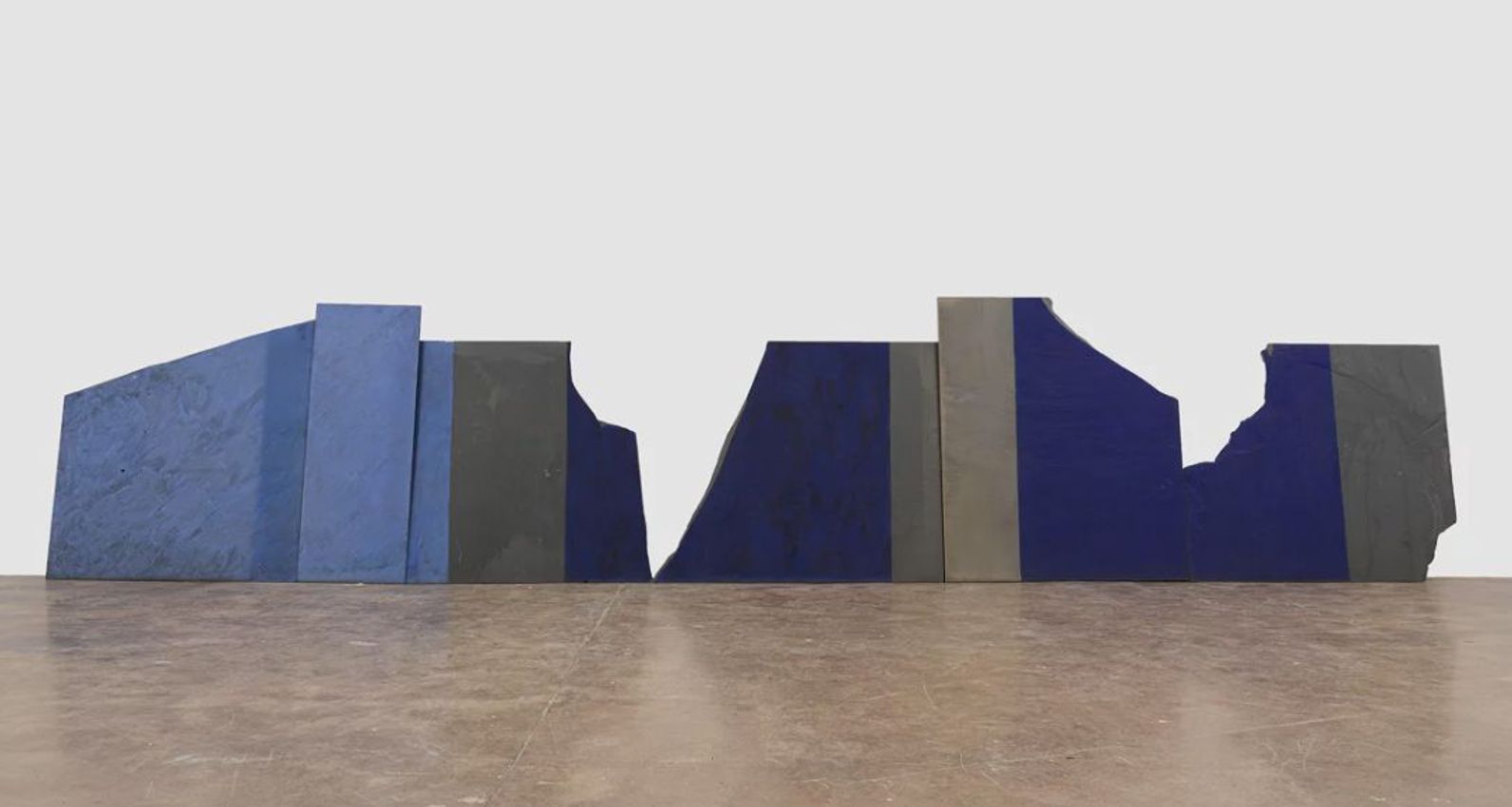
Wagner’s works in slate find their apotheosis in works such as Outerbridge Crossing (1986), whichunderscores the artist’s simultaneous embrace of both the formal and material qualities of thesesurfaces. Composed of rectangular planks of varying size as well as a small curved fragment, thegeometry of the composition is further accentuated by vertical bands of blue paint. The undulatingform, which takes its name from the bridge that spans between New York’s Staten Island and NewJersey, is ultimately reminiscent of both the structure itself and the body of water across which itstretches. As curator Lilly Wei has noted, such works evoke a wide range of references ‘withimpressive economy and visual tension, a mountain range, a deconstructed and downsizedStonehenge, a blown-up Song dynasty landscape, an urban canyon—or just broken pieces of slate.’

The artist’s small, impressionistic landscapes are yet another way in which she seeks to paint time.These intimately scaled oil paintings, which were created en plein air at the Wagner’s farm inPennsylvania, feature the deep reds of fall leaves, the snow-whites of winter, and the vibrant yellows,pinks, and lavenders of spring and summer blooms. Often titled after the month in which they werepainted, these compositions chronicle the effects of the changing seasons year after year.

The exhibition will also include examples of Wagner’s steel paintings, which the artist began in thelate 1980s—works that seamlessly juxtapose the organic and the industrial. Using primarily rustpreventative paint on cold-rolled steel, Wagner applies swashes of colour to the steel’s glossy surface.These reflective works, with their industrial materiality and their bands of pigment, are reminiscent ofboth colour field painting and minimalist sculpture. Williams Street (1988) is composed of two sheetsof steel that cross one another and are further unified by a painted teal square that overlaps the boundary of each individual piece. Likewise, Assertion (2005) features horizontal stripes of varyingwidths in shades of canary yellow, grey, black, and blue. Wagner embraces the irregularities of herfound material and invites natural colour variation and evidence of corrosion into her composition.

In other works such as Untitled (1991), two irregularly shaped pieces of slate have been structurallyjoined together and are further unified by the thin white lines of oil pastel that Wagner applied totheir surfaces. The slate has a rough, uneven quality that contrasts with the delicately rendered andalmost thread-like line. Whether working with tape, paint, stone, slate, or steel, Wagner is attractedto and compelled by the natural evolution of materials. She embraces the cracking, staining, veining,fading, and natural slubs of the media and found materials that she employs, creating works whosefinal compositions are dictated by process and time, but which are nevertheless ever guided by herfocused attention to color and her keen painterly sensibility.

Press release courtesy David Zwirner.

Read More
About the Artist

Merrill Wagner was born in 1935 in Tacoma, Washington. She completed her BA at Sarah Lawrence College, Bronxville, New York, in 1957 and studied painting at the Art Students League, New York, training under figurative painters Edwin Dickinson, George Grosz, and Julian Levi from 1959 until 1963.

View Artist Profile

Also Exhibiting at David Zwirner

About the Gallery
Since opening its doors in 1993, David Zwirner has been home to innovative, singular, and pioneering exhibitions across a variety of media and genres. The gallery has helped foster the careers of some of the most influential artists working today, and has maintained long-term representation of a wide-ranging, international group of artists and estates. Based in New York with spaces in Chelsea and the Upper East Side, David Zwirner expanded to Europe in 2012 with a gallery in an eighteenth-century Georgian townhouse in London’s Mayfair district, and opened its first gallery in Asia in January 2018 in Central Hong Kong.
View Gallery Profile
Address
5-6/F, H Queen's
80 Queen's Road Central
Hong Kong
Hong Kong
Opening Hours
Tuesday – Saturday
11am – 7pm
(1)
Hong Kong 5-6/F, H Queen's, 80 Queen's Road Central
David Zwirner
5-6/F, H Queen's, 80 Queen's Road Central, Hong Kong, Hong Kong
+852 211 959 00
http://www.davidzwirner.com

Opening hours
Tuesday – Saturday
11am – 7pm
The art world in focus