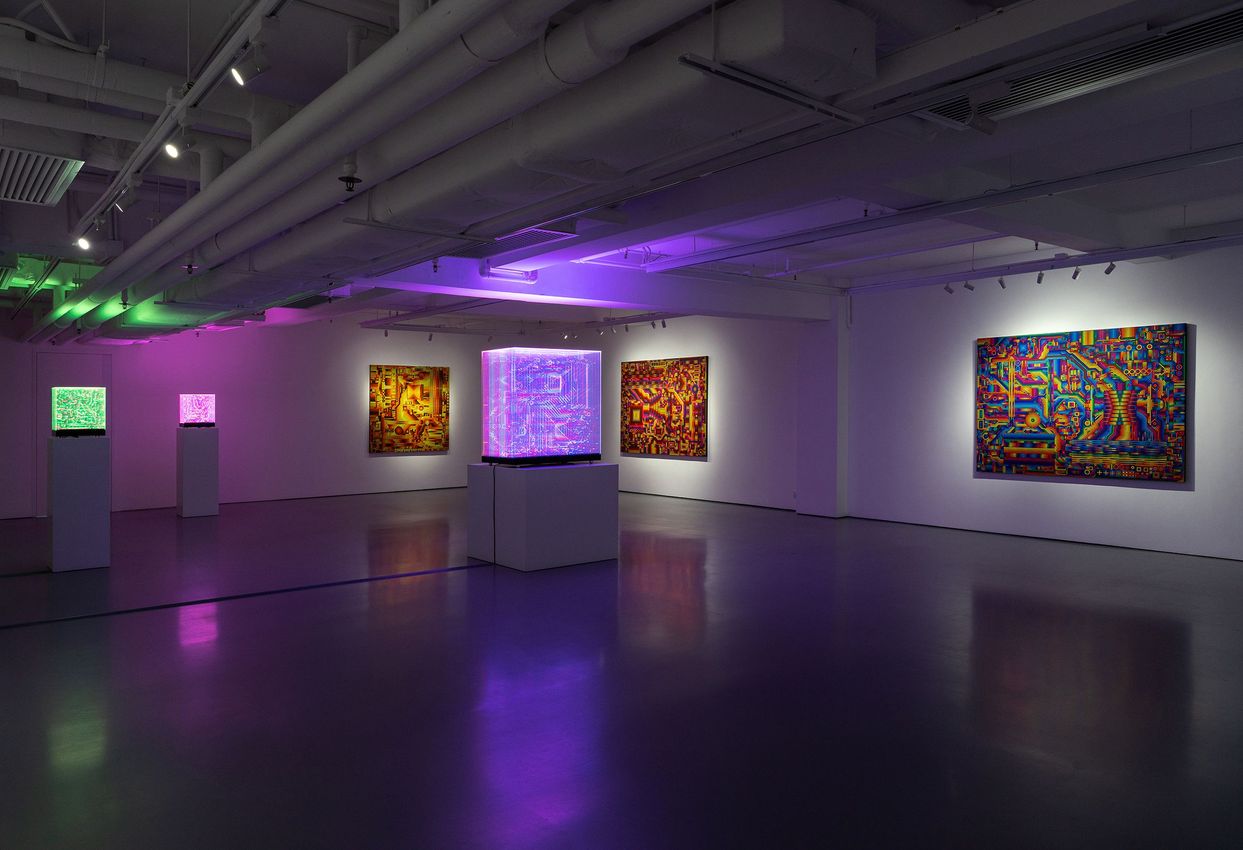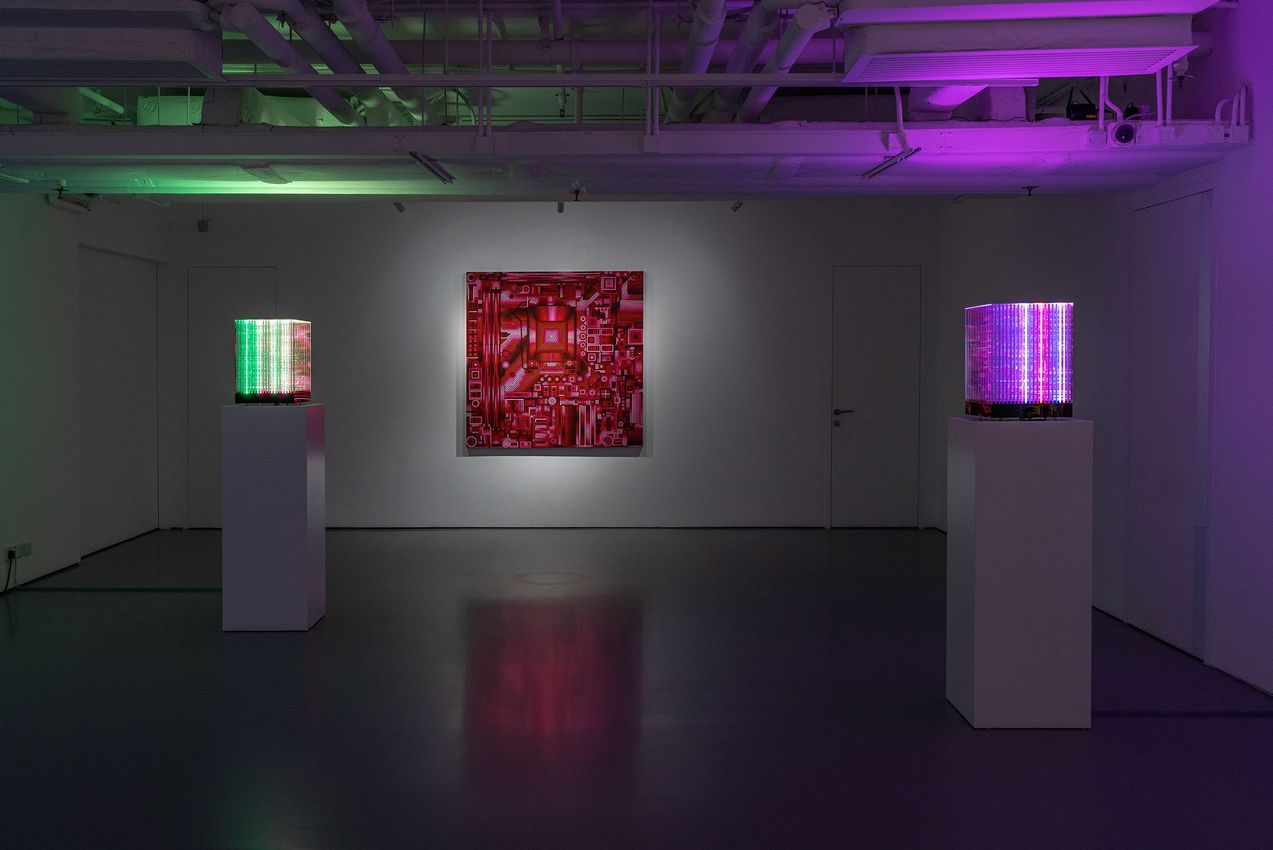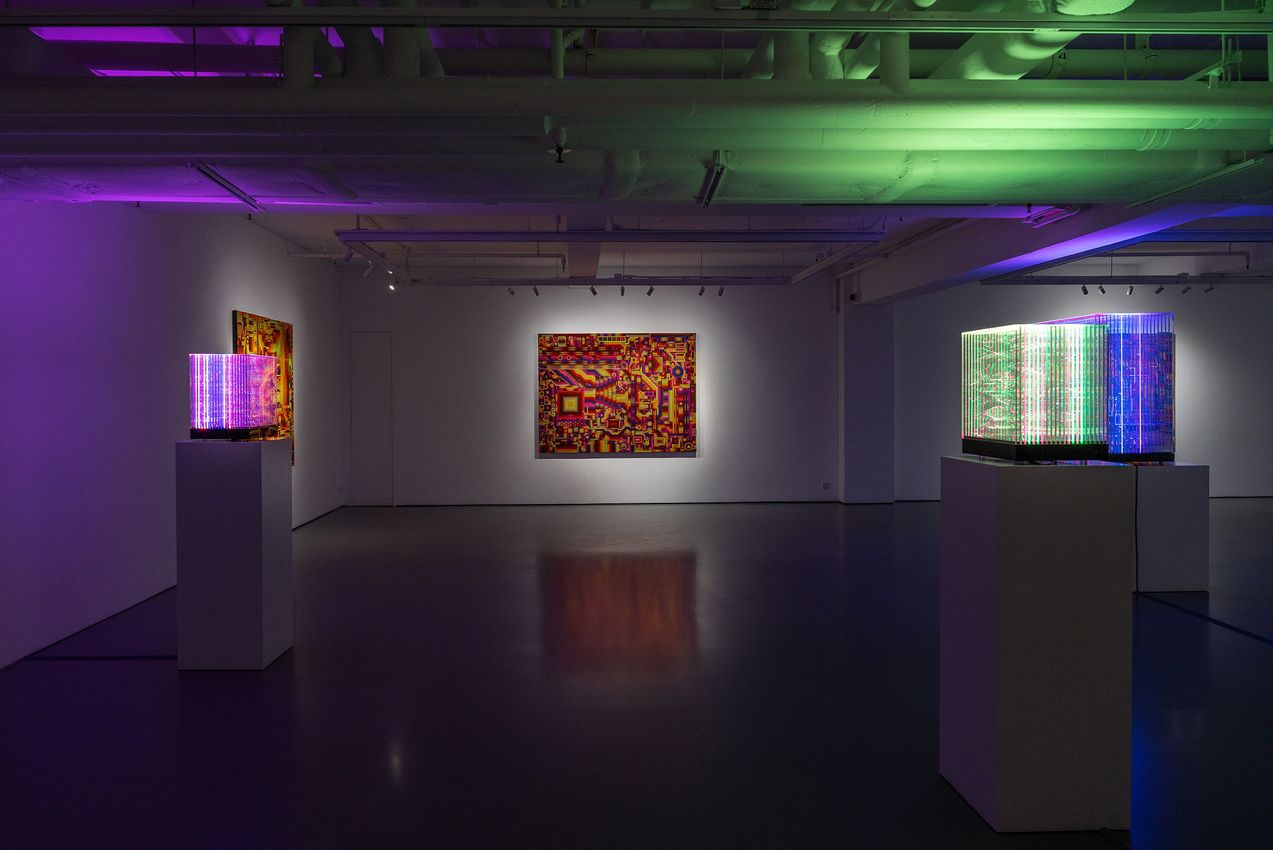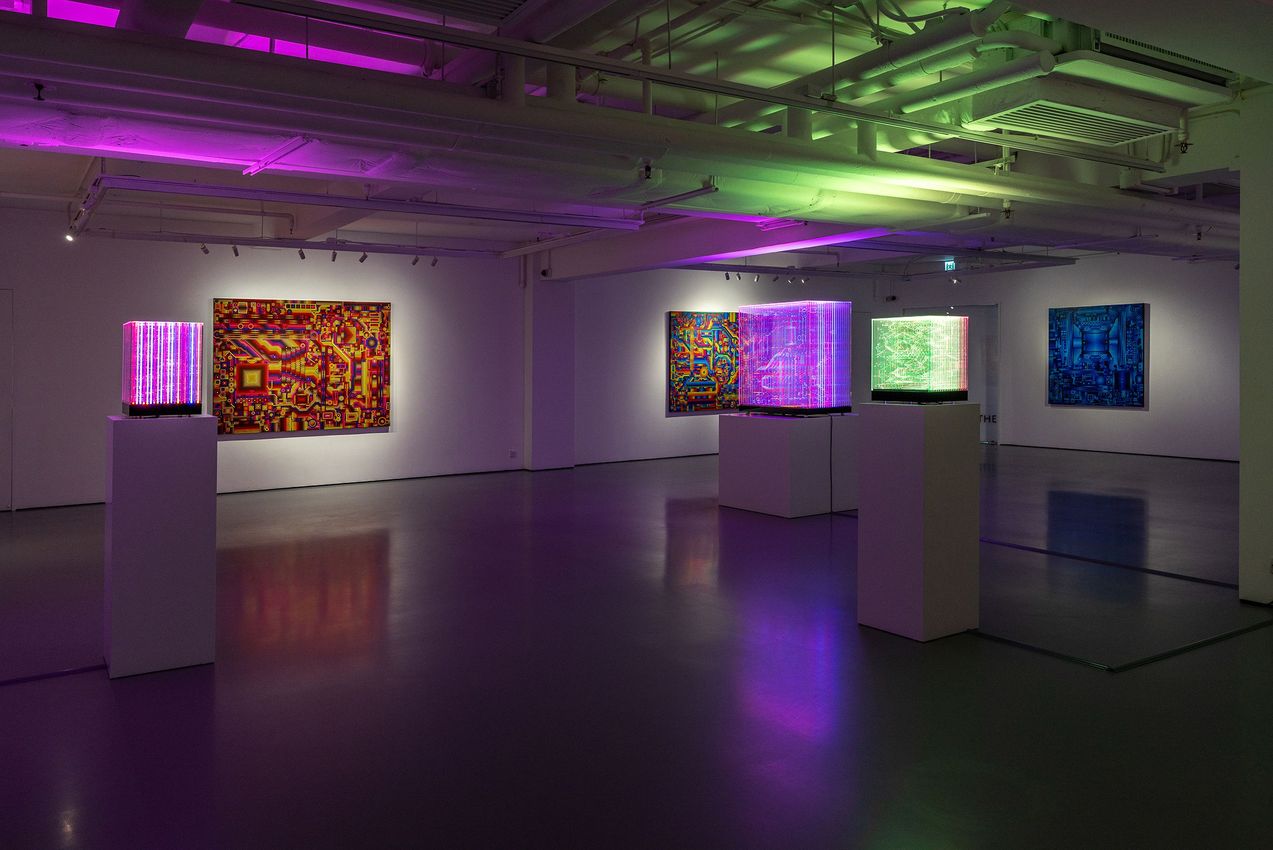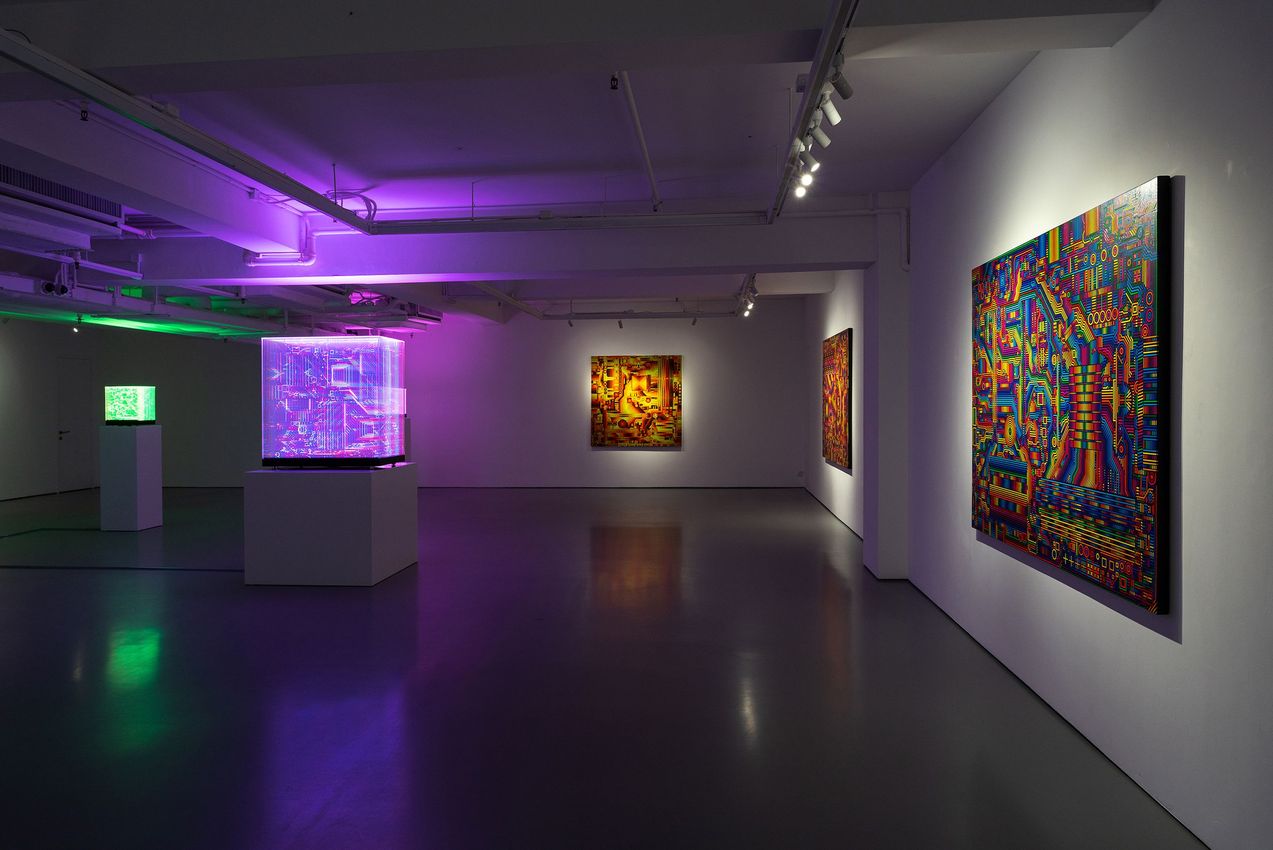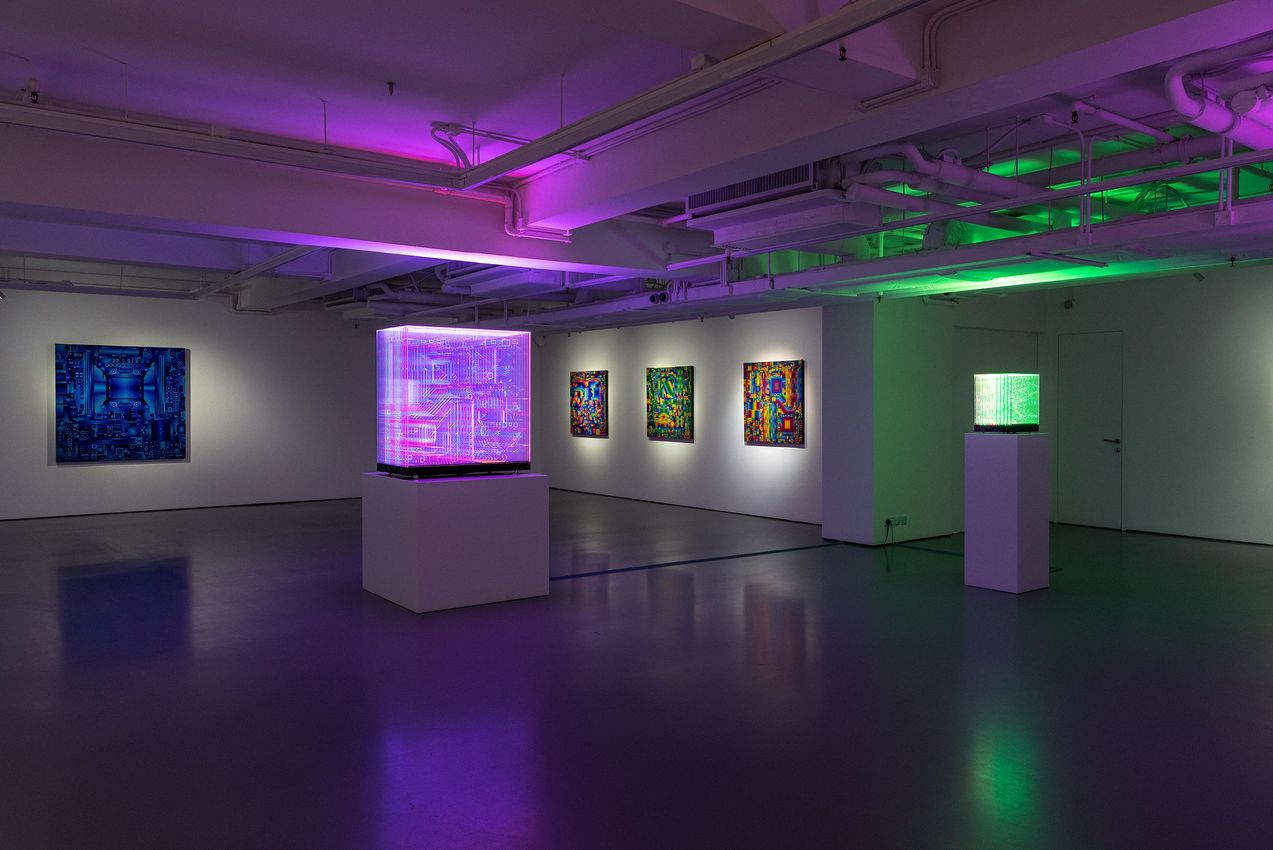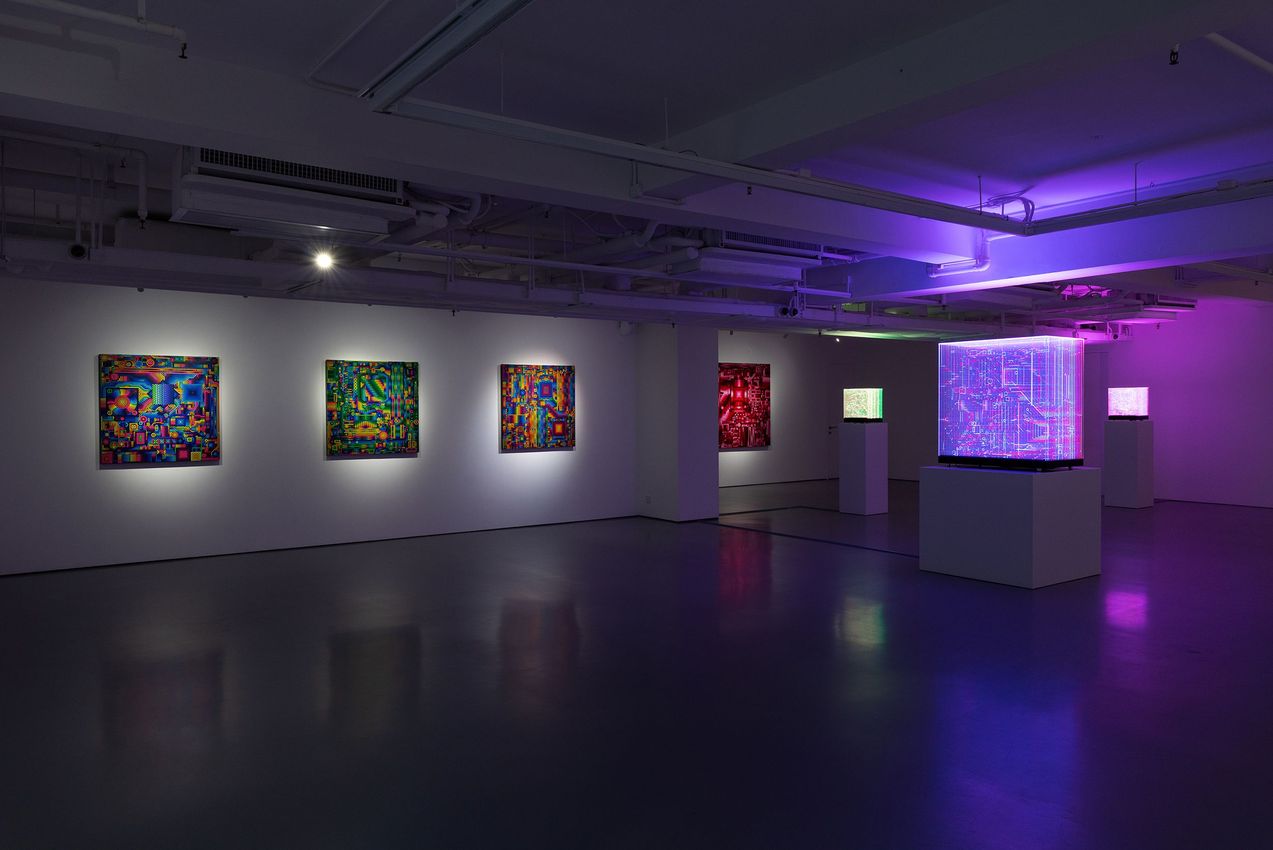
DE SARTHE is pleased to present Into the Matrix, a solo exhibition by Shanghai-based artist Lu Xinjian, featuring a new series of works on canvas and luminous installation artworks. Observing the relationship between urban and technological advancement, the exhibition draws inspiration from the similarities between the infrastructures of civilization and the constructs of contemporary culture. An extension of the artist’s iconic visual language, Lu’s mesmerizing artworks elucidate the layered spectrum of the post-human era. Into the Matrix opens October 5th and runs through November 23rd.
As of the 21st century, society has become an increasingly formatted existence. The form of grids has become ubiquitous to the prevailing landscape, manifesting in social platforms, electronic hardware, and city planning alike. A new ecosystem has been fostered as a by-product of development, wherein individual entities serve as data points in a matrix, collectively illuminating the topography of the digital Anthropocene.
Titled Matrix (2024), Lu Xinjian’s newest body of paintings juxtaposes the physical structures of technology with that of a contemporary city. The works are evolution from the artist’s City DNA series, in which he reimagines major cities and monuments using views captured by Google Maps. While his former artworks pointed toward the digitisation of physical environments, Matrix presents a reversal through which the artist takes on the role of the cartographer and illustrates the fabric and makings of technology.
Using a different motherboard as the blueprint for each composition, his artworks comprise meticulously fitted lines and symbols, saturated with electrifying gradients that travel in multiple directions. Resembling both electric lights and digital effects, closer inspection of the works would reveal that camouflaged within are the contours of architectural forms. Viewed as a whole, his intricate imagery is evocative of an aerial view of a moving city – likening the transit of heat and energy to that of information. Lucrafts an analogy between the system of a computer circuit board and the operation of social infrastructures, wherein each entity has a designated function within the master scheme.
Unveiled in the exhibition are also the artist’s newly developed installation artworks, conceived as part of the same series. Each work is composed of layered acrylic sheets that are engraved and prismatically illuminated. In contrast to the compression of space in his paintings, Lu crafts an expansion of dimension in the installation artworks. Within each work, the artist deconstructs the composition into lines, dots, and shapes and strategically overlays them to mimic the cross-sections of a three-dimensional space. Creating the illusion of infinite depth, the works not only allude to the growing heights of civilisation, but the stretching depth of virtual places. The use of dissection and reconstitution within the works illumines the digital means in which the contemporary social landscape is formed as well as perceived.
Lu’s - series poses an interesting shift in scale that asks its viewers to contemplate the invisible paradigms that shape and regulate societal patterns. The artist’s creative logic compares the activity center of a computer to a microcosm of both the virtual and physical world. As individuals grow progressively reliant on social media platforms as well as isolated user-to-user communication methods, Lu takes a step back through his artworks and pictures the paths, power, and animation of the information flow. As if the chorography of an imagined dimension, Lu’s view into the matrix is as potent as it is alluring.
Lu Xinjian was born in 1977 in Yixing, Jiangsu province of China. Upon graduating in 2000 from the Computer Graphic Design department of the Nanjing Arts Institute, Lu pursued an Interactive Media Postgraduate degree at the Design Academy Eindhoven. In 2006, he received his M.F.A. from the Interactive Media and Environment department at the Frank Mohr Institute in the Netherlands.

DE SARTHE is a pioneering platform for boundary-pushing contemporary art from Asia. It has also contained an influential international presence in modern and post-war art since 1977.

A respected voice in contemporary art discourse.
Focusing on ambitious storytelling and insightful art-world commentary. Ocula Magazine publishes in-depth interviews, critical essays and timely analysis on the artists, exhibitions and ideas driving the global art world.
Learn more about Ocula Magazine
Showcasing the best of the art world.
Ocula partners with galleries from around the world to highlight their artists, artworks and exhibitions. Gallery membership is by application and invitation, with each member vetted by an independent panel.
Learn more about Ocula Membership

Specialises in the sale of major artworks.
Led by a team with deep ties to the world’s leading auction houses, galleries and collectors. Ocula’s advisory team offers bespoke services to high-net-worth clients from around the world who are looking to acquire the best of contemporary and modern art.
Learn more about our team and services