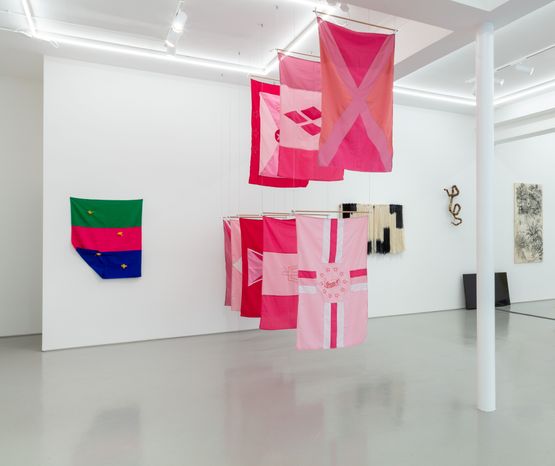
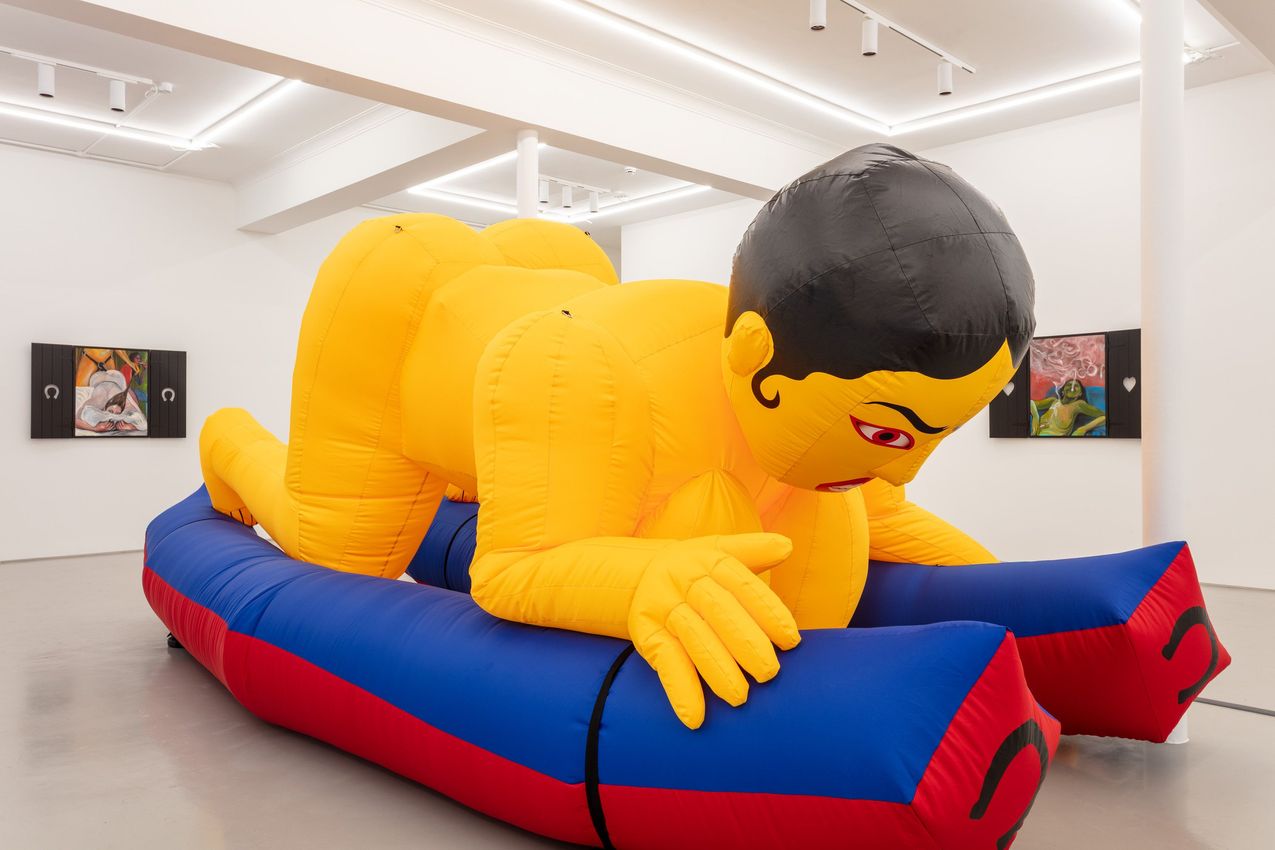
Our Place in These Worlds, at Elizabeth Xi Bauer, is an artist-led touring exhibition featuring works by Esvin Alarcón Lam, Antonio Pichillá Quiacaín, and Simón Vega. Curated by Maria do Carmo M. P. de Pontes, the show is shaped through non-hierarchical collaboration and takes a collective, non-authoritarian approach centred on exchange. Challenging dominant Eurocentric ideas of belonging, Our Place in These Worlds engages with histories of colonisation and migration while resisting exoticisation and fixed notions of identity, opening space for shifting perspectives. The show considers how ideologies shape the ways worlds—and the lives within them—are imagined. In the context of ongoing debates around migration and cultural polarisation, Our Place in These Worlds advocates for more nuanced and relational approaches to identity. While some works have been part of the project since its first iteration in 2023, others are presented here for the first time.
The touring project is conceived by the three participating artists, whose continued dialogue forms its conceptual framework as it moves between contexts. Previously, the exhibition included a curatorial essay by María Jacinta Xón Riquiac, a Maya K’iche’ anthropologist and Indigenous rights activist. Our Place in These Worlds at Elizabeth Xi Bauer has been developed by curator Maria do Carmo M. P. de Pontes, marking further evolution through the introduction of her curatorial perspective. Additional reading will include a newly commissioned conversation between the three artists and de Pontes.
Esvin Alarcón Lam’s multidisciplinary practice examines mobility and cultural inheritance through the movement of symbols across geographies, with a particular focus on the Chinese diaspora in Central America, which he traces through his maternal grandfather. Working across performance, video, textile, and sculpture, Alarcón Lam brings together personal memory and ancestral stories to explore how they shift across generations. His works trace how motifs circulate and accrue layered associations as they move across settings, challenging fixed definitions of selfhood. Through this framework, Alarcón Lam foregrounds hybridity as a state shaped through encounters and continual negotiation.
Antonio Pichillá Quiacaín’s textile-based practice draws on Indigenous epistemologies and craft lineages that carry meaning through making. Working with woven structures, he draws on his Tz’utujil Maya heritage to reflect cosmological understandings embedded in cloth and process. His works treat textiles as living systems that hold knowledge and encode ways of relating to land and community. Pichillá draws attention to Western hierarchies that separate art from craft, presenting weaving as a site of reclamation and contemporary expression.
Simón Vega’s practice draws on constructed environments shaped by speculation and displacement, using sculpture, installation, and drawing to reflect on postcolonial conditions. His works often bring together seemingly incompatible references, pairing everyday materials with DIY technologies to question prevailing notions of progress and aspiration. Through these juxtapositions, Vega addresses how futures are envisioned from the margins and how global power orders continue to influence such projections. His contribution to the exhibition positions humour and critique as tools for rethinking inherited narratives.
Previous versions of Our Place in These Worlds were presented at Sol del Río Gallery, Guatemala City (2023) and Liliana Bloch Gallery, Dallas (2025).
Paige Ashley
Founded in 2015, Elizabeth Xi Bauer began as an innovative online platform accompanied by pop-up exhibitions. In 2021, as the UK was exiting lockdown restrictions, the gallery took on the challenge to open a permanent space in South-East London. Since then, in addition to an exhibition programme, Elizabeth Xi Bauer has collaborated on projects with international institutions, curators, and artists across various cities, including São Paulo, Amsterdam, Brussels, and Lisbon.

A respected voice in contemporary art discourse.
Focusing on ambitious storytelling and insightful art-world commentary. Ocula Magazine publishes in-depth interviews, critical essays and timely analysis on the artists, exhibitions and ideas driving the global art world.
Learn more about Ocula Magazine
Showcasing the best of the art world.
Ocula partners with galleries from around the world to highlight their artists, artworks and exhibitions. Gallery membership is by application and invitation, with each member vetted by an independent panel.
Learn more about Ocula Membership

Specialises in the sale of major artworks.
Led by a team with deep ties to the world’s leading auction houses, galleries and collectors. Ocula’s advisory team offers bespoke services to high-net-worth clients from around the world who are looking to acquire the best of contemporary and modern art.
Learn more about our team and services