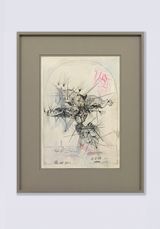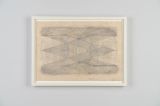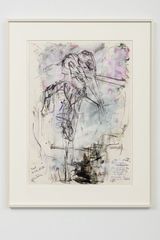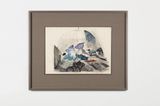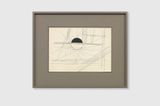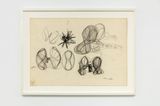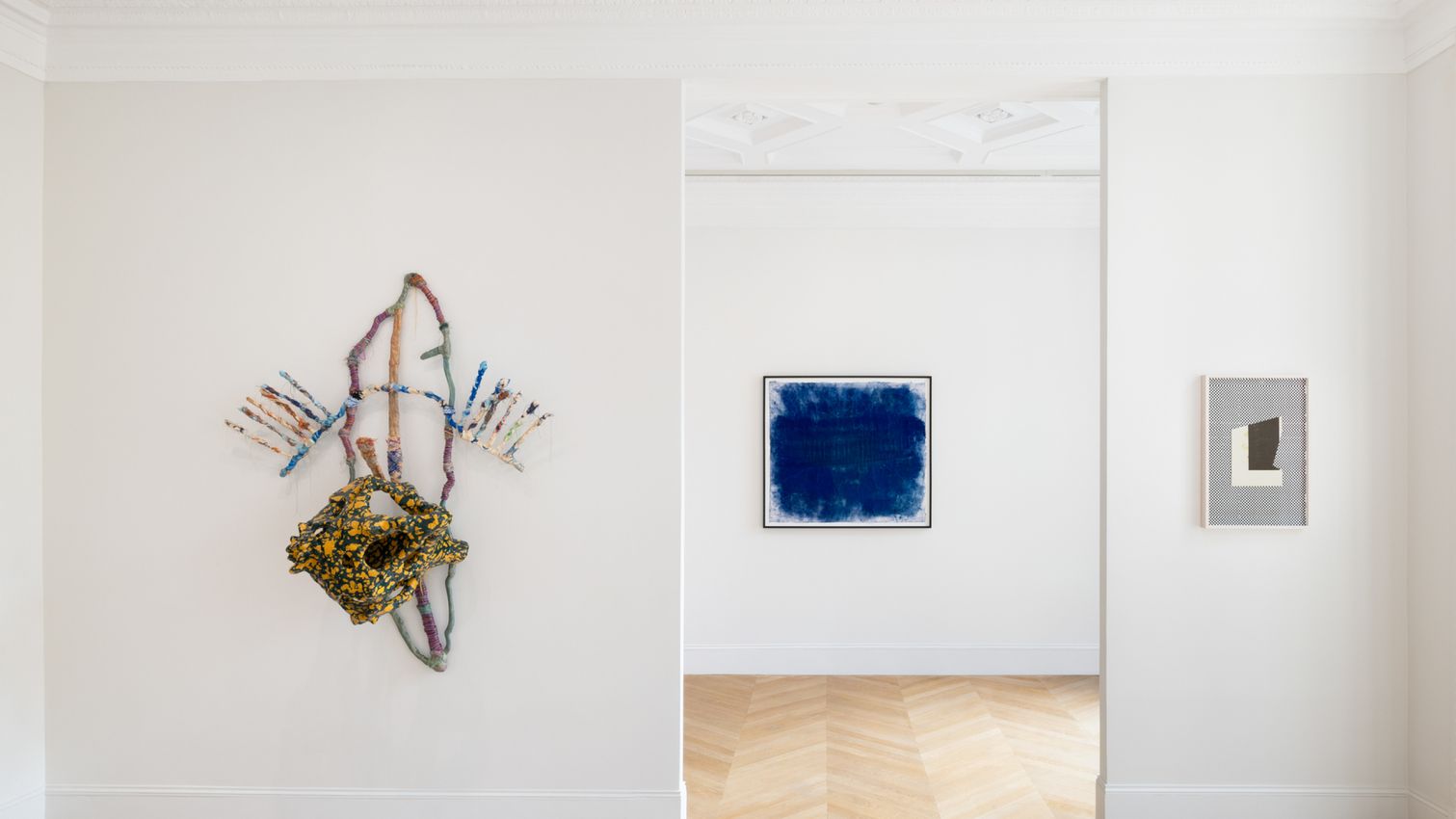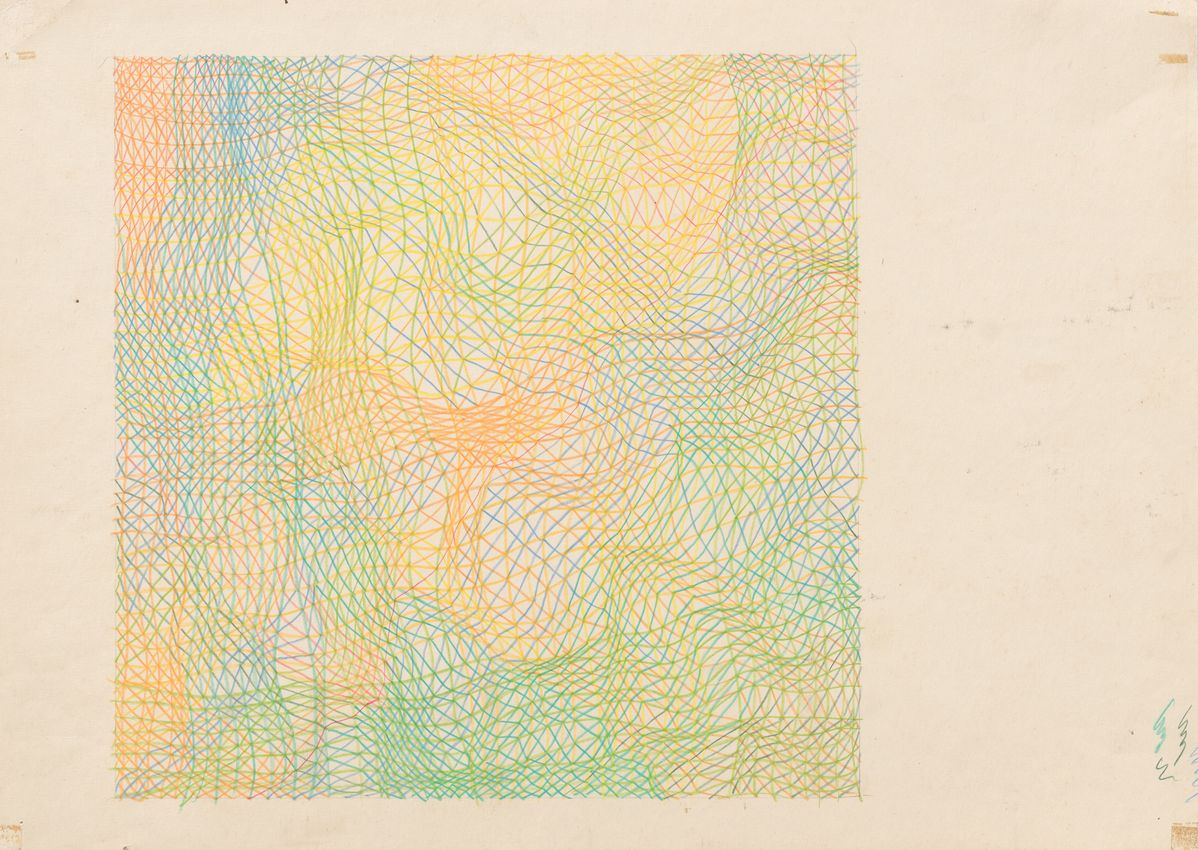
Esther Schipper is pleased to announce Ends of Research, an exhibition of works by Stefan Bertalan. Onview will be over 50 works on paper spanning from the 1960s through the 2000s, selected by the Romanianart historian Erwin Kessler, an authority on Bertalan’s work.
Stefan Bertalan (1930–2014) was the main figure of research-based, process-oriented and innovation-drivenart in Romania. In 1966 he founded the experimental neo-constructivist group 111, with Roman Cotoșmanand Constantin Flondor. After the defection of Roman Cotoșman, another group, Sigma (1969-1982), wasfounded. Bertalan was a driving force both of 111 and Sigma. For decades, the two groups were the mostinfluential, innovative art groups in Romania and shaped the artistic, educational and curatorial practices ofgenerations of young artists and theorists.
Bertalan worked in many media, producing drawings, photographs, installations, actions, environmentsand happenings, often with innovative materials such as plastics, natural and synthetic fibres, X-ray photos,aluminium. However, nearly ninety procent of his output are works on paper.
The selected works exhibited in Ends of Research are taken from different series across Bertalan’s entirecareer. They display the discontinuities but also the striking continuum of a career balanced between the earlierends of his scientific-like research (the geometric, abstract perfection of shapes and objects), and the laterends of his psycho-political, manic research in which he projected himself (as self-portrait) into the biological-cosmic-fantastic world around him. Ends of Research shows how the research of abstract structuresslowly opens towards the figures of the outer world and subsequently unfold into research of his own humantraits, which then develop into research of his body, but one whose anatomy progresses into geology andcosmology.
Ecological mysticism made its way into Bertalan’s experiments of the late ‘70s. The universal order which heperceived underneath the wide-ranging correspondences between the mind’s procedures and the naturalprocesses induced the belief in an overreaching, transcendental communication and harmony. Anything could
connect to anything, the universal system being a speculative association of concealed/revealed features.Bertalan’s extensive research papers are filled with sketches, diagrams and complex calculations, geometricschemes, keen observations of plants, rocks, shells, insects, animals, landscapes, but also abstract structures,nightmarish monsters and violent politics. They re-construct earth and skies, nature, human faith, and ethics.Inspired by pioneering work in systems theory and bionics, he investigated the formal relationships betweenorganic and inorganic natural structures, human artifacts, and spiritual visions. He aimed at disclosing the deepisomorphism between mental, abstract cognitive processes and the natural laws of growth and geometricstructures. Bertalan’s maps of drawings look like a scientific/speculative diary, filled with experimentalobservations, theoretical reflections, and political statements. Research was not a means of his art, but itsproper end.
Ends of Research is an introduction to Bertalan’s enthralling, creative research process, and his (mystical)ecology and blistering political criticism. The exhibition unveils utopian and modernist ambitions andparadoxes, the limits of reason, the perpetual, inner and outer emigration, the status of the artist as a risky,fragile researcher of the absolute perfection, and the weird workings of an indomitable, critical consciousnesspreying on itself until the very last moments of life. It simultaneously points to the political and ethical issuesraised by repression, age, and illness. Bertalan is a paragon of the emerging concerns of sustainability andconservation both in society and art. His profuse and ecstatic work foreshadowed the contemporary focus onan holistic consciousness of the nature and the human.
Stefan Bertalan was born in 1930 in Răcăştie, Romania and died in 2014 in Timişoara, Romania.
Stefan Bertalan studied at the Institute of Fine Arts “Ion Andreescu” in Cluj-Napoca. Beginning in 1962 hewas Professor at the School of Fine Arts in Timişoara. From 1970 to 1981 he was lecturing at the Faculty ofEngineering in Timişoara (Department of Architecture).
The artist represented Romania at the 46th Venice Biennale in 1995. In 2013 his work was included in theexhibition The Encyclopedic Palace at La Biennale di Venezia, curated by Massimiliano Gioni in Venice.
Bertalan’s solo exhibitions include: Ştefan Bertalan, Muzeul de Artă, Timişoara (2012); The Self-PunishingOne, Mogosoaia Palace, traveling to Muzeul de Artă, Timişoara/ The Bánffy Palace, Cluj-Napoca andNeuklosterburg (2009).
Selected group exhibitions include: Things we sense about each other, Badischer Kunstverein, Karlsruhe(2021); Parlament der Pflanzen, Kunstmuseum Liechtenstein, Liechtenstein (2020); Ex-East. Past andrecent stories of the Romanian avant-garde, Espace Niemeyer – Siège du Parti communiste Français,Paris (2019); La Brique, The Brick, Cărămida, La Kunsthalle Mulhouse, Mulhouse (2019); Dissolve into ared dwarf, Islands, Brussels (2017); Derjenige, der sich selber bestraft, Bucureşti/Timişoara/Cluj-Napoca(2009); Speech, Performance Festival Zona 4, Timişoara (2002) and Selbstbildnis in der zeitgenössischenrumänischen Kunst, Kunstmuseum Timişoara (2001).
Recent comprehensive monographic publications include Ştefan Bertalan: inner emigration by ErwinKessler and Ştefan Bertalan: Überlagerungen/Suprapuneri/Overlappings by Ileana Pintilie.


Esther Schipper founded the gallery in 1989 in Cologne. In 1997 the gallery relocated to Berlin. Through more than three decades of continuous exhibition practice, the gallery has established itself as a major force not only in Germany but in an international context, with offices in Paris and Seoul and representatives in France, Spain, the United States, Latin America, South Korea, Taiwan and China. The gallery holds up to ten gallery exhibitions as well as multiple off-site projects each year and participates in leading art fairs across the globe.

A respected voice in contemporary art discourse.
Focusing on ambitious storytelling and insightful art-world commentary. Ocula Magazine publishes in-depth interviews, critical essays and timely analysis on the artists, exhibitions and ideas driving the global art world.
Learn more about Ocula Magazine
Showcasing the best of the art world.
Ocula partners with galleries from around the world to highlight their artists, artworks and exhibitions. Gallery membership is by application and invitation, with each member vetted by an independent panel.
Learn more about Ocula Membership

Specialises in the sale of major artworks.
Led by a team with deep ties to the world’s leading auction houses, galleries and collectors. Ocula’s advisory team offers bespoke services to high-net-worth clients from around the world who are looking to acquire the best of contemporary and modern art.
Learn more about our team and services