

I’m governed by nature. Anything I do, I want it to feel natural. —Neil Jenney
Gagosian is pleased to present paintings by Neil Jenney from his recent series ‘Modern Africa’ (2015–)—a subseries of the ‘New Good Paintings’ (2015–)—and the preceding series, ‘Good Paintings’ (1971–2015).
Jenney is committed to exploring, and ultimately transcending, realism as both style and philosophy—a project first sparked by the preponderance of Pop-themed Photorealism in late-1960s New York. Having designated his early work ‘Bad Painting’ (a term coined by Marcia Tucker, director of the New Museum, New York, in 1978) and his output after 1970 ‘Good Painting,’ he continues to challenge familiar models of taste and subject matter while pursuing a meticulous and highly idiosyncratic approach to the representation of culture and place.
As with proto-Surrealist writer Raymond Roussel’s fanciful travelogue Impressions d’Afrique (Impressions of Africa, 1910), Jenney’s approach to his subject in the paintings on view is rooted in personal imagination, and in Western fantasies about the continent. Although these paintings are landscapes, they eschew sweeping panoramas in favour of more intimate, even introspective scenes. But despite his pictorial restraint, Jenney’s series addresses fundamental conflicts between nature and civilisation, and reflects a concern with our deteriorating environment.
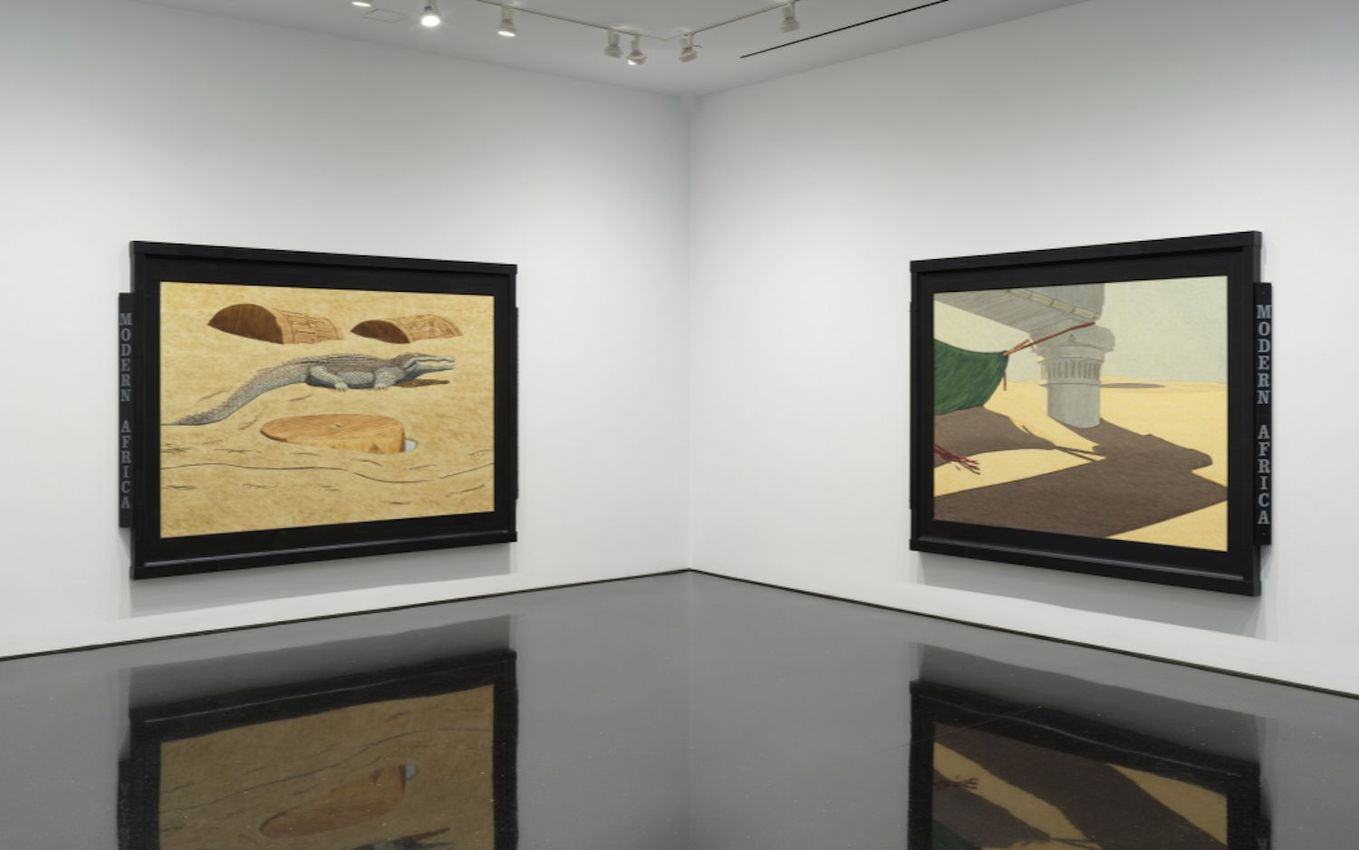
‘Modern Africa’ shows architectural fragments that Jenney characterises as ‘utilitarian’—columns, ramps, and stairways—half-submerged in undulating sand dunes. These monumental structures seem to exist in past and future simultaneously, providing both a critical look at the legacies of colonialism and a speculative view of what may lie in wait for humanity should we fail to address climate change. While the shadows and footprints that intrude here and there reveal a continued human presence, no figures are visible, suggesting that Jenney’s envisioned world is incapable of supporting many survivors.
Jenney refers to his work as ‘painted sculpture,’ and uses handmade black wooden frames, which he first designed in the early 1970s, to present canvases executed in a crisp, high-contrast style. This device was inspired by the classical Greek notion of viewing a painting as a scene through a window, an idea that he encountered in a Fourth Avenue bookstore. Providing in this way an ‘architectural foreground’ as well as—through their stencilled captions—a guide to title and setting, the frames situate the paintings as objects and interpretations and continue to provide Jenney with what he has described as ‘the most stimulating prospect’ with which he has ever worked.
‘I had two striking realizations: one, that even if I produced the worst paintings possible, they would not be good enough; and two, that idealism is unavoidable.’—Neil Jenney


A respected voice in contemporary art discourse.
Focusing on ambitious storytelling and insightful art-world commentary. Ocula Magazine publishes in-depth interviews, critical essays and timely analysis on the artists, exhibitions and ideas driving the global art world.
Learn more about Ocula Magazine
Showcasing the best of the art world.
Ocula partners with galleries from around the world to highlight their artists, artworks and exhibitions. Gallery membership is by application and invitation, with each member vetted by an independent panel.
Learn more about Ocula Membership

Specialises in the sale of major artworks.
Led by a team with deep ties to the world’s leading auction houses, galleries and collectors. Ocula’s advisory team offers bespoke services to high-net-worth clients from around the world who are looking to acquire the best of contemporary and modern art.
Learn more about our team and services