I can’t understand why most people believe in medicine and don’t believe in art, without questioning either.
—Damien Hirst
Gagosian is pleased to present Cathedrals Built on Sand, the largest exhibition of Damien Hirst‘s ‘Pill Cabinets’ to date. The presentation is realised in conjunction with Cherry Blossoms, on view from July 6, 2021, to January 2, 2022, at the Fondation Cartier pour l’art contemporain in Paris, marking Hirst’s first solo museum exhibition in France.
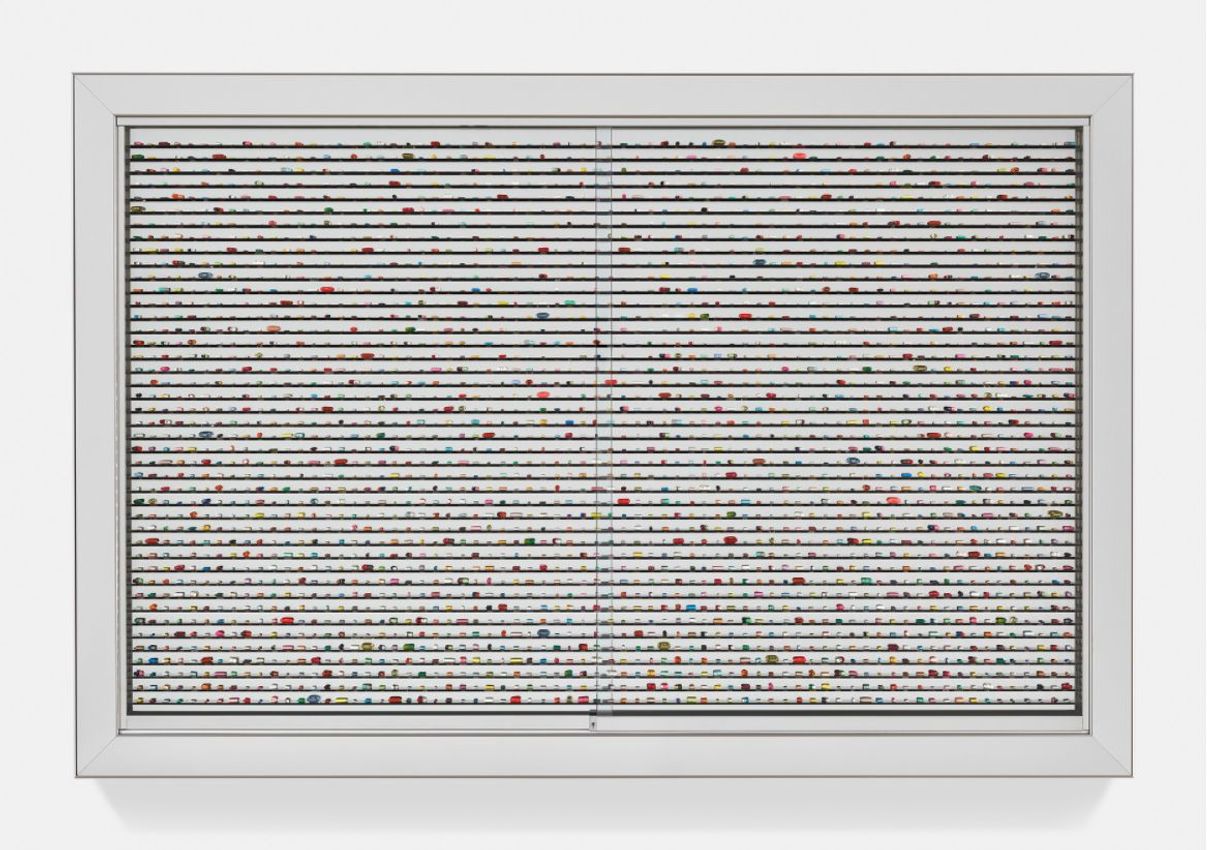
For this landmark sculptural series, Hirst filled wall-mounted cabinets with arrangements of pills—some real, some fabricated from resin, metal, or plaster. Intermingling art and science, the ‘Pill Cabinets’ examine the limits of human belief and confront society’s faith in drugs as a panacea. The works have taken on new significance during the COVID-19 pandemic, a testament to the enduring and prescient nature of Hirst’s creations.
On view is Prototype for Lies (1998), the first work created in the series. Featuring open fibreboard shelves, the sculpture imbues the sterile grid of pills with a certain warmth. The ‘Pill Cabinets’ as a whole evolved from Hirst’s earlier ‘Medicine Cabinets’, in which empty pharmaceutical packages are arranged on shelves, emulating the displays one might see at a drugstore. Clinical and pragmatic, yet inextricably linked to the human body, the Medicine Cabinets unite Hirst’s interest in post-Minimalist forms with Pop art–inspired commentary on commercial goods.
Unlike the preceding body of work, however, the ‘Pill Cabinets’ revel in playful chromatic variations that are made all the more striking by the simple shapes and rounded edges of the capsules at the heart of each work. Infusing these pared-down sculptural forms with what Hirst calls ‘minimalist delicious color,’ the installations evoke the industrial origins of Gerhard Richter’s colour charts, as well as the intimacy and seriality of Felix Gonzalez-Torres’s candy arrangements. Pills have been a part of Hirst’s artistic vocabulary for years; he is drawn to their power to convince, their symbolic combination of remedy and risk making them an ideal subject for his dichotomous focus.
While the sheer number of pills in each cabinet is designed to elicit a sense of wonder, it also raises moral questions about the commodification of healthcare. The ‘Pill Cabinets’ present the pharmaceutical drug as a sort of fetish object; removed from its packaging and laid out for individual consumption, each unassuming tablet becomes a loaded promise—a seductive token of trust between the patient and the faceless medical institutions that dictate his or her well-being.
Damien Hirst first rose to public recognition in 1988 during his time studying at Goldsmiths College in London, when he conceived and curated Freeze, a group exhibition of his work and that of his contemporaries at Goldsmiths. In the near quarter century since that pivotal show, Hirst has become one of the most prominent artists of his generation. Through work that includes the iconic shark suspended in formeldahyde, The Physical Impossibility of Death in the Mind of Someone Living (1991), to the platinum cast of a human skull set with 8,601 flawless diamonds, For the Love of God (2007), Hirst takes a direct and challenging approach to ideas about existence. Of the latter, art historian Rudi Fuchs has said, ‘The skull is out of this world, celestial almost. At the same time, it represents death as something infinitely more relentless. Compared to the tearful sadness of a vanitas scene, the diamond skull is glory itself.’ His work calls into question our awareness and convictions about the boundaries that separate desire and fear, life and death, reason and faith, love and hate. Hirst uses the tools and iconography of science and religion, creating sculptures and paintings whose beauty and intensity offer the viewer insight into art that transcends our familiar understanding of those domains. ‘There [are] four important things in life: religion, love, art and science,’ the artist has said. ‘At their best, they’re all just tools to help you find a path through the darkness. None of them really work that well, but they help. Of them all, science seems to be the one right now. Like religion, it provides the glimmer of hope that maybe it will be all right in the end…’


A respected voice in contemporary art discourse.
Focusing on ambitious storytelling and insightful art-world commentary. Ocula Magazine publishes in-depth interviews, critical essays and timely analysis on the artists, exhibitions and ideas driving the global art world.
Learn more about Ocula Magazine
Showcasing the best of the art world.
Ocula partners with galleries from around the world to highlight their artists, artworks and exhibitions. Gallery membership is by application and invitation, with each member vetted by an independent panel.
Learn more about Ocula Membership

Specialises in the sale of major artworks.
Led by a team with deep ties to the world’s leading auction houses, galleries and collectors. Ocula’s advisory team offers bespoke services to high-net-worth clients from around the world who are looking to acquire the best of contemporary and modern art.
Learn more about our team and services