



‘When I built the first model of the fish, I saw in it the movement that I was looking for. It was startling that a static object could express motion in such a dynamic way.’
—Frank Gehry
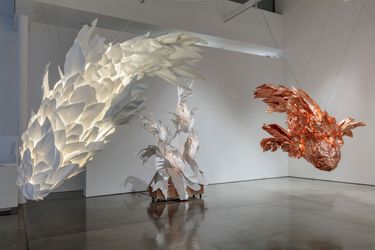
Gagosian is pleased to present Spinning Tales, an exhibition of new work by renowned architect Frank Gehry. It pairs large-scale elaborations on the Fish Lamps series with a new installation, Wishful Thinking (2021), and is Gehry’s eighth exhibition with the gallery since 1999.
Celebrated for his groundbreaking architectural designs, Gehry has also produced significant bodies of sculpture and furniture, from Easy Edges (1969–1973) and Experimental Edges (1979–1982)—chairs and tables made from layers of corrugated cardboard—to bentwood furniture items designed for Knoll (1989–1092). The Fish Lamps evolved from a 1983 commission by the Formica Corporation to utilise ColorCore, a type of plastic laminate. After accidentally breaking off a shard of the material, Gehry was inspired by its scale-like appearance; moulding wire armatures into piscine forms, he affixed ColorCore fragments to them.
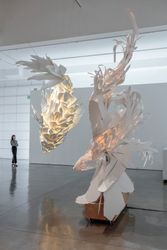
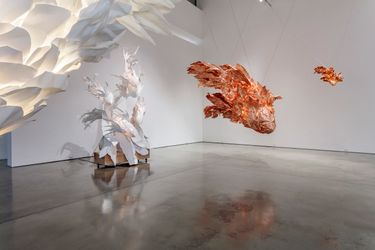
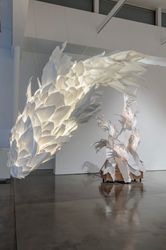
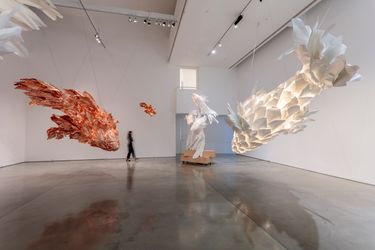
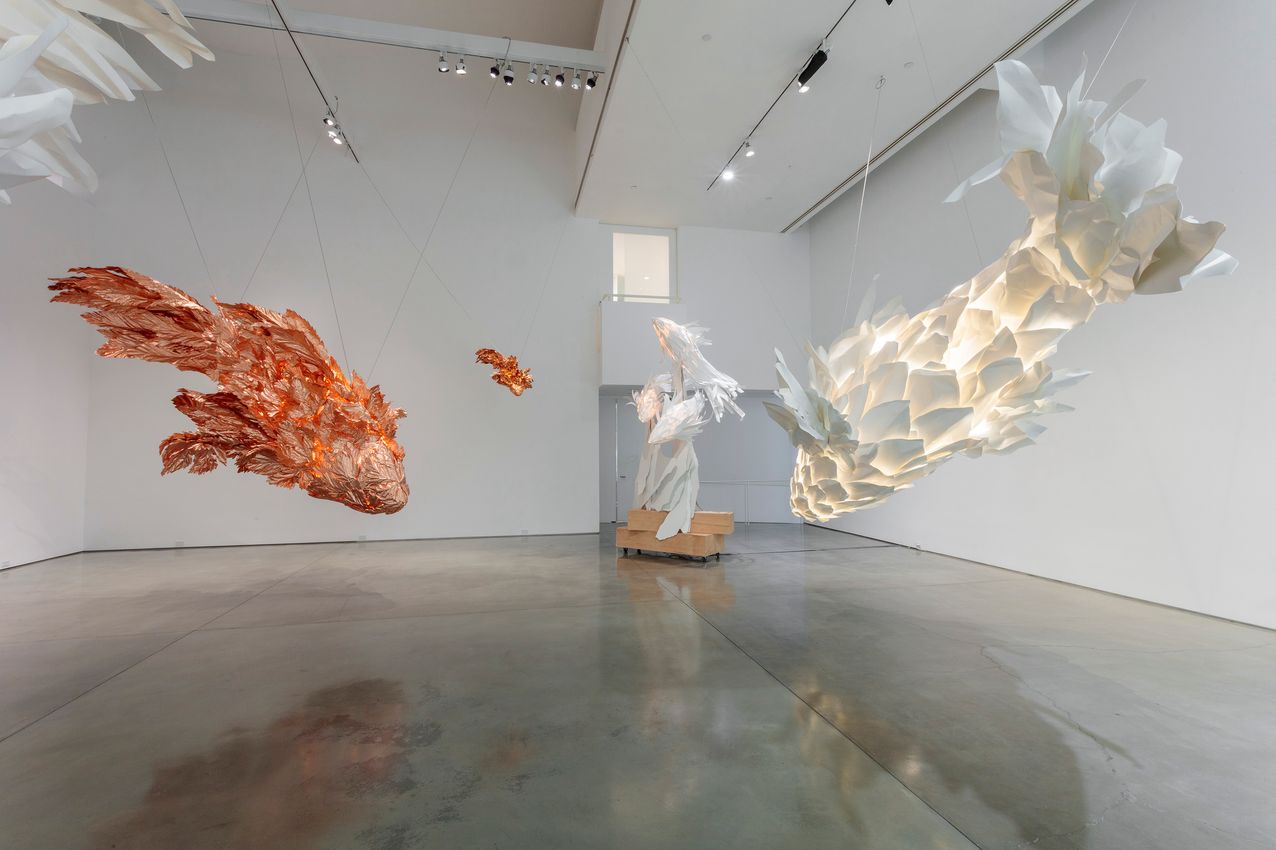
In the main gallery, three outsize, internally illuminated Fish Lamps sculptures are suspended from the ceiling in dynamic, twisting poses, as if swimming through water. In these works, Gehry has used polyvinyl and copper for the first time. These central forms are surrounded by lively, colourful sculptures that are more baroque in their ornamentation. While these sculptures are autonomous works, the ‘perfect form’ of the creature that they emulate reappears throughout Gehry’s architectural oeuvre, lending itself to the undulating profiles of buildings including the Guggenheim Bilbao, Spain (1997), and the Walt Disney Concert Hall, Los Angeles (2003).
Filling the upstairs gallery is the immersive installation Wishful Thinking, based on a scene from Alice’s Adventures in Wonderland. Gehry renders the Mad Hatter’s tea party as a group of ten surreal figures, twice life-size. Fashioned from brilliantly painted metal, Gehry’s abstracted interpretations of Carroll’s original characters surround an internally lit table, the glowing heart of the scene. Three overlapping woven steel ‘tapestries’ of trees evoke the episode’s forest setting, while a mirror on the opposite wall implicates the viewer. The crumpled surfaces of Wishful Thinking‘s figures establish a new visual connection with some of Gehry’s best-known designs.


The designs of Frank Gehry—one of the most innovative architects working today—grace numerous metropolitan skylines around the world. Known for their deconstructivist approach and creative use of materials, his buildings incorporate a wealth of textures that lend a sense of movement to his dynamic structures. Early in his career, Gehry created both sculpture and furniture, which similarly reflected his concern with inventive forms made from unexpected materials. The Easy Edges (1969–1973) and Experimental Edges (1979–1982) series of chairs and tables were made of industrial corrugated cardboard, while a later Knoll furniture series (1989–1992) was made from pliable bentwood. Gehry was commissioned by the Formica Corporation to use a translucent plastic laminate, ColorCore, in a series of lamps consisting of radiant snake and fish forms (1983–1986). The fish has been a recurring motif in Gehry’s work, recognisable in the undulating, curvilinear forms of his architecture as well as various sculpture projects, including his Fish Sculpture at Vila Olímpica in Barcelona, Spain (1989–1992), and his Standing Glass Fish for the Minneapolis Sculpture Garden (1986). The first Fish Lamps were shown in Frank Gehry: Unique Lamps in 1984 at the former Robertson Boulevard location of Gagosian in Los Angeles.


A respected voice in contemporary art discourse.
Focusing on ambitious storytelling and insightful art-world commentary. Ocula Magazine publishes in-depth interviews, critical essays and timely analysis on the artists, exhibitions and ideas driving the global art world.
Learn more about Ocula Magazine
Showcasing the best of the art world.
Ocula partners with galleries from around the world to highlight their artists, artworks and exhibitions. Gallery membership is by application and invitation, with each member vetted by an independent panel.
Learn more about Ocula Membership

Specialises in the sale of major artworks.
Led by a team with deep ties to the world’s leading auction houses, galleries and collectors. Ocula’s advisory team offers bespoke services to high-net-worth clients from around the world who are looking to acquire the best of contemporary and modern art.
Learn more about our team and services