





FRANK GEHRY
1929-2025, CanadaFrank Gehry was a Canadian American architect whose sculptural, deconstructivist buildings reshaped contemporary architecture, including the Guggenheim Museum Bilbao, Walt Disney Concert Hall in Los Angeles, and the Fondation Louis Vuitton in Paris. Renowned for expressive forms and experimental materials, Gehry received the Pritzker Architecture Prize in 1989 and became one of the world’s most widely recognised architects.
Early Life and Background
Frank Gehry grew up in a Jewish family in Toronto before moving to Los Angeles as a teenager, a shift that rooted his practice in the cultural and urban landscape of Southern California. He studied architecture at the University of Southern California, graduating in 1954, and later pursued urban planning at Harvard Graduate School of Design before establishing his own firm in Los Angeles in 1962.
Time in Paris in the early 1960s exposed Gehry to European modernism and historical architecture, from Le Corbusier to French Romanesque churches, which informed his later collision of classical references with radically new forms. By the 1970s he was experimenting with low-cost materials such as corrugated metal, plywood, and chain-link fencing, most famously in his altered Santa Monica house, which turned an ordinary suburban dwelling into a fragmented sculptural envelope.
Frank Gehry’s architecture treats buildings as large-scale sculptural objects, characterised by asymmetric compositions, sweeping curves, and complex geometries often realised in titanium, stainless steel, glass, and concrete. Drawing inspiration from contemporary art and modern sculpture, he used digital tools such as the aerospace-derived CATIA software to translate freehand models into buildable forms, helping to transform design and construction practice globally.
Breakthrough experiments and Early landmarks
In the 1970s and 1980s Gehry refined an idiosyncratic language through modest commissions, including the Danziger Studio/Residence in Los Angeles (1964) and the renovation of his own Santa Monica house (remodel begun in 1978), which layered raw industrial materials around a conventional bungalow. Institutional projects such as the Temporary Contemporary for the Museum of Contemporary Art, Los Angeles (now the Geffen Contemporary at MOCA, 1983) and the Vitra Design Museum in Weil am Rhein, Germany (completed 1989), signalled his move onto the international stage.
Guggenheim Bilbao and global recognition
The Guggenheim Museum Bilbao (opened 1997) in Spain, clad in curving titanium panels over a complex structure, became an emblem of late 20th-century architecture and gave rise to the so-called ‘Bilbao Effect’, describing how a single cultural building can catalyse urban and economic transformation. Its success consolidated Gehry’s reputation as a ‘starchitect’ and led to major commissions worldwide, including concert halls, museums, and cultural centres that similarly prioritise sculptural form and public presence.
Concert halls and later projects
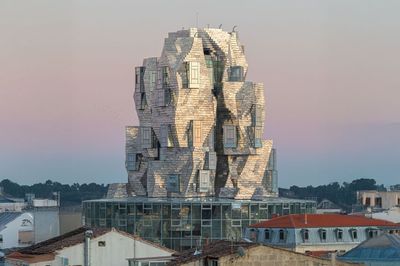
Gehry’s concert halls, notably Walt Disney Concert Hall in Los Angeles (completed 2003) and later projects such as the New World Center in Miami Beach, combine dynamic exteriors with precisely tuned acoustics and innovative interior volumes for orchestral music. The stainless-steel sails of Walt Disney Concert Hall have become a symbol of Los Angeles, while Fondation Louis Vuitton in Paris (2014) uses glass ‘sails’ around a sculptural core, extending his exploration of transparency and light.
Frank Gehry’s Artworks
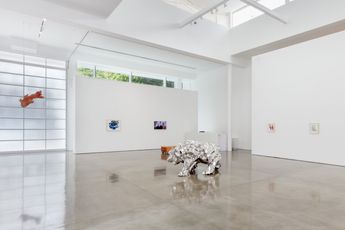
Frank Gehry’s artworks focus on his long-running exploration of animal-inspired sculptural forms, particularly his illuminated Fish Lamps and related works in metal, laminate, and light. Drawing on an interest in movement, texture, and the play of light across complex surfaces, these pieces translate ideas from Gehry’s architecture—such as curving, scale-like skins and dynamic silhouettes—into gallery-scale objects and drawings that emphasise material experimentation and gesture.
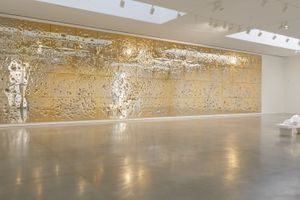
At Gagosian, Gehry has had a series of exhibitions across global venues, culminating in shows such as Ruminations at 976 Madison Avenue in New York, where large-scale fish and crocodile lamp sculptures in copper, Formica, and LED light were presented alongside works on paper that echo the fluid lines and spirals of his architectural sketches. Earlier Gagosian presentations of his Fish Lamps in cities including Beverly Hills, Paris, London, and Hong Kong established these illuminated sculptures as a key strand of his practice, underscoring how Gehry’s experiments in furniture, lighting, and sculpture parallel and extend the concerns of his landmark buildings.
Select Public Commissions by Frank Gehry
- Guggenheim Museum Bilbao, Bilbao, Spain, opened 1997
- Walt Disney Concert Hall, Los Angeles, USA, completed 2003
- Fondation Louis Vuitton, Paris, France, opened 2014
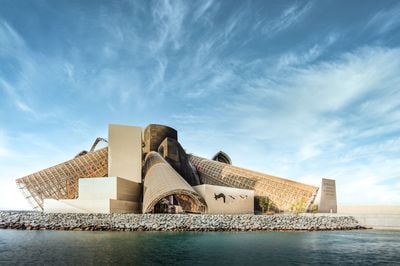
- Biomuseo, Panama City, Panama, opened 2014
- Jay Pritzker Pavilion, Millennium Park, Chicago, USA, opened 2004
Select Awards and Accolades
- Pritzker Architecture Prize, 1989
- Arnold W. Brunner Memorial Prize in Architecture, American Academy of Arts and Letters, 1977
- Numerous national and regional American Institute of Architects awards (25-plus cited by the Pritzker Prize)
Frank Gehry Exhibitions
Gehry has been the subject of major museum retrospectives and architectural exhibitions that examine his models, drawings, and built work. These exhibitions often trace his development from early Los Angeles projects to global landmarks, highlighting his role in advancing digital design, material experimentation, and the cultural role of architecture.
Select solo exhibitions
- Frank Gehry, Los Angeles County Museum of Art (LACMA), Los Angeles, 2015, large survey with drawings and models from the 1960s onwards
- Travelling retrospective organised by Walker Art Center, touring major museums in the late 1980s, bringing wide attention to his practice
Frank Gehry FAQs
Who is Frank Gehry?
Frank Gehry was a Canadian American architect known for innovative, sculptural buildings such as the Guggenheim Museum Bilbao and Walt Disney Concert Hall, and is widely regarded as one of the most influential architects of his generation.
Where can I see work by Frank Gehry?
Frank Gehry’s built projects can be experienced in cities worldwide, including Bilbao (Guggenheim Museum Bilbao), Los Angeles (Walt Disney Concert Hall), Paris (Fondation Louis Vuitton), Chicago (Jay Pritzker Pavilion), and Panama City (Biomuseo).
Are there any lesser-known facts about Frank Gehry?
A lesser-known aspect of Frank Gehry’s career is his extensive work designing exhibition installations, including major shows at the Los Angeles County Museum of Art, and his early use of aerospace software (CATIA) to resolve complex forms in construction.
Where did Frank Gehry live?
Frank Gehry was born in Toronto but spent most of his life in Los Angeles, where he established his architectural practice and developed many of his key projects.
Ocula | 2025

Explore Frank Gehry's Exhibitions










Explore and Follow Artists Shaping Contemporary Art
A respected voice in contemporary art discourse.
Focusing on ambitious storytelling and insightful art-world commentary. Ocula Magazine publishes in-depth interviews, critical essays and timely analysis on the artists, exhibitions and ideas driving the global art world.
Learn more about Ocula Magazine
Showcasing the best of the art world.
Ocula partners with galleries from around the world to highlight their artists, artworks and exhibitions. Gallery membership is by application and invitation, with each member vetted by an independent panel.
Learn more about Ocula Membership
Specialises in the sale of major artworks.
Led by a team with deep ties to the world’s leading auction houses, galleries and collectors. Ocula’s advisory team offers bespoke services to high-net-worth clients from around the world who are looking to acquire the best of contemporary and modern art.
Learn more about our team and services