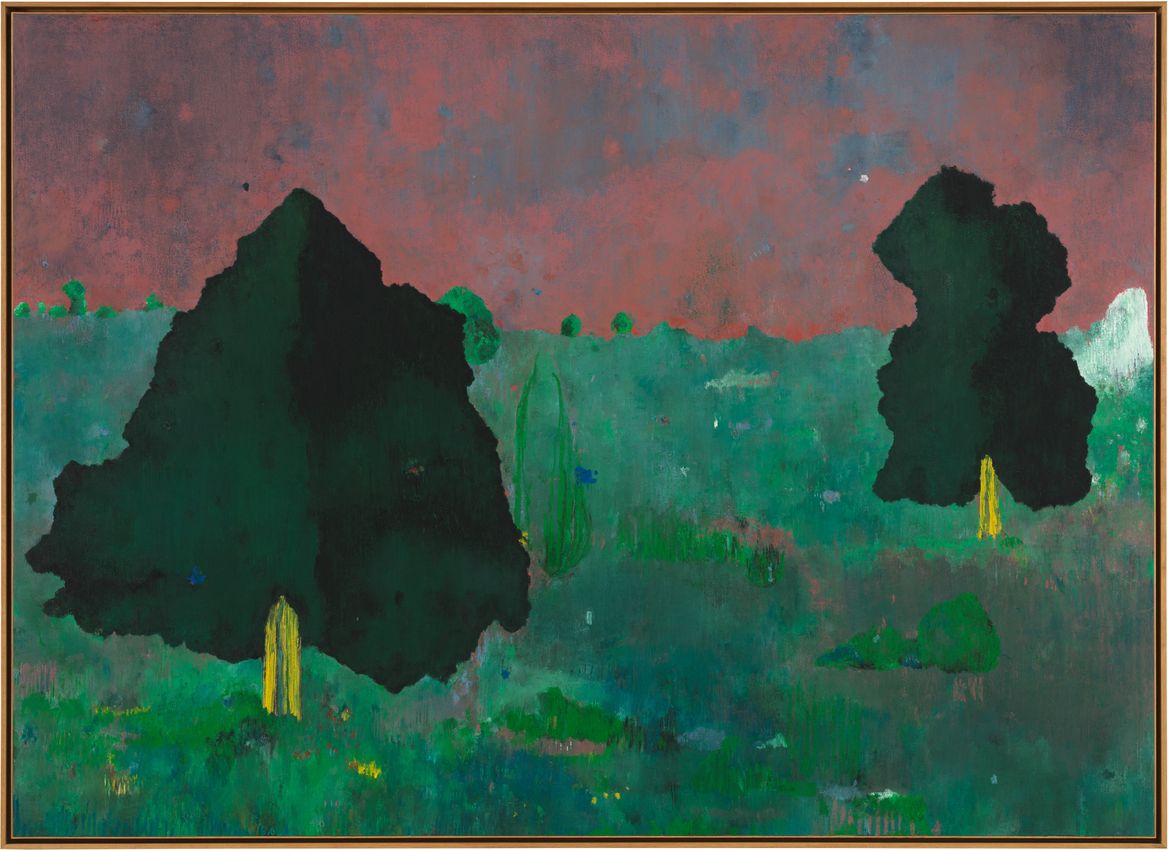
Gagosian is pleased to announce Maison Ancart, an exhibition of new paintings by Harold Ancart, opening on October 14, 2024, at 4 rue de Ponthieu.
The paintings in Maison Ancart are conceived in conversation with the spirit of radical freedom and innovation put forth by pioneering abstractionists, from the Post-Impressionists and the School of Paris to postwar American artists, among others. The trees, meadows, ponds, mountains, and other features operate as archetypal forms that Ancart revisits throughout this body of work. According to the artist, these subjects serve as an “alibi” for painting, providing a platform through which he can experiment with paint.
Ancart develops his paintings with the medium of oil stick, using saturated colors and boldly defined forms to picture imagined places abstracted from landscape motifs. He emphasizes the primacy of his artmaking process, defining his subjects to alternately anchor the compositions and disrupt their stability. The viewpoints established are from below or straight on, emphasizing their scale and the artist’s negotiation of surface and depth, abstraction and representation. Made with attention to the boundaries between forms and their contours, the paintings are unified by Ancart’s articulation of horizons through juxtapositions of color, offering through lines across the canvases.
Trees are the most prominent element in these works. These vary in shape and silhouette, distilling the structures of trunks and foliage into abstract passages.__The duo of Deux Arbres (2024) echo one another in their massed shapes and wavering contours, the contrasts of color introducing ambiguities between figure and ground. A grove of similar shapes in a dark blue palette occupies the middle ground of Le Grand Parc (2024), differentiated from another pair of trees with branching structures that end in pillowy clusters of bright red leaves.
Branches (2024) represents a network of dark limbs tipped by blossoms over a fiery warm ground, evoking Utagawa Hiroshige’s 1857 woodblock print Plum Garden in Kameido and Vincent van Gogh’s painted interpretation of it from 1887. L’étang le soir (2024)__is a scene of a pond in ambient twilight, its atmospheric character emerging through compositional doubling. The staggered repetitions of dark trees and smaller shapes in primary colors are roughly mirrored in the painting’s watery lower half, their reflections disrupted by blue currents.
On the upper floor of the gallery is a single panoramic work: The upper reaches (2024), an alpine triptych more than 25 feet widethatsuggests a view through a sequence of windows. In dialogue with mountainous subjects by Paul Cezanne and Ernst Ludwig Kirchner, the painting is defined by silhouettes of trees in the foreground, arrayed in pictorial counterpoint to the ridges and sky above.
Harold Ancart’s paintings, sculptures, and installations explore our experience of natural landscapes and built environments. Alluding to a range of art historical sources and often characterised by abstract passages of color, they are sometimes arranged into multipart tableaux.


A respected voice in contemporary art discourse.
Focusing on ambitious storytelling and insightful art-world commentary. Ocula Magazine publishes in-depth interviews, critical essays and timely analysis on the artists, exhibitions and ideas driving the global art world.
Learn more about Ocula Magazine
Showcasing the best of the art world.
Ocula partners with galleries from around the world to highlight their artists, artworks and exhibitions. Gallery membership is by application and invitation, with each member vetted by an independent panel.
Learn more about Ocula Membership

Specialises in the sale of major artworks.
Led by a team with deep ties to the world’s leading auction houses, galleries and collectors. Ocula’s advisory team offers bespoke services to high-net-worth clients from around the world who are looking to acquire the best of contemporary and modern art.
Learn more about our team and services