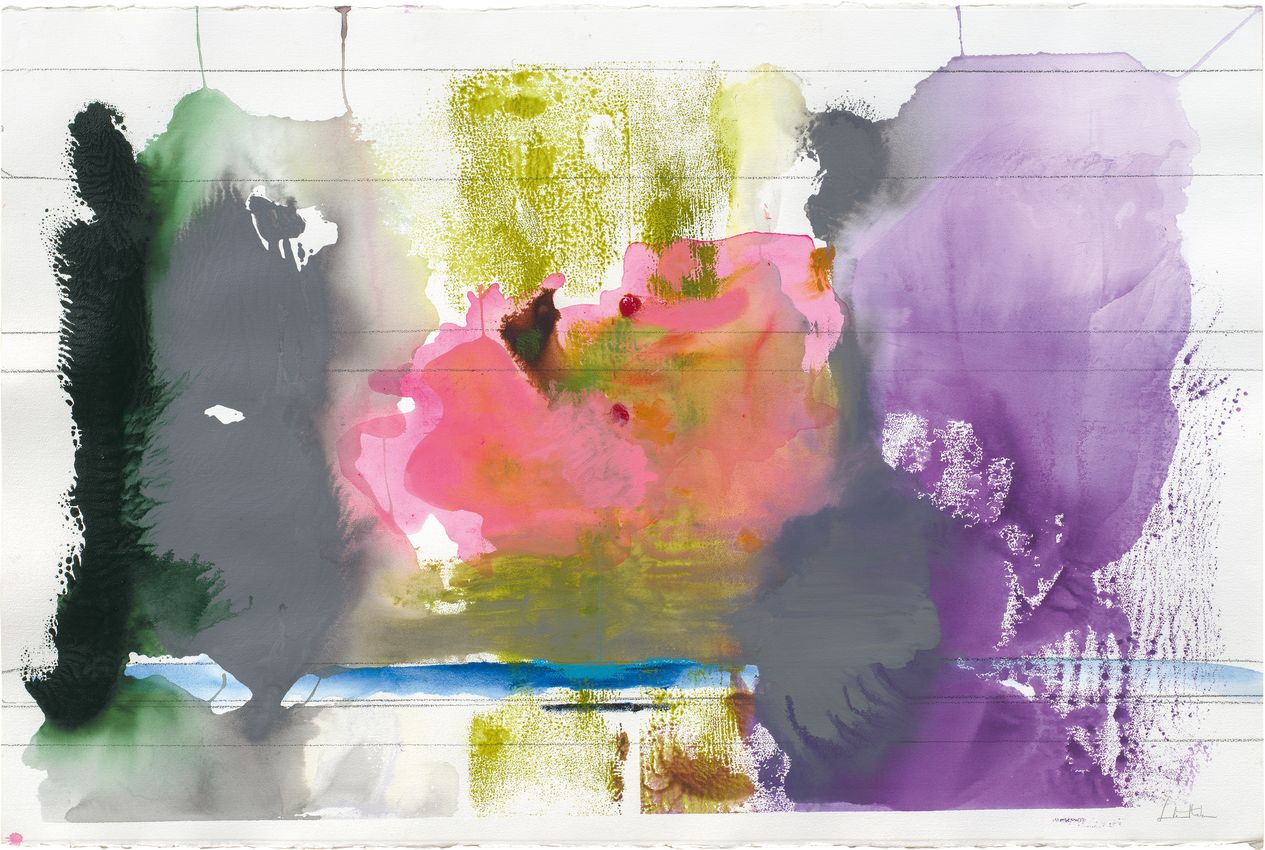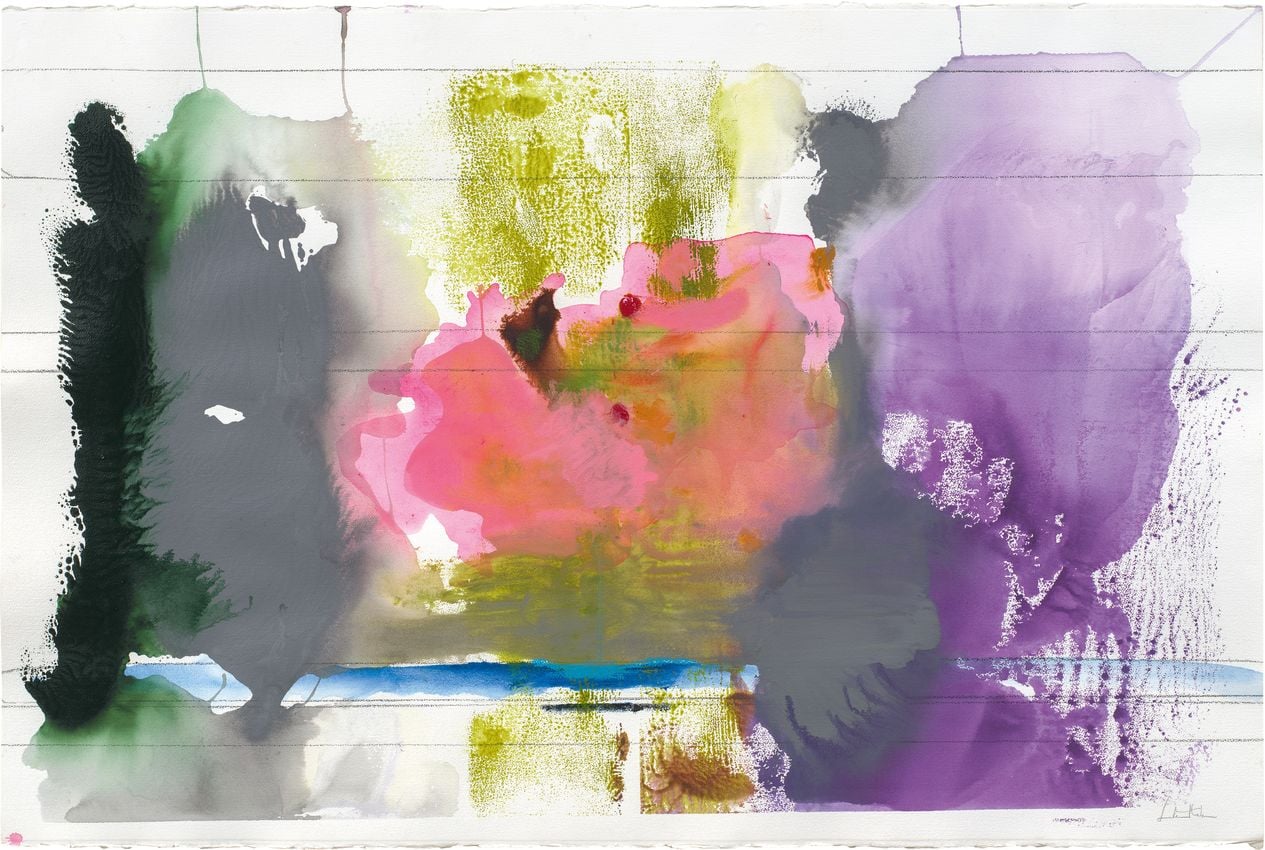
Gagosian is pleased to announce _Helen Frankenthaler: Painting on Paper, 1990–2002, _an exhibition opening at the gallery in Rome on September 30, 2024. It features eighteen large-scale paintings on paper from the later part of Frankenthaler’s career, many of which have never before been exhibited.
Helen Frankenthaler (1928–2011) was one of the most highly regarded American artists of her time. Over her last decade of art making, painting on paper became Frankenthaler’s primary means of expression. ‘I’ve always worked on paper,’ she noted in 1996, ‘but not conceived on the scale of my canvases. . . . The shift was a tremendous move for me.’ The paintings in the exhibition reveal her exploration of the material and compositional possibilities of working on paper: new kinds of chromatic juxtapositions and painterly gestures, often set down on a smoother surface than canvas.
At several earlier moments in her career, Frankenthaler had added more visibly dense brushstrokes and applications of pigment to the revolutionary soak-stain technique she had pioneered in the early 1950s. This approach became a constant in her late compositions. After working directly on the floor during the first four decades of her career, she began painting on large, waist-high tabletops, a concession to her age; the turn to painting on paper also coincided with her increased activity in printmaking.
These works exhibit the range of approaches that Frankenthaler brought to painting on paper. _Santa Fe XIII _(1990) and New Mexico (1995)—abstractions that recall, respectively, the light-filled skies and sandy vistas of the Southwestern landscape—were inspired by her teaching residencies at the Santa Fe Art Institute in 1990 and 1991. With warm earth tones and variegated greens in layered washes, End of Summer (1995) evokes a sunlit landscape with an application that emphasises the irregular texture of the handmade paper.
Free-flowing lines of great variety can be seen throughout these works, alternately defining contours and remaining unbounded. An untitled painting from 1994 with a bright yellow ground is defined by linear traces drawn in pastel, coloured pencil, and charcoal, accentuated by washes of hot and cool hues that appear animated by elemental interactions. Another large-scale untitled work from 1996 features softly spreading areas of colour resting on a linear horizontal reminiscent of her celebrated 1952 canvas, Mountains and Sea, except for the pencil grid that runs through and around the colours in the later composition.
The dark shades and layered luminosity of _White Owl _(2002) make it one of Frankenthaler’s most expressive later works. Others are nearly monochromatic, placing emphasis on variations in tone, application, directionality, and layering. Contentment Island (2002) is titled after the district on the Connecticut shore overlooking the Long Island Sound, where Frankenthaler had moved her home and studio in 1997. With its aqueous spread of turquoise and blues, the work recalls her observation that ‘On certain days, the horizon line disappears completely. The sky seems to fall into the water.’ The dark purple-black palette of Port of Call (2002) suggests a nocturnal seascape, a thin stroke of radiant blue evoking a distant horizon.
A fully illustrated catalogue with an essay by curator and art historian Isabelle Dervaux accompanies the exhibition.
The exhibition in Rome is concurrent with Helen Frankenthaler: Painting without Rules at Fondazione Palazzo Strozzi, Florence, on view September 27, 2024–January 26, 2025. The largest presentation of works by Frankenthaler ever mounted in Italy, it features thirty paintings that survey the artist’s oeuvre, together with paintings and sculptures by contemporaries from her circle, highlighting the reciprocal influences and synergies between these artists.
This fall, Gagosian, in collaboration with the Helen Frankenthaler Foundation, will publish John Elderfield’s revised and expanded edition of Frankenthaler, his definitive monograph on the artist initially published in 1989. Extensively updated to cover the entirety of the artist’s career, it features more than three hundred full-colour reproductions of her paintings, works on paper, prints, and sculpture, including many that have never before been published in colour, along with over a hundred comparative illustrations and documentary photographs.

Helen Frankenthaler (1928–2011), whose career spanned six decades, has long been recognised as one of the great American artists of the twentieth century. Heir of first-generation Abstract Expressionism, she brought together in her work—with prodigious inventiveness and singular beauty—a conception of the canvas as both a formalised field and an arena for gestural drawing. She was eminent among the second generation of postwar American abstract painters and is widely credited for playing a pivotal role in the transition from Abstract Expressionism to Colour Field painting. One of the foremost colourists of our time, she produced a body of work whose impact on contemporary art has been profound.


A respected voice in contemporary art discourse.
Focusing on ambitious storytelling and insightful art-world commentary. Ocula Magazine publishes in-depth interviews, critical essays and timely analysis on the artists, exhibitions and ideas driving the global art world.
Learn more about Ocula Magazine
Showcasing the best of the art world.
Ocula partners with galleries from around the world to highlight their artists, artworks and exhibitions. Gallery membership is by application and invitation, with each member vetted by an independent panel.
Learn more about Ocula Membership

Specialises in the sale of major artworks.
Led by a team with deep ties to the world’s leading auction houses, galleries and collectors. Ocula’s advisory team offers bespoke services to high-net-worth clients from around the world who are looking to acquire the best of contemporary and modern art.
Learn more about our team and services