



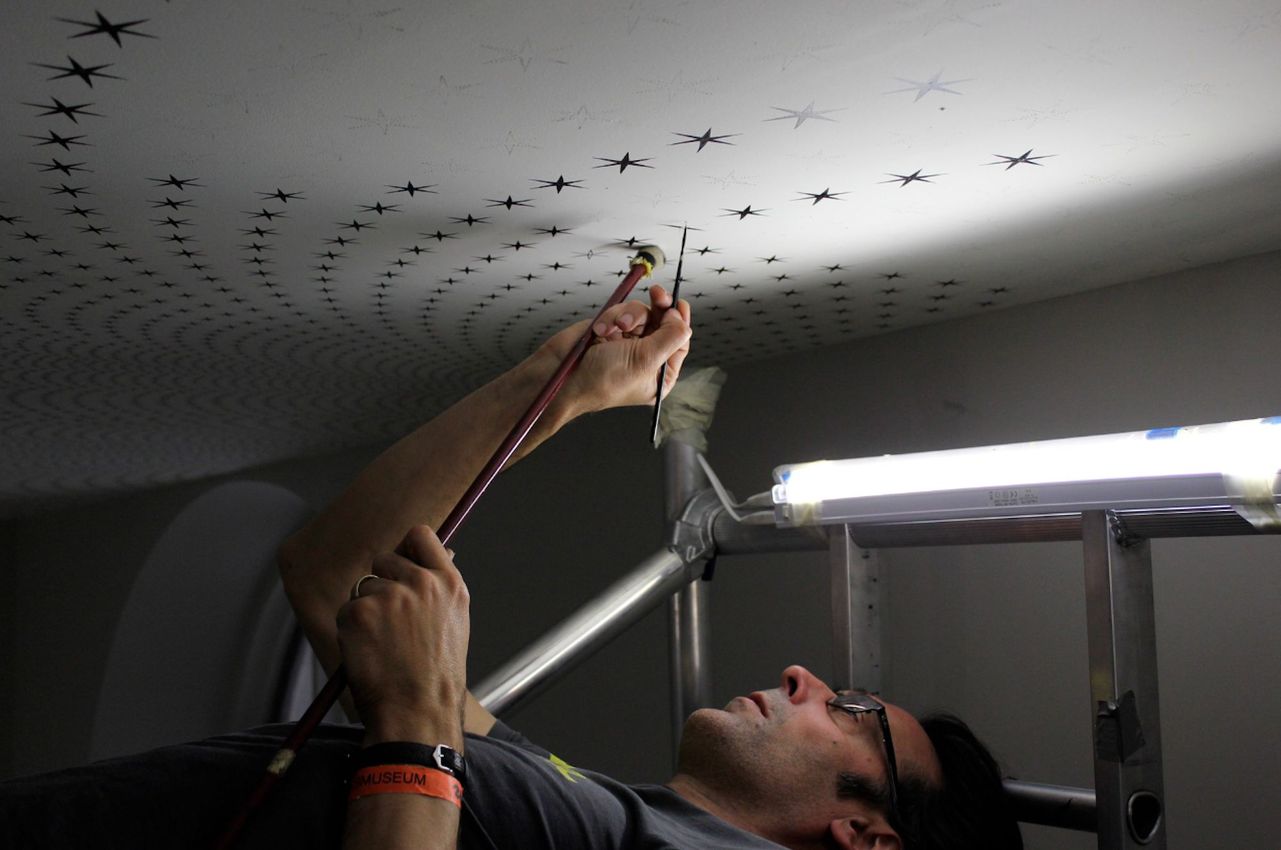
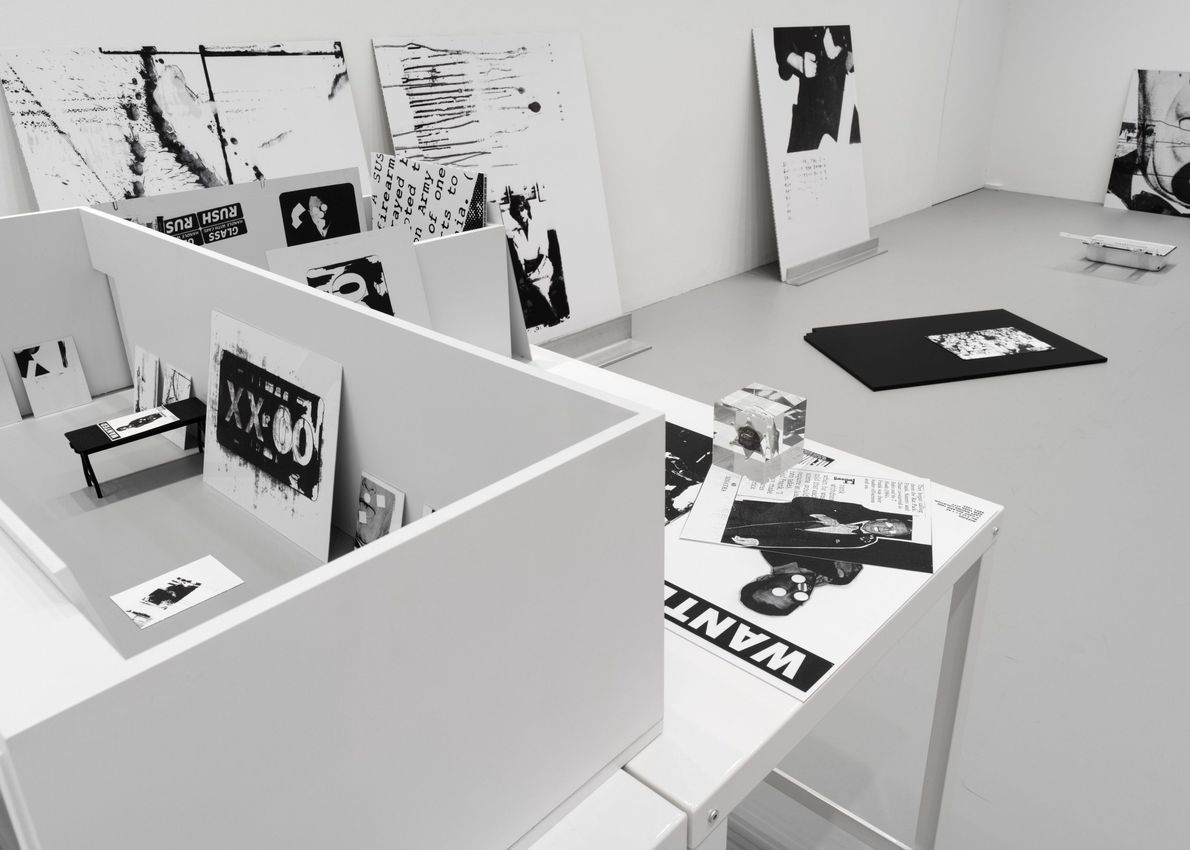
Gagosian is pleased to announce an exhibition by Richard Wright featuring painted objects, works on paper, books, and painting executed on the gallery interior.
Wright is known for large-scale and site-specific—but often temporary—painted and applied metal-leaf installations and leaded window works that invest architectural spaces with new optical and associative complexity. Shifting between illusionism and abstraction, his projects alter the viewer’s perception of space. Incorporating graphic and ornamental elements, they allude to Minimalism and Renaissance art, as well as to commercial image making. In his stylistically diverse works on paper, Wright employs ink drawing, gilding, printmaking, enamel, and watercolor painting techniques.
A new site-specific painting at the Davies Street gallery incorporates the surfaces of an internal door, Wright once again disrupting the traditionally static relationship between artwork and viewer by drawing attention to an architectural feature that, while habitually considered purely functional, maintains a rich symbolic history. In mythology, religion, and literature, doors suggest the transition from one world to another; in psychology and psychoanalysis, they represent choices and decisions. Painting on a large nineteenth-century oak cabinet, Wright recasts the still-functional piece as a vessel of abstract visuality. The gridded design, characteristic of his most recent work, suggests patchwork quilts or tiled walls, while also evoking the dizzying retinal effects of Op art.
In several painted book works, Wright layers designs over the printed pages of much-loved volumes from his personal collection, in some cases improvising on their existing illustrations, in others obscuring the images entirely or adding images to text. These works evoke a wide variety of sources and references, from medieval illuminated manuscripts to Tom Phillips’s painted and collaged bookwork A Humument: A Treated Victorian Novel (1966–2022), in which the artist transforms an obscure original into an entirely new personal narrative.
Fully and actively engaged with the history of design as well as of abstract and figurative painting, Wright approaches making book works as if authoring visual-verbal guides to his practice as a whole. The same could be said for his drawn and painted works on paper, which are similarly intricate and immersive. The pages of some are covered with thousands of delicate strokes; elsewhere, more fluid organic designs, kaleidoscopic patterns, and typographic extrapolations predominate, sometimes betraying an ongoing interest in Russian Constructivism.
A major monograph on the artist documenting projects from the past ten years will be published by Gagosian in June.
Richard Wright is best known for his site-specific yet transient works that unite painting with graphic and typographic elements, charging architectural spaces with a fourth dimension of subtle yet extreme optical complexity and subverting the traditionally static dynamic between painting and viewer. His paintings and applied metal-leaf schemes connote memory and ephemerality—these works are short-lived, oftentimes lasting only as long as the exhibition. Alongside works on interior surfaces such as walls and ceilings, Wright’s works on paper encompass a range of handmade prints, ink drawings, gilding, and watercolours. More recently, Wright has installed leaded glass into existing window or skylight apertures, allowing the work to meld with the fabric of the building. These interventions, utilising various mediums, serve to shift the viewer’s perception of the space. As Sofia Karamani commented in her text for the Turner Prize in 2009:


A respected voice in contemporary art discourse.
Focusing on ambitious storytelling and insightful art-world commentary. Ocula Magazine publishes in-depth interviews, critical essays and timely analysis on the artists, exhibitions and ideas driving the global art world.
Learn more about Ocula Magazine
Showcasing the best of the art world.
Ocula partners with galleries from around the world to highlight their artists, artworks and exhibitions. Gallery membership is by application and invitation, with each member vetted by an independent panel.
Learn more about Ocula Membership

Specialises in the sale of major artworks.
Led by a team with deep ties to the world’s leading auction houses, galleries and collectors. Ocula’s advisory team offers bespoke services to high-net-worth clients from around the world who are looking to acquire the best of contemporary and modern art.
Learn more about our team and services