Press Release

Roy and Irving: A bad name for a ‘60s folk duo, but a great name for a powerful art combo.

—Steve Martin

NEW YORK, July 12, 2023—Gagosian is pleased to present Lichtenstein Remembered, an exhibition of sculptures and related studies by Roy Lichtenstein, curated by Irving Blum in recognition of the centenary of the artist’s birth. Featuring a visionary exhibition design by Bill Katz, undertaken in close collaboration with the organisers, Lichtenstein Remembered opens at 980 Madison Avenue, New York, on September 9, 2023. This is the first gallery exhibition dedicated to Lichtenstein’s sculpture since the survey presented in London and New York in 2005.

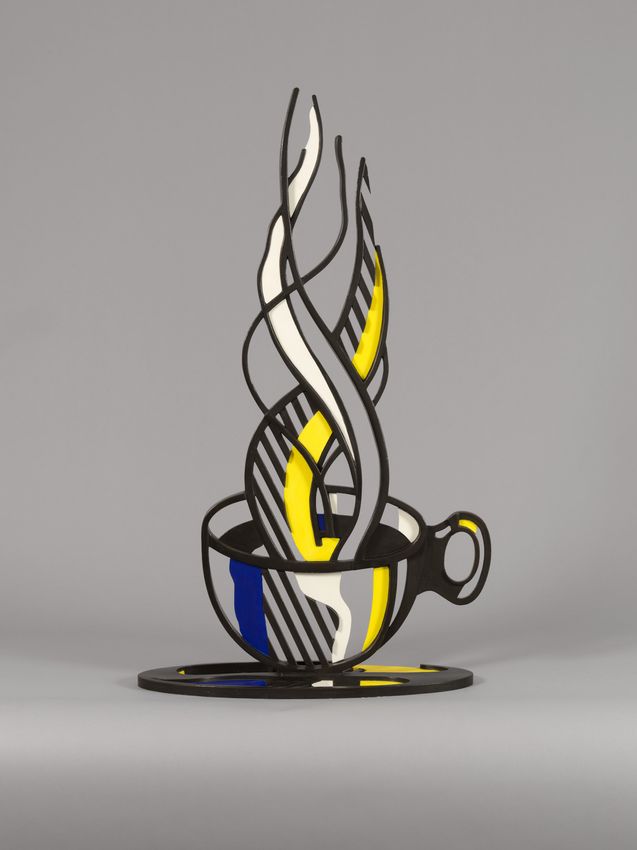
To create the miraculous drawings in space that constitute his sculptural work, Lichtenstein employed an array of visual strategies familiar from his painting and printmaking. Representing glasses, lamps, mirrors, and mobiles, as well as portrait heads and stylised explosions, he produced witty and seductive sculptures in the Pop art mode of which he was a progenitor. Referencing his adaptation of popular print media in general and comic book illustration in particular, the works on view in New York evoke the stylistic and conceptual innovations of artists including Matisse and Picasso.

Also included in Lichtenstein Remembered are drawn and painted studies that illuminate the sculptures’ conception and manufacture. Desk Explosion (1965), for instance, is a small sculpture in porcelain enamel on steel that reduces its subject to a burst of yellow and red, with the perforations in a flat sheet of white metal representing a cloud of smoke that approximates the artist’s use of the Benday dot. Desk Explosion (Study) (c. 1965) is a loose pencil sketch of the same basic form that has a jagged energy all its own. Lichtenstein turned such outlines into full-scale drawings from which an assistant, sculptor Carlos Ramos, made wooden maquettes. Tallix Foundry (now UAP) used these to produce molds, from which the sculptural editions were cast (most often in bronze), and then typically painted and patinated.

‘Though obviously sculptural in the common meaning of the term, heavy wrought objects freestanding in space,’ writes Adam Gopnik in the exhibition’s catalogue, ‘these works are more optical than tactile—planar and pictorial, more than ‘haptic’ and three-dimensional, more like crystallised drawings than like full-bodied sculpture. They invite us to look through them, rather than to walk around them.’ Lichtenstein incorporates multiple layers of reference into each work, alluding to the aesthetic codes of modern art and design; examples such as Cup and Saucer 1 (c. 1976) combine allusions to the reductive palette of Mondrian, the biomorphic forms of Surrealism, the patterning of Deco ornamentation, and the graphic shorthand of cartoons.

Daniel Belasco, in his catalogue essay, repeats Diane Waldman’s earlier assertion that Lichtenstein’s sculptures are three-dimensional projections of his paintings—a claim also endorsed by the artist himself—but counters it with the more radical argument that the artist in fact set out to ‘assassinate’ sculpture by revealing its fundamental artificiality and dependence on art historical self-reference. Pointing out that sculpture differs from painting in that it has no need to replicate physical volume, Belasco describes how Lichtenstein’s sculptures modify, teasingly, the painter’s language of modeling and foreshortening.

Lichtenstein Remembered is accompanied by a fully illustrated catalogue that includes a foreword by Larry Gagosian; essays by Daniel Belasco, Adam Gopnik, and Steve Martin; and a conversation between Dorothy Lichtenstein and Irving Blum. It also features documentary and contextual photographs accompanied by quotations about Lichtenstein from fellow artists, collaborators, collectors, curators, gallerists, and friends, including Naomi Spector Antonakos, Georg Baselitz, Edye Broad, Barbara Bertozzi Castelli, James dePasquale, Ruth Fine, David Hockney, James Mayor, Adam McEwen, James Rondeau, Ed Ruscha, and Sheena Wagstaff.

Roy Lichtenstein was born in 1923 in New York, where he died in 1997. His work is represented in collections worldwide. Retrospective exhibitions include All About Art, Louisiana Museum of Modern Art, Humlebæk, Denmark (2003, traveled to Hayward Gallery, London; Museo Nacional Centro de Arte Reina Sofía, Madrid; and San Francisco Museum of Modern Art, through 2005); Classic of the New, Kunsthaus Bregenz, Austria (2005); Meditations on Art, Triennale di Milano, Italy (2010, traveled to Museum Ludwig, Cologne, Germany); and A Retrospective, Art Institute of Chicago (2012, traveled to National Gallery of Art, Washington, DC; Tate Modern, London; Centre Pompidou, Paris, through 2013). In 2015, Gagosian presented a full-scale replica of Lichtenstein’s Greene Street Mural (1983) in the gallery at 555 West 24th Street, New York. Other recent exhibitions include Artist Rooms: Roy Lichtenstein in Focus, Tate Liverpool, England (2018); Order and Ornament: Roy Lichtenstein’s Entablatures, Whitney Museum of American Art, New York (2019); and History in the Making, 1948–1960, Colby College Museum of Art, Waterville, ME (2021, co-organized with Nasher Museum of Art at Duke University, Durham, NC, and traveled to Parrish Art Museum, Water Mill, NY; Columbus Museum of Art, OH; and Nasher Museum of Art, through 2023). In 1995, Lichtenstein was a recipient of the Kyoto Prize, Inamori Foundation, Japan, and National Medal of the Arts, Washington, DC.

Read More
About the Artist

Roy Lichtenstein’s early appropriation of the aesthetics of American popular culture made him integral to the development of Pop art. A student of the work of Pablo Picasso, Joan Miró, and Paul Klee, Lichtenstein incorporated elements of contemporary art theory and popular print media into his painting. In 1961 he began to replicate the Benday dot system used in mass-circulation printed sources such as comics, newspapers, and billboards; this would become a signature element of his painting and sculpture. By mimicking this industrial method and appropriating images from high and low culture, his work realised a broader accessibility that had not yet been achieved in contemporary art. Some of his most recognisable series evolved from imagery drawn from popular culture: advertising images, war-time comics, and pin-up portraits, as well as traditional painting genres such as landscapes, still lifes, and interiors.

View Artist Profile

Also Exhibiting at Gagosian

About the Gallery
Gagosian is a global network of art galleries specialising in modern and contemporary art with eighteen exhibition spaces worldwide.
View Gallery Profile
Address
980 Madison Avenue
New York
United States
Opening Hours
Tuesday – Saturday
10am – 6pm
(1)
New York 980 Madison Avenue
Gagosian
980 Madison Avenue, New York, United States
+1 212 744 2313
http://gagosian.com

Opening hours
Tuesday – Saturday
10am – 6pm
The art world in focus