
Press Release

‘I wanted to change art, to change life—I became a radical.’ —Arakawa

Gagosian is pleased to present Waiting Voices, an exhibition of works on canvas and paper by Arakawa produced between 1964 and 1984. This is the artist’s first exhibition with the gallery in Basel.

Arakawa (1936–2010) was one of the earliest international pioneers of Conceptual art, and a founding member of the Japanese avant-garde collective Neo Dada. Working in painting, drawing, printmaking, and architecture, he described himself as an ‘eternal outsider’ and an ‘abstractionist of the distant future.’ After relocating from Tokyo to New York in 1961, where he encountered Marcel Duchamp and many of the French artist’s contemporaries, he began producing ‘diagram paintings,’ combining schematic images with text in a study of epistemology and perception. In 1962, Arakawa met his future wife and collaborator, the poet, writer, and philosopher Madeline Gins. From 1963 to 1973, the couple collaborated on an eighty-painting suite, The Mechanism of Meaning, and in the 1990s they worked on a theory of ‘procedural architecture’ through which they aimed to extend the lives of a building’s occupants.

Waiting Voices features paintings and drawings produced by Arakawa over a twenty-year span. A Diagram of Imagination (1965), Separated Continuums (1966), and A Couple (1966–67) are among several paintings from the mid-1960s that represent architectural space. The earliest of the three shows part of a simple town plan layered over a grid; the others focus on interior space. In Separated Continuums, coordinates on a grid—featureless apart from two coloured lines—are labelled with the names of household objects and fixtures. A Couple is, for the most part, similarly schematic, but Arakawa has added renderings of windows to the graphic marks as well as stencilled words and numbers that denote the contents of the room. The painting’s diptych format also hints at a narrative progression and allows viewers to imagine the unseen titular duo.

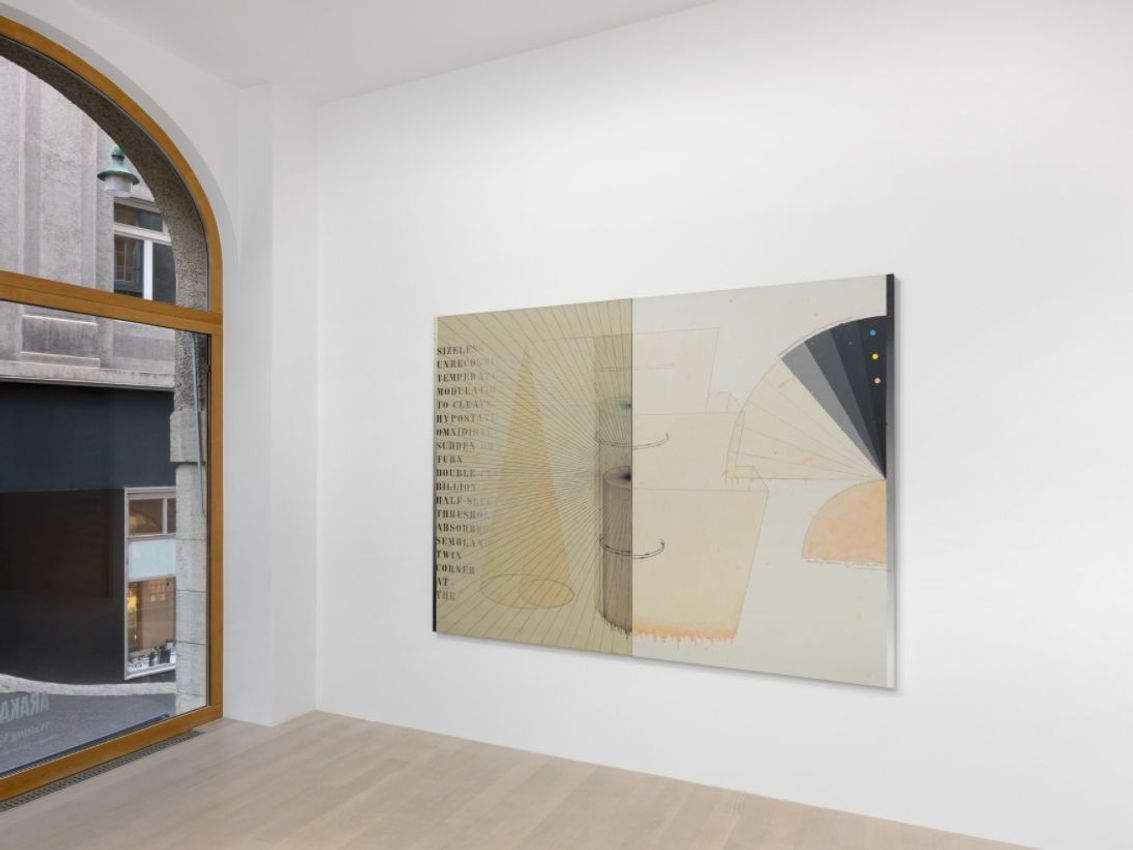
In Untitled (Voice Inoculations) (1964–65), a diagram of a cube is labelled with words—some of them stencilled backward—that conjure an ambiguous play on orientation, scale, and other attributes of an object. Hard or Soft No. 3 (1969) also features text, which in this case informs the viewer—with Arakawa’s characteristic deadpan wit—that the composition’s meandering arrows ‘indicate almost nothing’ and that the accompanying numbers may be rearranged in any order. The two-part Waiting Voices (1976–77) pairs a grouping of geometric forms—reminiscent of the ‘suitors’ in Duchamp’s The Bride Stripped Bare by Her Bachelors, Even (The Large Glass) (1915–23)—with an abstruse marginal text.

Also on view are several works on paper, including Study for “Blank” No. 2 (1981) and Study for the “Sharing of Nameless” No. 3 (1983–84), both of which feature plan-like networks layered over words, arrows, and, in the later example, a grid of variegated tones. Blending coded signification with a shifting ambiguity, they build bridges from Arakawa’s imagination to create an art that is fully realized only in the mind and body of the viewer.

Read More
About the Artist

enowned for his paintings, drawings, and prints, as well as his innovative architectural constructions, Arakawa was one of the earliest practitioners of the international Conceptual art movement of the 1960s. After moving to New York from Japan in 1961, Arakawa produced diagrammatic paintings, drawings, and other conceptual works that employed systems of words and signs to both highlight and investigate the mechanics of human perception and knowledge. In 1962, Arakawa met American poet Madeline Gins, with whom he developed a personal and creative partnership. Together they expanded Arakawa’s painting practice into an important series entitled The Mechanism of Meaning, a suite of eighty canvases that explored the workings of human consciousness. The Mechanism of Meaning exists in two versions that were exhibited in their entirety by the Sezon Museum of Modern Art, Karuizawa in 1988 and the Solomon R. Guggenheim Museum, New York in 1997. In the 1990s, Arakawa and Gins developed the theory of “procedural architecture” to further impact on human lives. Through architecture specifically, they endeavored to “learn how not to die.” Terming this concept “reversible destiny,” they believed firmly in the capacity of their architectural works to positively influence the personal well-being and longevity of those who lived within them. Arakawa and Gins dedicated the remainder of their lives to seeing these ideas integrated into architectural theory and contemporary building methods.

View Artist Profile

Also Exhibiting at Gagosian

About the Gallery
Gagosian is a global network of art galleries specialising in modern and contemporary art with eighteen exhibition spaces worldwide.
View Gallery Profile
Address
Rheinsprung 1
Basel
Switzerland
Opening Hours
Open by appointment
(1)
Basel Rheinsprung 1
Gagosian
Rheinsprung 1, Basel, Switzerland
+41 61 262 00 80
http://gagosian.com

Opening hours
Open by appointment
The art world in focus