Press Release
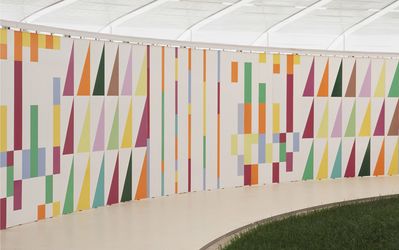
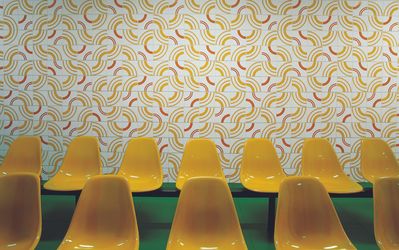
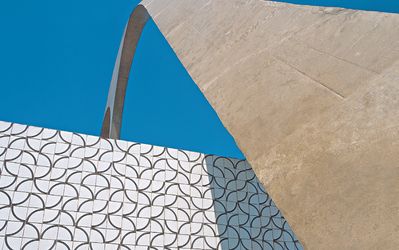
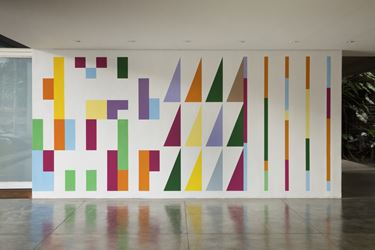
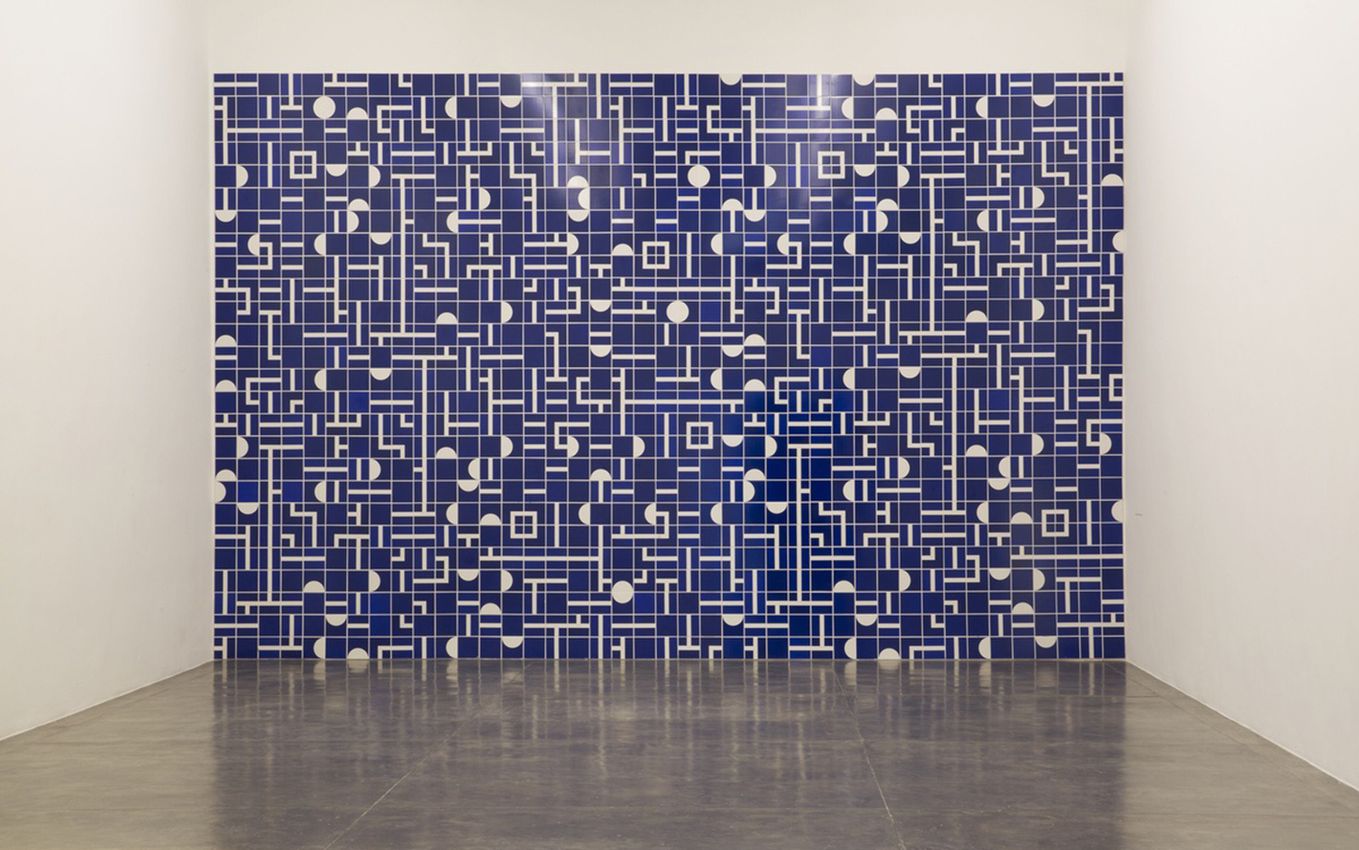
Galeria Nara Roesler is proud to present a memorable exhibition: a set of six trademark tile panels by the artist Athos Bulcão, who passed away in 2008. This will be the first São Paulo showing of the reissue of his original works, under a representation agreement signed by the gallery and Fundação Athos Bulcão in 2014. Two of the panels, whose tiles were forged in the same plant as the original ones, premiered in the Lupa section of ArtRio 2014.

Farias defines Bulcão as a “unique artist concerned with bringing his refined work into the social sphere,” someone whose genius has elevated tile murals “from icons to abstract compositions, to intricate formal puzzles, from manufacture to standardized industrial language, and from mural panels to the elaboration of architectural elements.” His mastery of mural art, which he embraced as an integral element of architecture as opposed to a mere padding for the structure, is attested to at Galeria Nara Roesler by the following pieces: one from Museu das Gemas, at a top spot in the gallery window; one from Hospital de Brasília and
Rede Sarah Kubitschek’s Rehab Center; one from the Rio Branco Institute; one from Diretoria de Gestão e Atendimento ao Público (DGAP, a department of the Brazilian Ministry of Finance); and one from Rio de
Janeiro’s Sambadrome.

Why is Bulcão regarded as a pioneer of tile murals? His formal departure from the standardized geometry of his day, moving closer to the public, provides a clue to the importance of this segment of his work. The very creation of the artworks became more organic through the addition of the human element as an agent of chance. In the curator’s words, ”(...) the application of all his panels is always entrusted to the construction worker at hand, a criterion which, according to the artist, has the merit of being ‘de-educated,’ i.e. stripped of the taste for equilibrium or even the neat disorder imbued by our schools. Each unit joins the next one in a random whole of syncopated pace whose sequence we cannot apprehend at once.”

As a result, the monotony of modernist architecture, in its exacerbated rationality, as in the case of Brasília, and of the passerby’s habit-dulled gaze gets subverted. Spectators are surprised by randomly combined patterns that disrupt the harmony an eyesight accustomed to placing whatever it captures in order has come to expect. “The pulsating effect, a reflection of the saturated retinas of those experiencing the artwork, can be achieved either through closed-off forms, complex, colorful polygons that compete for space with the white of the tiles, polygons as dense and concise as a letter or a logotype, or by linear, circular or striped forms, lines that bleed out of the square’s boundaries, insinuating themselves beyond it. Either way, the artist can add to it the use of color, a prodigal use of color (...).”

Paradoxically, this intricate game that invades daily life thanks to its existence within the cities, a game that
surprises and subverts one’s gaze, is at everyone’s reach to such an extent, as an artwork amenable to constant, democratic enjoyment, that it is therefore intimately assimilated by the public, which is often unaware of its relevance. “Though invariably large-sized, many of Athos Bulcão’s works, for their close connection with architecture and the city, for the familiarity imposed by day-to-day contact, end up eclipsing their exceptional condition, their nature of refined plastic arts thinking.”

Thus, “In his now long and prolific career, Athos Bulcão achieves what few artists dream of achieving: that his work no longer belongs to him. (...) His work moves toward anonymity, integrating the imagery, becoming a source of expression for a people, the people Athos Bulcão loves and for whose well-being he has worked throughout his life.” By reissuing these iconic works of art, Galeria Nara Roesler makes sure that, in addition to the incorporation of his work as part of the national spirit, Athos Bulcão gets recognition as the seminal artist he is to art history in Brazil and other countries.

Installation Views

Also Exhibiting at Galeria Nara Roesler

About the Gallery

Founded in São Paulo in 1989, Galeria Nara Roesler is a leading Brazilian gallery dedicated to showing the work of contemporary Brazilian and international artists. The gallery established another branch in Rio de Janeiro in 2014, followed by its first international outpost in New York City in 2015.

View Gallery Profile
Address
Avenida Europa 655
JD Europa
São Paulo
Brazil
Opening Hours
Mon - Fri, 10am - 6pm
Sat, 11am - 3pm
Book your visit via the link or by emailing agendamento@nararoesler.art
(1)
São Paulo Avenida Europa 655, JD Europa
Galeria Nara Roesler
Avenida Europa 655, JD Europa, São Paulo, Brazil
+55 112 039 5454
http://www.nararoesler.art

Opening hours
Mon - Fri, 10am - 6pm
Sat, 11am - 3pm
Book your visit via the link or by emailing agendamento@nararoesler.art
The art world in focus