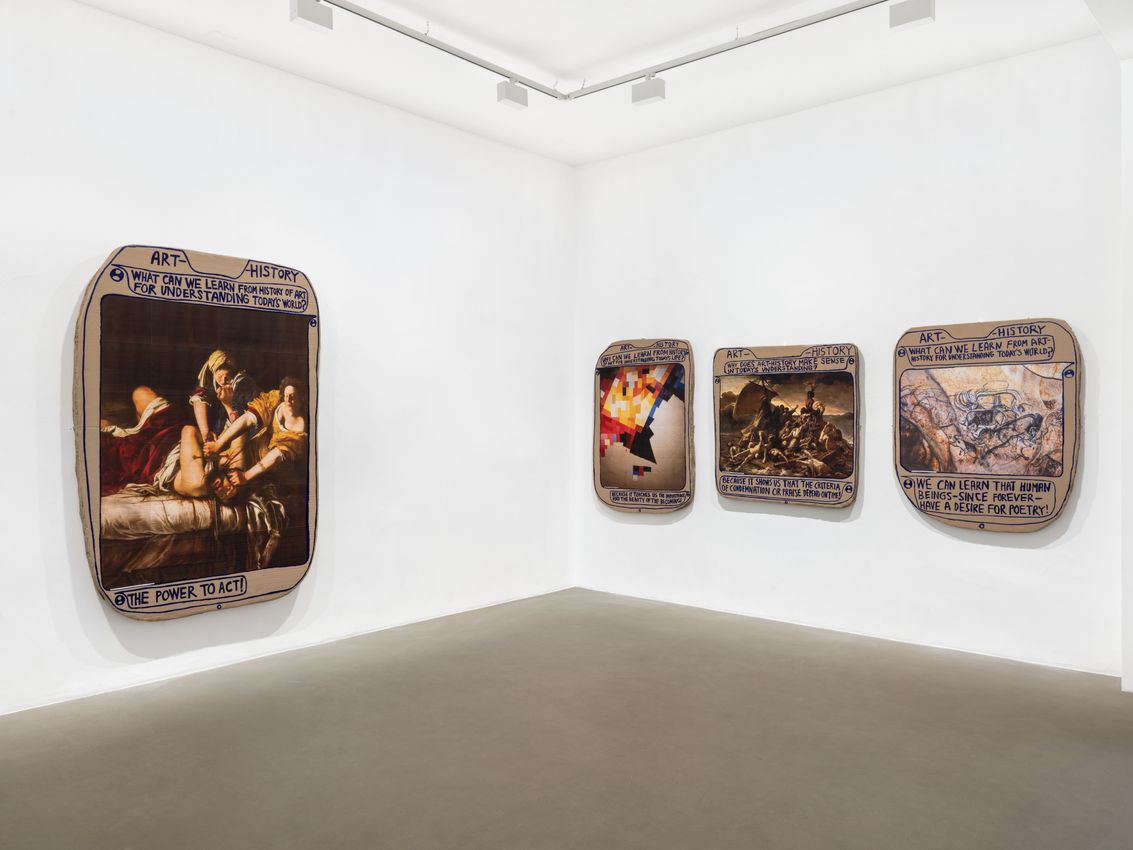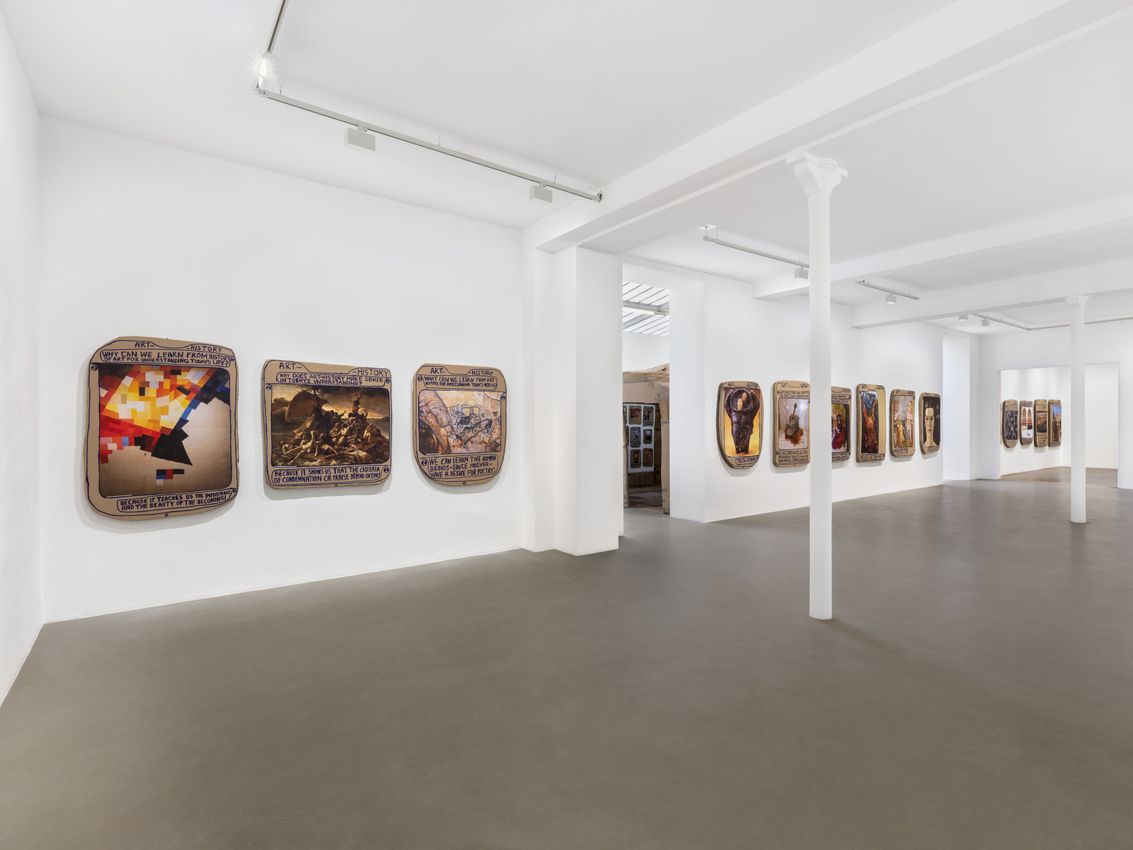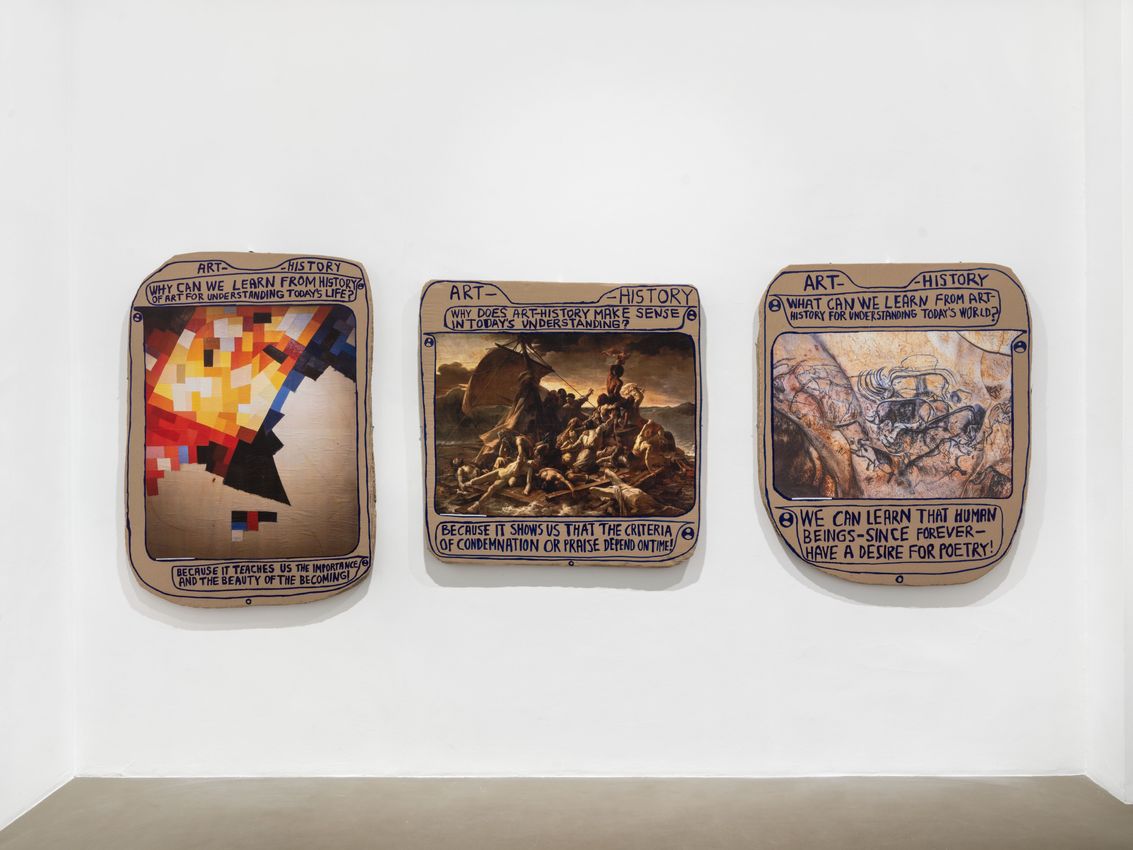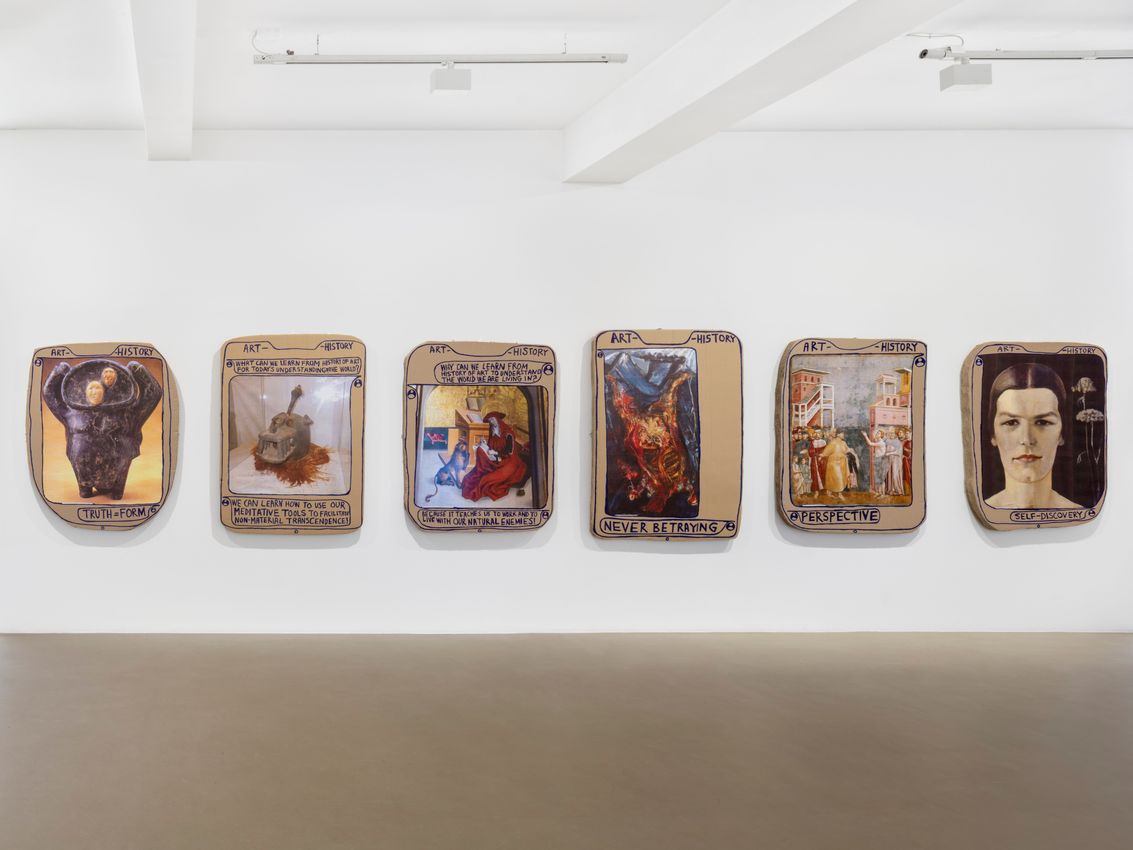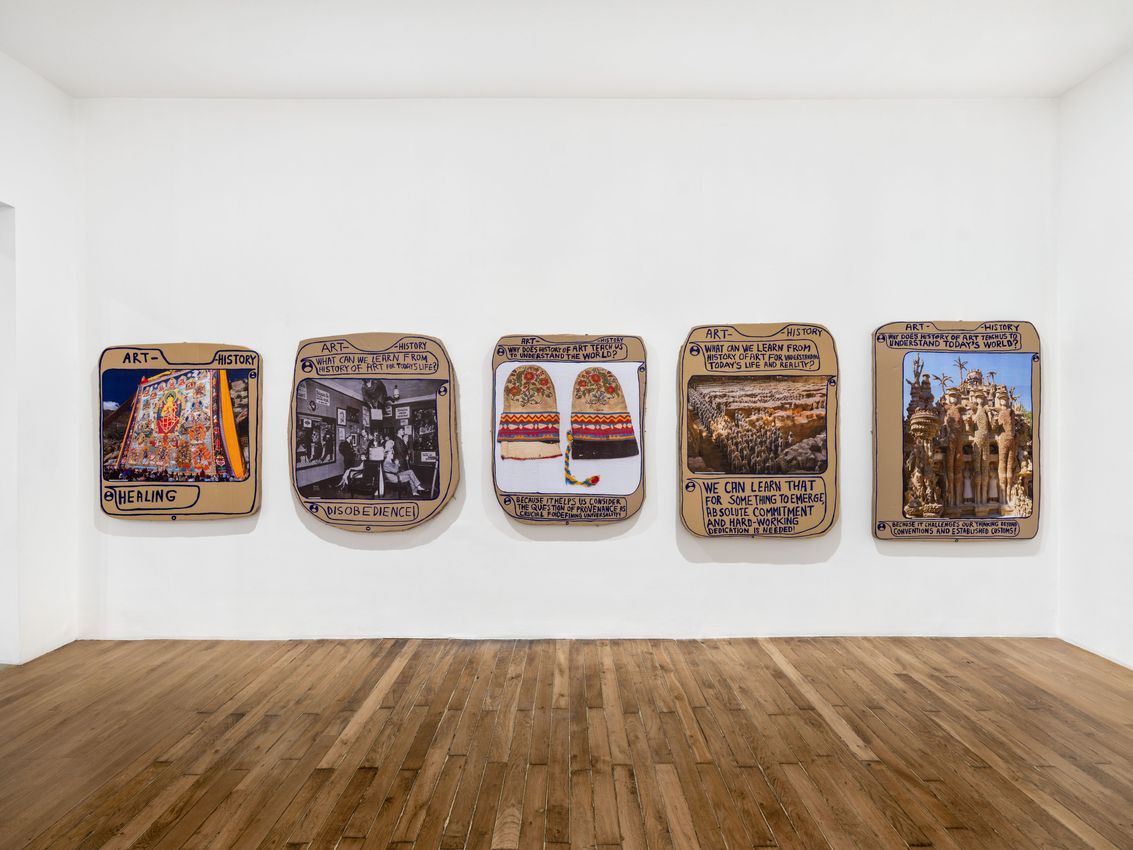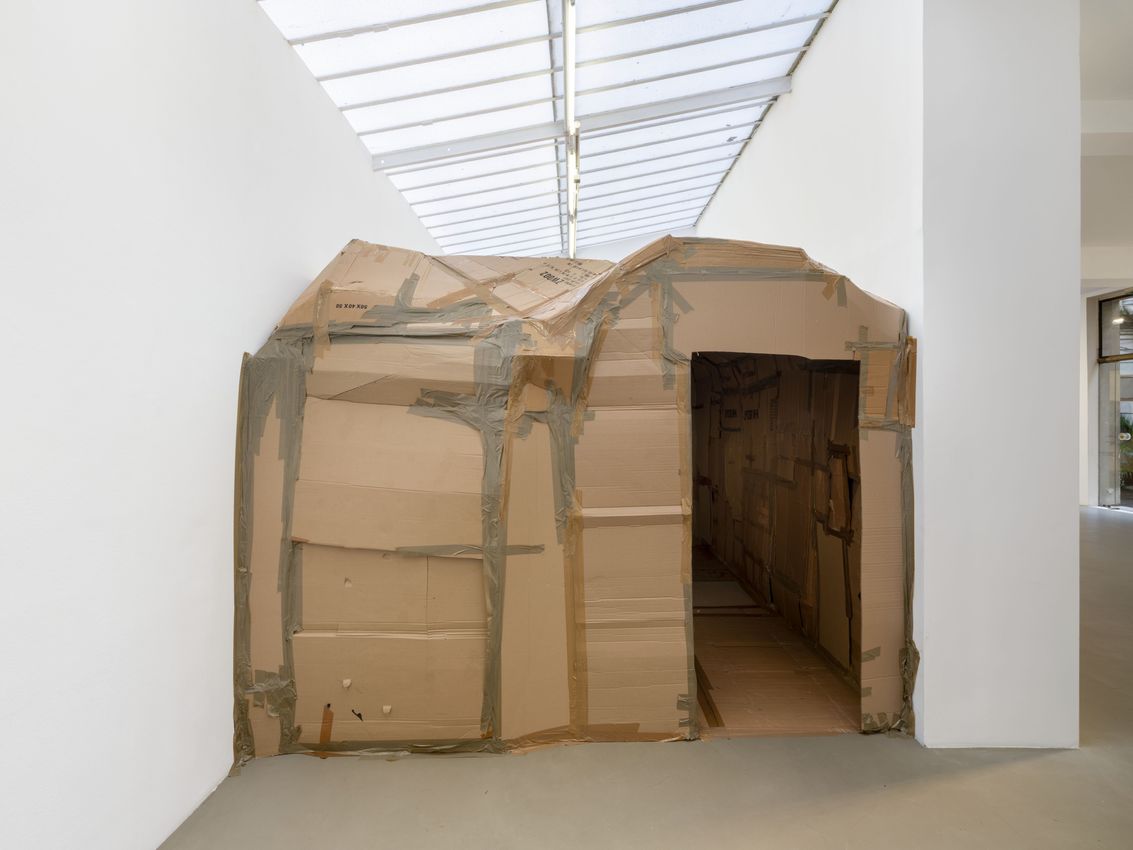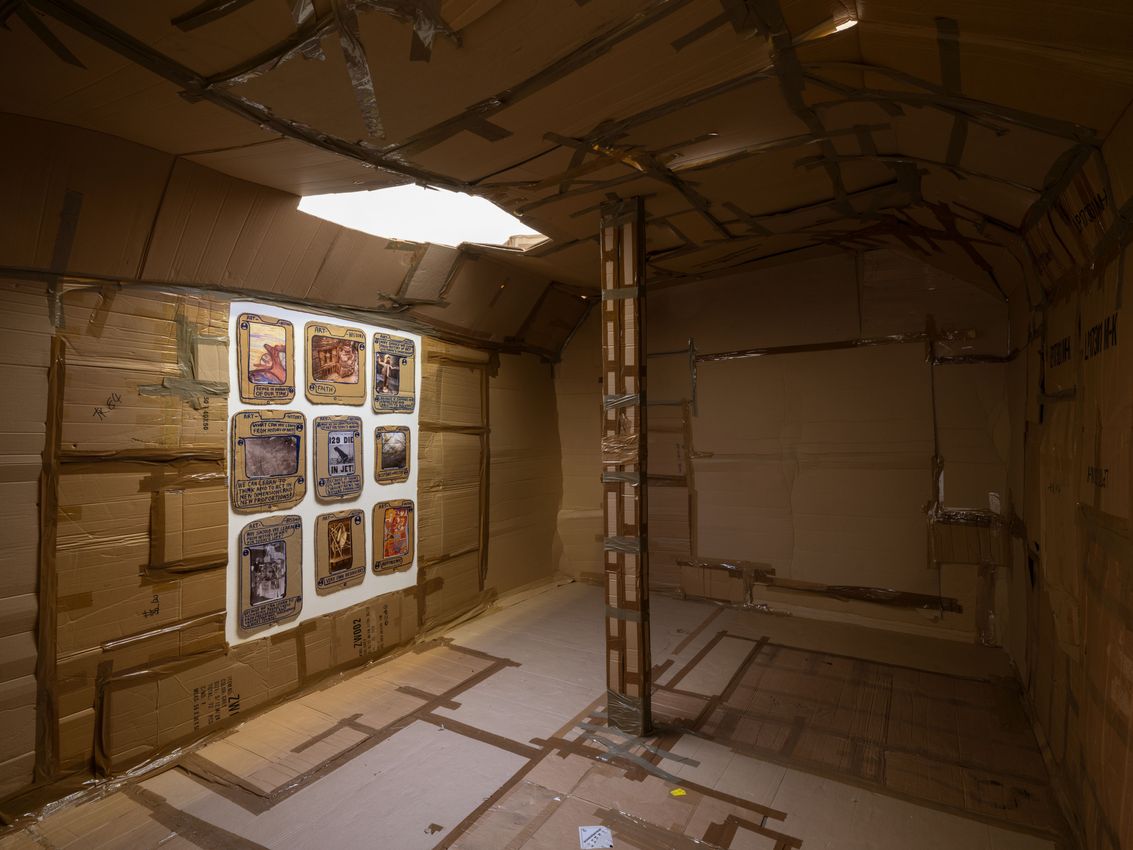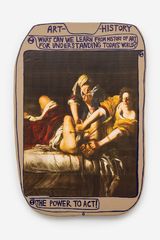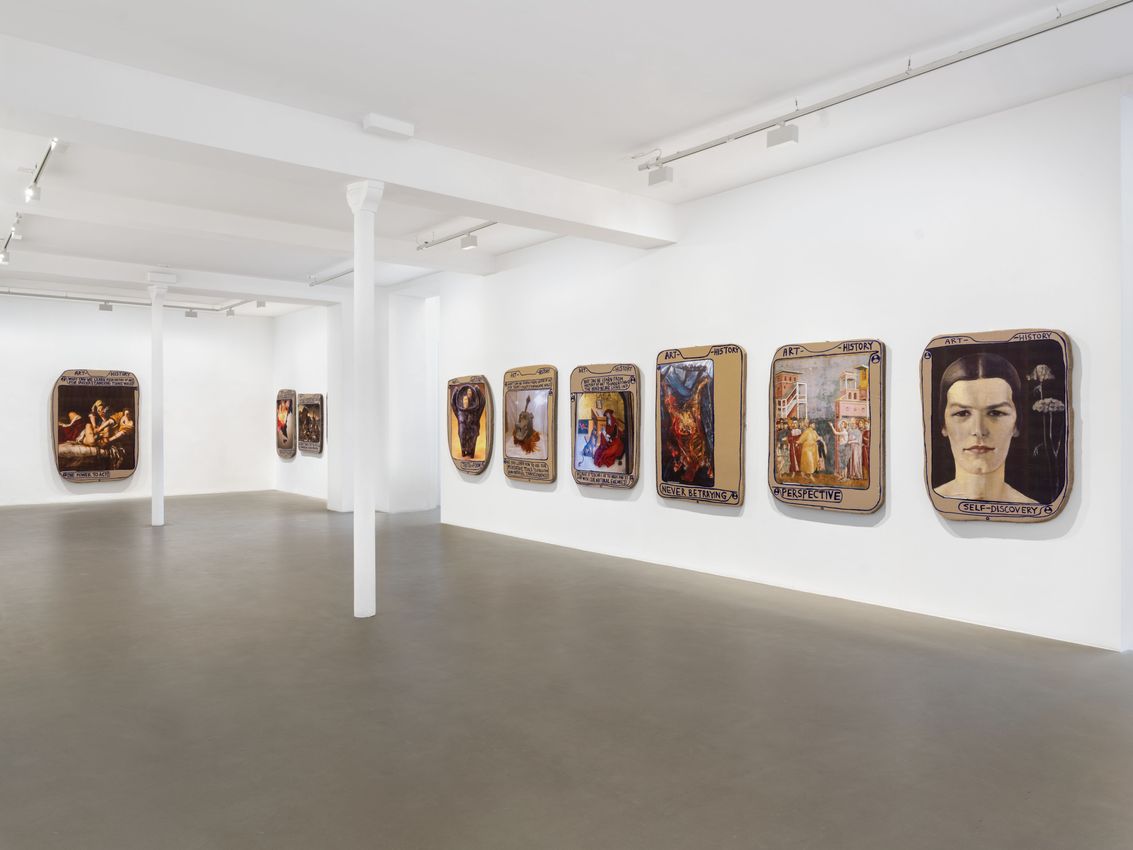
For his exhibition at Galerie Chantal Crousel, Thomas Hirschhorn presents a new body of works Art-History-Plaques, a continuation of his works inspired by the aesthetics of Instagram posts referring here to Art History and its legacy.
It seems—facing today’s wars in Ukraine, Russia, Palestine, Israel, Lebanon, Iran, among others—that we are not able to learn from History. Every day’s new deaths, injuries, destructions and ruins show us with cruelty that we are not able or unwilling to learn and draw the consequences of the past. Politicians, historians can’t or don’t want to help us understand our present times in order to change things.
Reflecting upon this—I, as an artist—want to assert the postulate that, if ‘Big History’, political, geographical, economical, cultural History can’t teach us, we must learn from History of Art—as our LAST CHANCE. The affirmation is therefore: History of Art must teach us to understand the world we are living in today. History of Art is what can teach us to push and drive our minds beyond borders and conventions. History of Art is what can create links between what does not seem connected today. This is the aim of “What can we learn from History
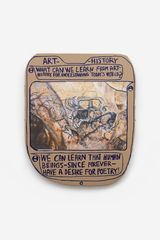
The form of this work is given with “Art-History-Plaques”—a series inspired by the “Post”- aesthetic as the ones I have been publishing on Instagram—and by the kind of self- manufactured military plaques, often made to ‘unofficially’ celebrate someone’s service and accomplishments. But instead of wood and metal used for military plaques, the “Art-History-Plaques” are made with thickly layered cardboard and photocopies. This plaque-gesture wants to emphasize the importance of belief in History of Art for learning and understanding—far from intimidating those who don’t relate to militaria or from establishing a bourgeois hierarchy.
Because I believe in the power of Art, which makes a universal and timeless breakthrough in the habits of daily facts commentary. This breakthrough—thanks to Art—can be the key for a real understanding and a true learning of what goes on in today’s world, and as a result, drive us to act consequently.
Therefore, the plaque’s thickness and its stature are important because they stand for this belief and give it a body. The plaque also builds a bridge between the past of Art History and the present of doing art, and wants to be a ‘permanent’ reminder of Art History’s significance.
The work “Art-History-Plaque” wants to hold a distinct position in the present time and prepares for the coming. This works shows—shows and doesn’t write or talk—the universal power of Art: to create, to include, to activate, to dare, to advance, to understand, to take position, to imagine, to progress, to produce, to give form. Can we learn and catch our LAST CHANCE?
Thomas Hirschhorn, Fall, 2024
—
Thomas Hirschhorn
Born in 1957 in Bern, Switzerland. Lives and works in Paris, France, since 1983.
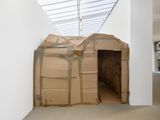
Thomas Hirschhorn studied in Zurich (1978-1983) and moved to Paris in 1983. Since the mid-eighties, the artist offer displays (“stalls”, “windows”), flimsy structures made of materials such as cardboard, aluminum foil, adhesive brown plastic. Adding photocopies, pictures cut from newspapers or magazines, and photographs, he enrolled in ballpoint comments or questions about recurring themes: culture, economy, politics, religion.
Thomas Hirschhorn is a recipient of the Meret Oppenheim Prize (2018); the Kurt Schwitters Preis, Niedersächsische Sparkassenstiftung (Lower Saxony Savings Bank Foundation) (2011); the Joseph Beuys-Preis, Joseph Beuys-Stiftung (2004); the Marcel Duchamp Prize (2000).
He has had major solo exhibitions at MAXXI, Roma (2021); GL Strand Copenhagen, Copenhagen (2021); Ming Contemporary Art Museum, Shanghai (2018); Museum Villa Stuck, Munich (2018); Kunsthal Aarhus, Aarhus (2017); Kunsthalle Bremen, Bremen (2015); Palais de Tokyo, Paris (2014); Institute Of Modern Art, Brisbane (2013); DIA Art Foundation, Bronx (2013); Mudam Luxembourg, Luxembourg (2012); 54th Venice Biennial, Swiss Pavillion, Venice (2011); The Power Plant, Toronto (2011); Museum Dhondt-Dhaenens, Sint-Martens-Latem (2010); Trussardi Foundation, Milan (2008); Secession, Vienna (2008); Serralves Museum, Porto (2006); Wattis Institute, San Francisco (2006); Musée Précaire Albinet, Aubervilliers (2004); Schirn Kunsthalle, Frankfurt (2003); Musée National d’Art Moderne, Centre Georges Pompidou, Paris (2001), among others.
Thomas Hirschhorn was also featured in several international group shows such as the Collection Lambert, Avignon (2022); Palais de Tokyo, Paris (2022, 2012); RMIT Gallery, Melbourne (2021); La Tallera, Mexico (2019); MoMA PS1, New York (2019); Mudam Luxembourg, Luxembourg (2019); Luma Foundation, Arles (2018); Mori Art Museum, Tokyo (2018); Serralves Museum, Porto (2018); Wiels, Brussels (2017); MOCA, Los Angeles (2016); Central Pavilion, 56th Venice Biennale, Venice (2015); MoMA, New York (2015); BNLMTL 2014 (Montreal Biennale), Montreal (2014); Centre Pompidou-Metz, Metz (2014); 13th Istanbul Biennial, Istanbul (2013); Marta Herford, Herford (2013); Shanghai Biennale, Shanghai (2012); Fundacion PROA, Buenos Aires (2011); Guggenheim Museum, Bilbao (2011); Guggenheim Museum, New York (2010); Walker Art Center, Minneapolis (2010); Gwangju Biennale, Gwangju (2010); Museion, Bolzano (2008).
His works have joined the collections of Serralves Museum, Porto; The Art Institute of Chicago, Chicago; Bard Museum, New York; La Caixa, Barcelona; Collection Lambert, Avignon; Fonds d’Art Municipal Contemporain de la ville de Genève, Genève; Fonds National d’Art Contemporain, Paris; Institute of Contemporary Art, Boston; Instituto Portugues de Museus, Lisbon; Musée National d’Art Moderne, Centre Pompidou, Paris; K21 Kunstsammlung Nordrhein-Westfalen, Düsseldorf; Kunsthaus Zürich, Zurich; Kunstmuseum Basel, Basel; Kunstmuseum St.Gallen, St.Gallen; Musée d’Art Contemporain de Montréal, Montréal; Musée d’Art Moderne Grand-Duc Jean, Kirchberg; Museo de Arte Contemporaneo de Castilla y León, León; MoMA, New York; The Museum of Contemporary Art, Los Angeles; Pinakothek der Moderne, Munich; Philidephia Museum of Art, Philidephia; S.M.A.K., Ghent; Tate Modern, London; Walker Art Center, Minneapolis; macLYON, Lyon; Museum of Modern Art, Warsaw.
Thomas Hirschhorn studied at Zurich (1978–1983) and moved to Paris in 1984. Since the mid-eighties, the artist offer displays (‘stalls’, ‘windows’), flimsy structures made of materials such as cardboard, aluminium foil, adhesive brown plastic. Adding photocopies, pictures cut from newspapers or magazines, and photographs, he enrolled in ballpoint comments or questions about recurring themes: culture, economy, politics, religion. It progressively integrates TV monitors and video devices to its facilities and now offers mobile and ephemeral show-cases works that can be placed within the public space.


Located on rue Charlot in the 3rd arrondissement in Paris, Galerie Chantal Crousel presents a selection of artists highly diverse in their national and cultural origins and mediums who together contribute to a universal visual language.

A respected voice in contemporary art discourse.
Focusing on ambitious storytelling and insightful art-world commentary. Ocula Magazine publishes in-depth interviews, critical essays and timely analysis on the artists, exhibitions and ideas driving the global art world.
Learn more about Ocula Magazine
Showcasing the best of the art world.
Ocula partners with galleries from around the world to highlight their artists, artworks and exhibitions. Gallery membership is by application and invitation, with each member vetted by an independent panel.
Learn more about Ocula Membership

Specialises in the sale of major artworks.
Led by a team with deep ties to the world’s leading auction houses, galleries and collectors. Ocula’s advisory team offers bespoke services to high-net-worth clients from around the world who are looking to acquire the best of contemporary and modern art.
Learn more about our team and services