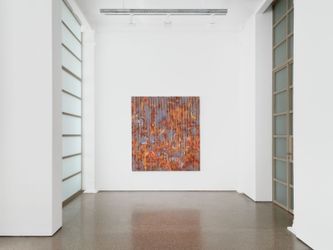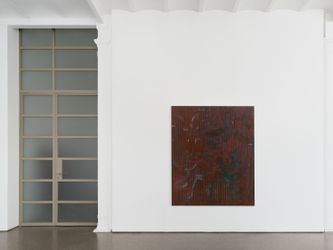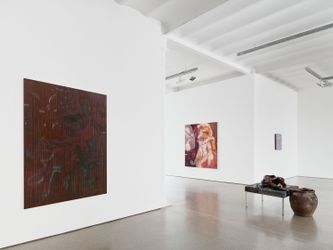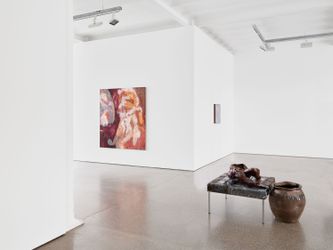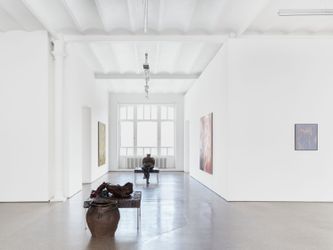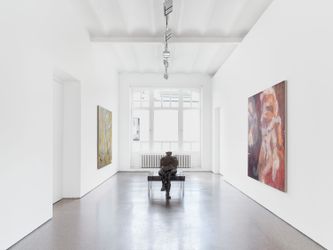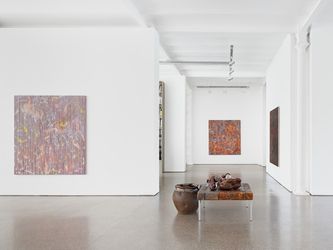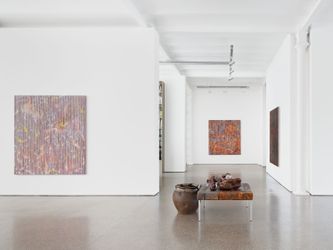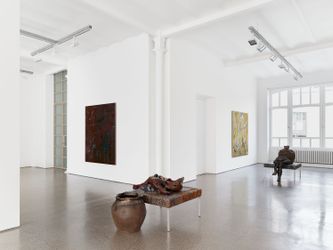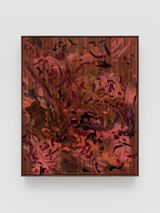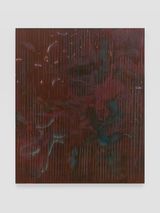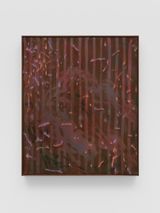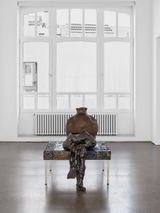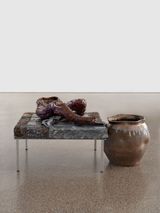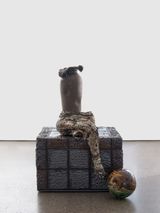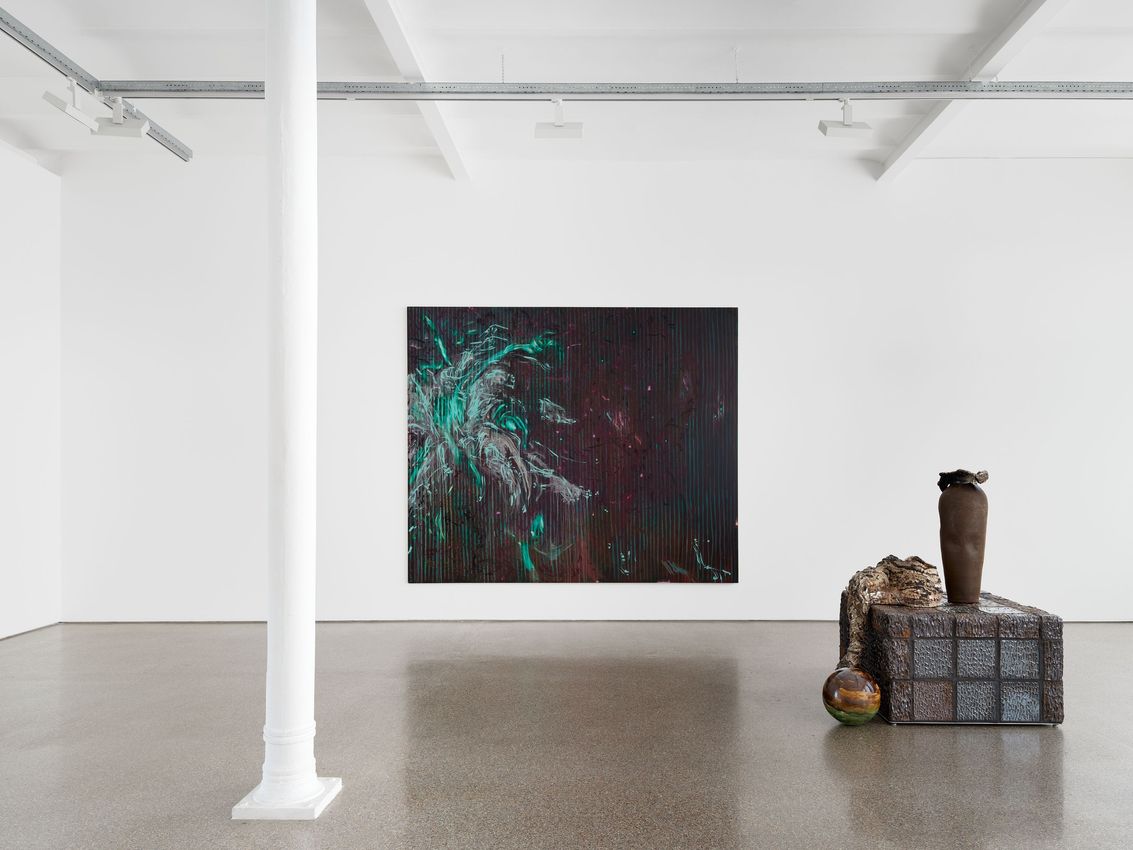
Galerie Greta Meert is pleased to present Evaporation Ceremony, its first solo exhibition of Los Angeles-based artist Erica Mahinay. The title itself operates as both threshold and tone: an evaporation ceremony suggests not loss, but transformation. Matter released from one state into another, the visible dissolving into something still present, still felt, though no longer fully legible. It is a title that asks us to attend to what remains after the gesture, after the making, after the heat of contact between hand and surface has passed.
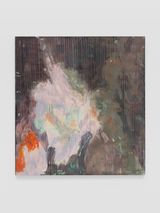
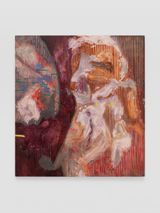
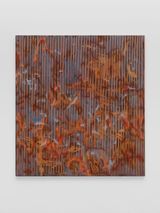
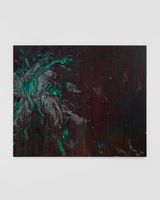
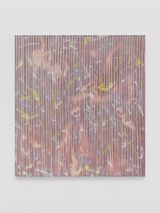
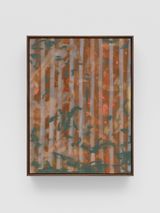
The exhibition rests on two distinct yet inseparable pillars. The first comprises a substantial new body of paintings in which Mahinay continues to develop her rigorously intuitive practice. These canvases resist easy categorisation. They are abstract, yet they bear the unmistakable pressure of a body at work. Paint is applied in a variety of ways, but most strikingly by hand, literally: the artist’s fingers become instruments of both structure and sensation, leaving traces that are at once gestural and deliberate. There is something almost symphonic in the accumulation of these marks, a lyrical drawing-out of form that unfolds across the surface with the logic of a score rather than a plan.
And yet these works are not lawless. Beneath their apparent freedom lies a grid-like sensibility, a latent architecture that organises without constraining, that gives the eye somewhere to move without telling it where to go. One senses that the grid is never imposed but rather discovered, as though it were already sleeping inside the canvas, waiting to be woken by colour and pressure. Colours, here, are never incidental. Each canvas asserts a chromatic identity that feels both chosen and inevitable, contributing to a body of work marked by striking diversity and, simultaneously, by a deeply coherent visual voice, one that is instantly recognisable across even the widest variation of surface or palette.
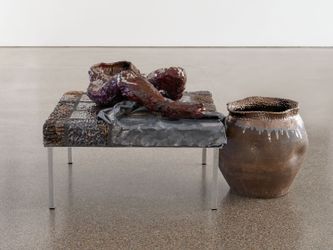
The second pillar emerged from Mahinay’s residency at Cerámica Suro in Guadalajara, Mexico, in 2025. The ceramic installations produced there occupies an entirely different register, though the resonances with the paintings are immediate and intuited. Fingerprints recur, and the directness of touch remains central but where the canvases lean fully into abstraction, the ceramic works flirt openly with the figurative. Human forms surface and recede.
Shapes carry the weight of archaeological memory, as though unearthed rather than made, bearing the marks of time and ritual alongside those of the artist’s own hands. Clay, unlike canvas, holds everything: pressure, hesitation, revision. In Mahinay’s hands it becomes a material of quiet testimony, registering the body’s presence with an intimacy that feels at once ancient and entirely contemporary.
The exhibition’s title, Evaporation Ceremony, encapsulates this dialogue. It suggests a rite of transformation, where the liquid immediacy of paint and the solidity of clay meet, and where the figurative solid can dissipate into the abstract ether. It speaks to a process of becoming, where a symphony of colour and gesture is both laid bare and obscured, like a memory or a landscape fading in the heat, or conversely, condensing from vapour into form.
Following her presentation in Brussels, Mahinay will continue her inquiry this summer at the Headlands Center for the Arts in California. There, against the threshold of ocean and sky, the work will encounter new conditions for evaporation.


Erica Mahinay is a Los Angeles-based artist working primarily in painting and sculpture, known for dynamic physical processes that explore the interplay of gesture, material, and the complexities of human experience. She has been referred to in the context of a new generation of abstract expressionists.

Over the past 30 years, Galerie Greta Meert established itself as one of Brussels’ leading contemporary art galleries. Founded in 1988 as Galerie Meert Rihoux, it was subsequently renamed after its founding director Greta Meert in 2006. Located in the center of Brussels, the gallery occupies a five-story Art Nouveau building designed by Louis Bral and renovated for the gallery by renowned Belgian architects Hilde Daem and Paul Robbrecht. Since 2012 three floors of the building are dedicated to exhibitions, making it possible to maintain an expanded exhibition schedule.

A respected voice in contemporary art discourse.
Focusing on ambitious storytelling and insightful art-world commentary. Ocula Magazine publishes in-depth interviews, critical essays and timely analysis on the artists, exhibitions and ideas driving the global art world.
Learn more about Ocula Magazine
Showcasing the best of the art world.
Ocula partners with galleries from around the world to highlight their artists, artworks and exhibitions. Gallery membership is by application and invitation, with each member vetted by an independent panel.
Learn more about Ocula Membership

Specialises in the sale of major artworks.
Led by a team with deep ties to the world’s leading auction houses, galleries and collectors. Ocula’s advisory team offers bespoke services to high-net-worth clients from around the world who are looking to acquire the best of contemporary and modern art.
Learn more about our team and services