Press Release

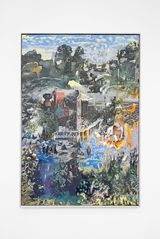
Tony Swain’s exhibition has a visionary quality, replete with compositions shifting between the utopian and dystopian. The panels merge photojournalism with acrylic paint, fostering tableaux somewhere between indexical fact and fictional space. The works on board begin in two separate places – direct acrylic washes and marks on their surfaces, and the selection and gluing on of pieces of already collaged and painted scraps of newspaper, from a pile built up over years of daily practice. These are then transformed into a whole by further connections made in paint. As Mason Leaver-Yap puts it, ‘Swain’s paintings repurpose the “eventfulness” of the press.’ On the one hand, this practice seems to ask a question of the reality portrayed in the news and our willingness to accept an editorial perspective but on the other the imagery simply provides an imaginative stimulus, and a means to think about the discipline of painting and its history. His collaging is intuitive, with each section inspired by the previous. The choice to cut or tear provides a variety of visual effects and Swain’s painting melds and adapts these combinations.

The show brings together large panoramic scenes with a series of smaller, folded compositions on board. In terms of scale, the latter hark back to paintings from the 2000s but resist the graphic quality of some of these early works – their spaces and formations are more enigmatic, foggy, disintegrating. They combine arial views and clouded skies with concrete zones of interior space. In contrast, the larger pieces depict landscapes and cityscapes, incorporating ancient fortifications, ruins, modernist buildings and flooded plains. In painterly terms, they invoke the stacked space and changes of scale we find in Andrea Mantegna’s ‘The Agony in the Garden’ (1455-6) or else the strange twisting landscape of Pieter Bruegel the Elder’s ‘The Hay Harvest’ (1565) but now emptied of figures. One mountain scene evokes the optimism of Nicolas Poussin’s neoclassical works, while others feel closer to John Martin’s apocalyptic ‘The Great Day of His (Lord’s – God of Abraham) Wrath’ (1851–1853). Equally the moments of discontinuity and impressionistic play between print and paint recall Pierre Bonnard’s (1867–1947) portrayals of light and shade in the south of France.

What is in question, both in these historical works and Swain larger panels, is a relationship to landscape, be that agrarian, leisure, political or religious. As Liza Dimbleby has commented on Swain’s panels, ‘The large paintings invoke the format of traditional landscape, European horizontals and Japanese vertical. But Arcadian reverie is interrupted by rips and gaps, the merging of paint and paper disrupted by tearing marks of paint itself.’ Swain offers visions of the future built from the present laid out in the press, composting and growing its imagery of climate crisis, reportage, business, politics, lifestyle and tourism.

Tony Swain (b.1967, Lisburn, Northern Ireland) lives and works in Glasgow. Selected solo presentations include: ‘Dilemma to Rely On’, Gallery Baton, Seoul (2024); ‘Pronouncing the Accent’, Celine, Glasgow (2023); ‘Sight Deserted’, The Modern Institute, Osborne Street, Glasgow (2022); ‘Works or Everyone’, The Modern Institute, Aird’s Lane, Glasgow (2017); ‘The Shorter Alphabet’, The Modern Institute, Aird’s Lane, Glasgow (2015); ‘Other Planets are Available’, Kunstverein Freiburg (2015); ‘Undetailed Progress’ BALTIC Centre for Contemporary Art, Gateshead (2015); ‘Drowned Dust, Sudden Word’, Fruitmarket Gallery, Edinburgh (2012). Swain was one of the artists representing Scotland in Venice as part of the 52nd Venice Biennale (2007). Selected group exhibitions include: ‘Brilliant Cut’, Gallery Baton, Seoul (2023); ‘NOW’, Modern One, Scottish National Gallery of Modern Art, Edinburgh (2017); ‘X’, Herald St, London, (curated by Sarah McCrory) (2015); ‘Continue Without Losing Consciousness’, DCA, Dundee (2014); ‘A Picture Show’, GOMA, Glasgow (2013); ‘Transmitter/ Receiver’, Hayward Gallery, London (2011-2013, touring to MIMA Sound Space, Middlesbrough, The Lightbox, Woking, and Tullie House, Carlisle).

Courtesy The Modern Institute

Read More
About the Artist

Tony Swain’s paintings use abstract and figurative elements to create landscapes which are surreal but familiar.

View Artist Profile

Also Exhibiting at The Modern Institute

About the Gallery

The Modern Institute was founded in Glasgow in 1997. The gallery works with internationally established and emerging artists including Martin Boyce, Jim Lambie, Richard Wright, Anne Collier, Cathy Wilkes, Simon Starling, Urs Fischer, Luke Fowler and Nicolas Party.

View Gallery Profile
Address
14–20 Osborne Street
Glasgow
United Kingdom
Opening Hours
Mon - Fri, 10am - 6pm
Sat, 12pm - 5pm
(1)
Glasgow 14–20 Osborne Street
The Modern Institute
14–20 Osborne Street, Glasgow, United Kingdom

Opening hours
Mon - Fri, 10am - 6pm
Sat, 12pm - 5pm
The art world in focus