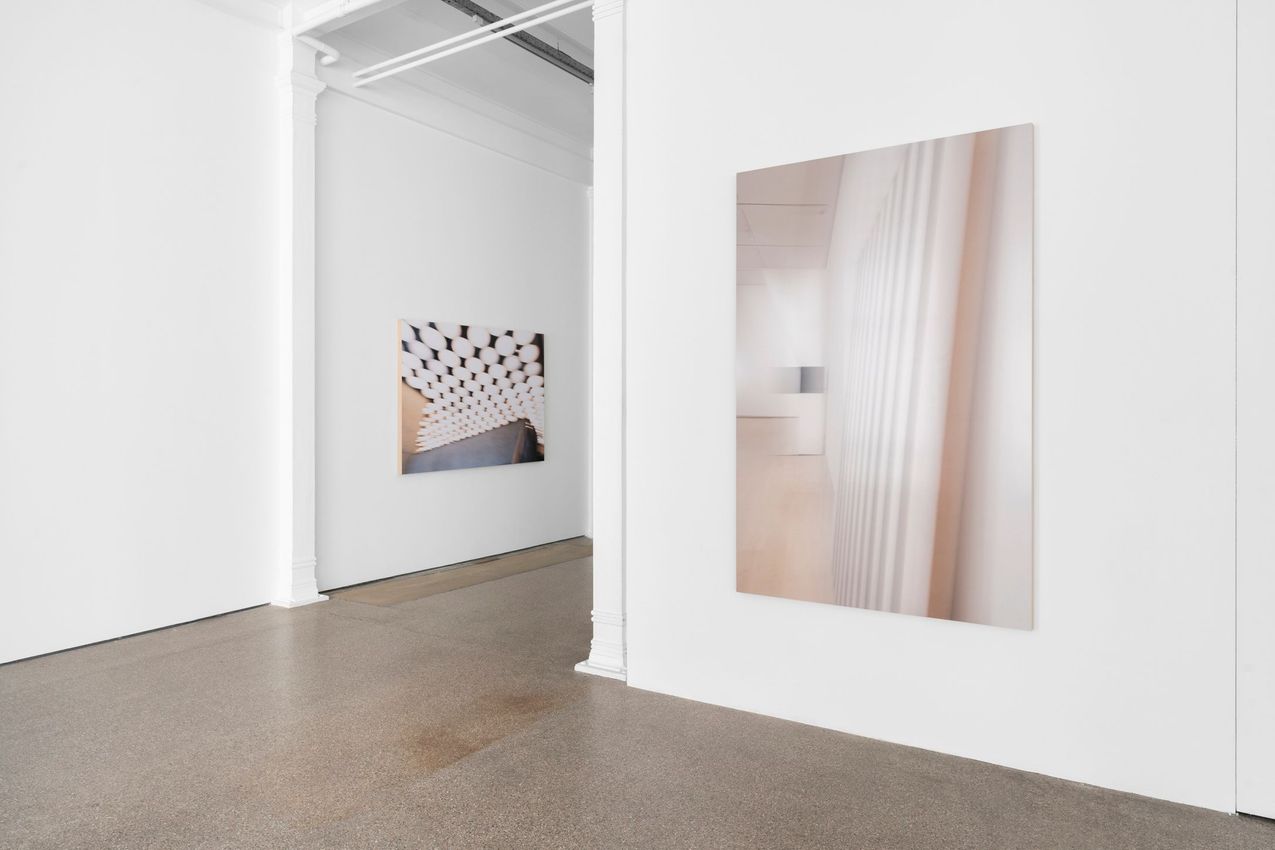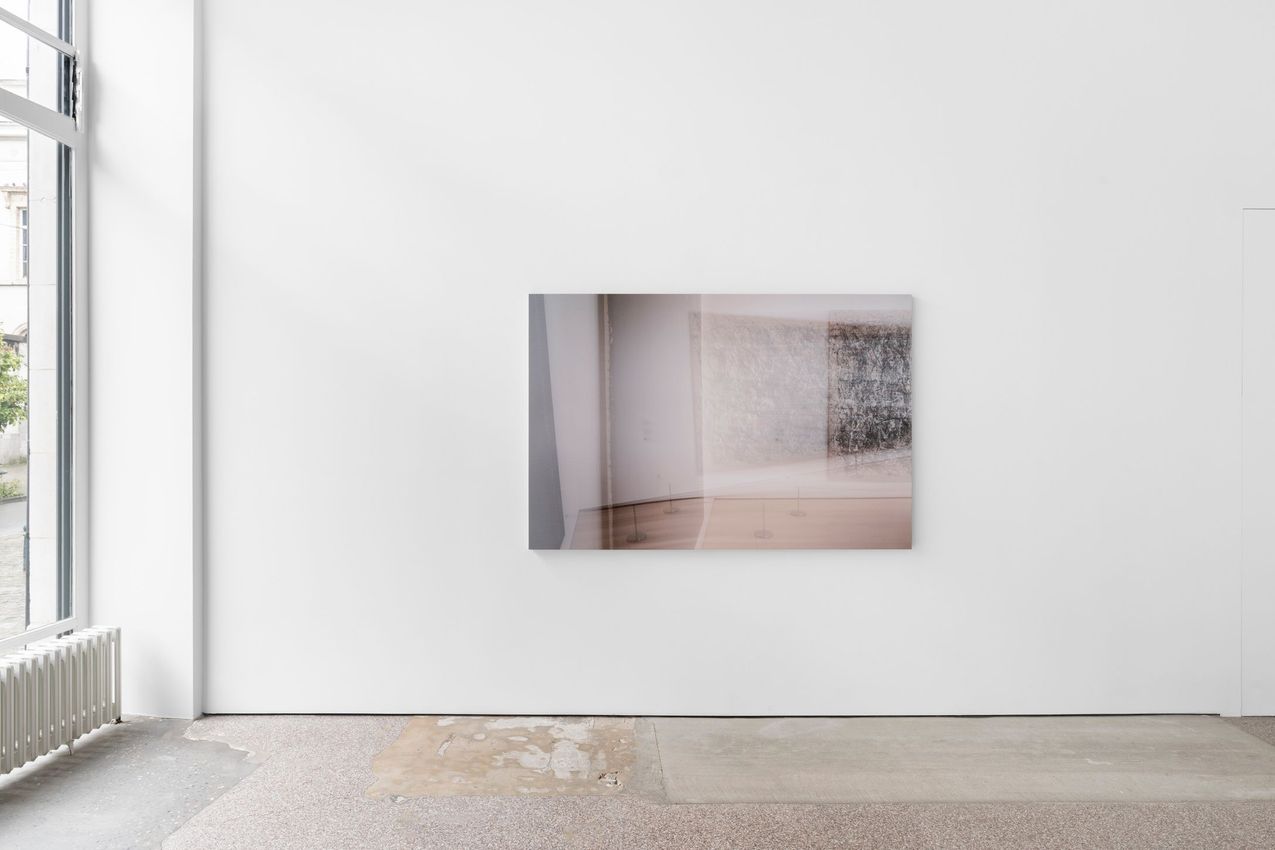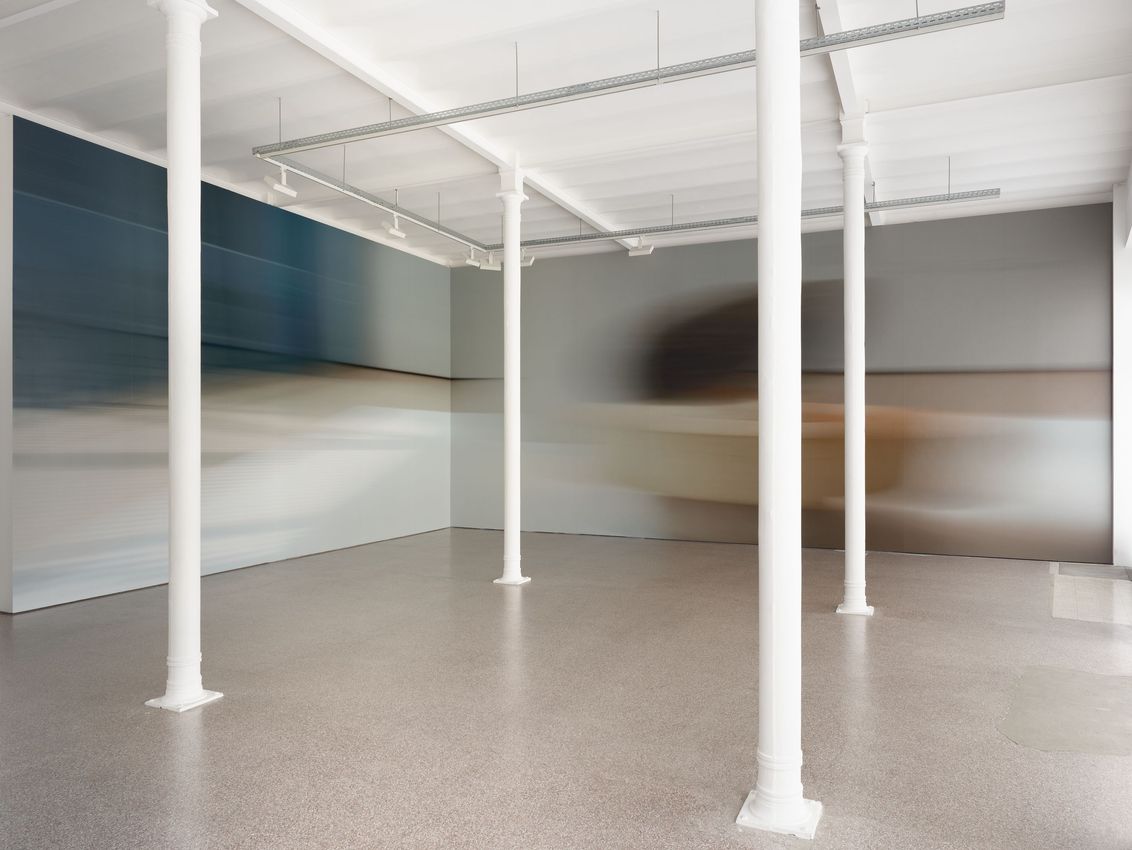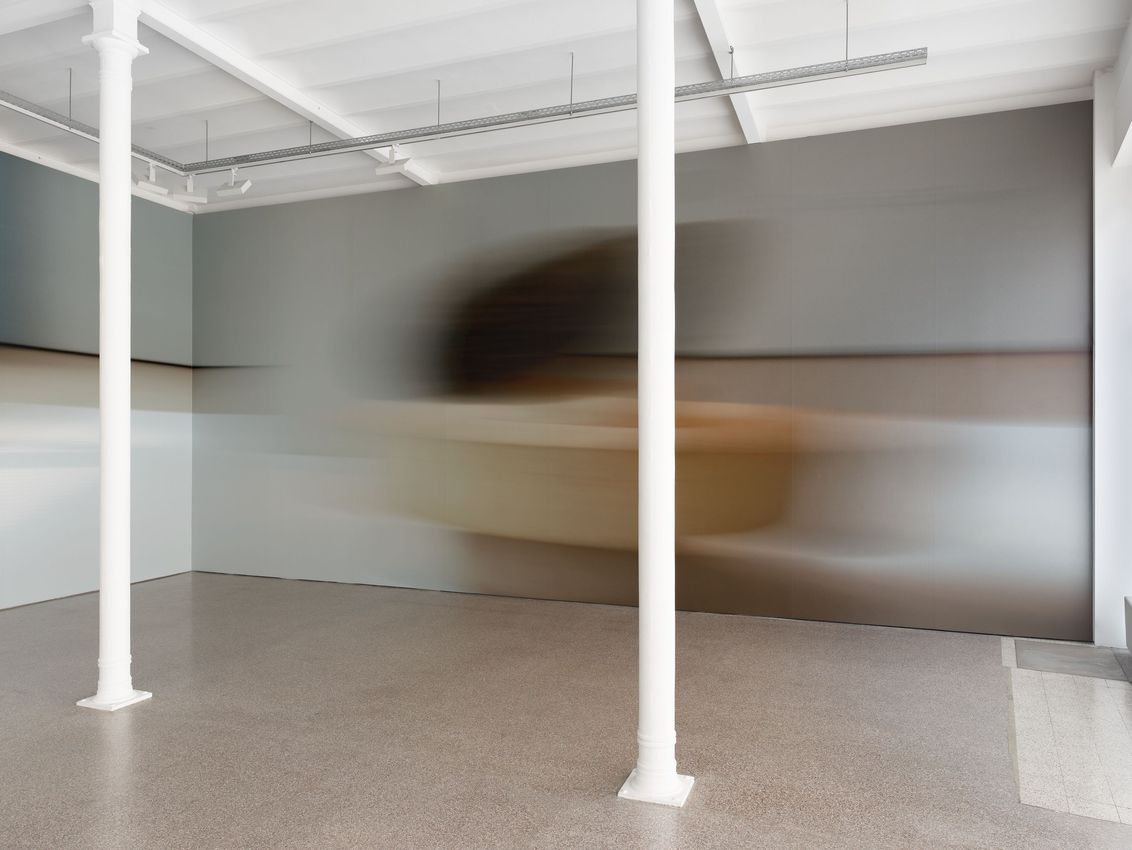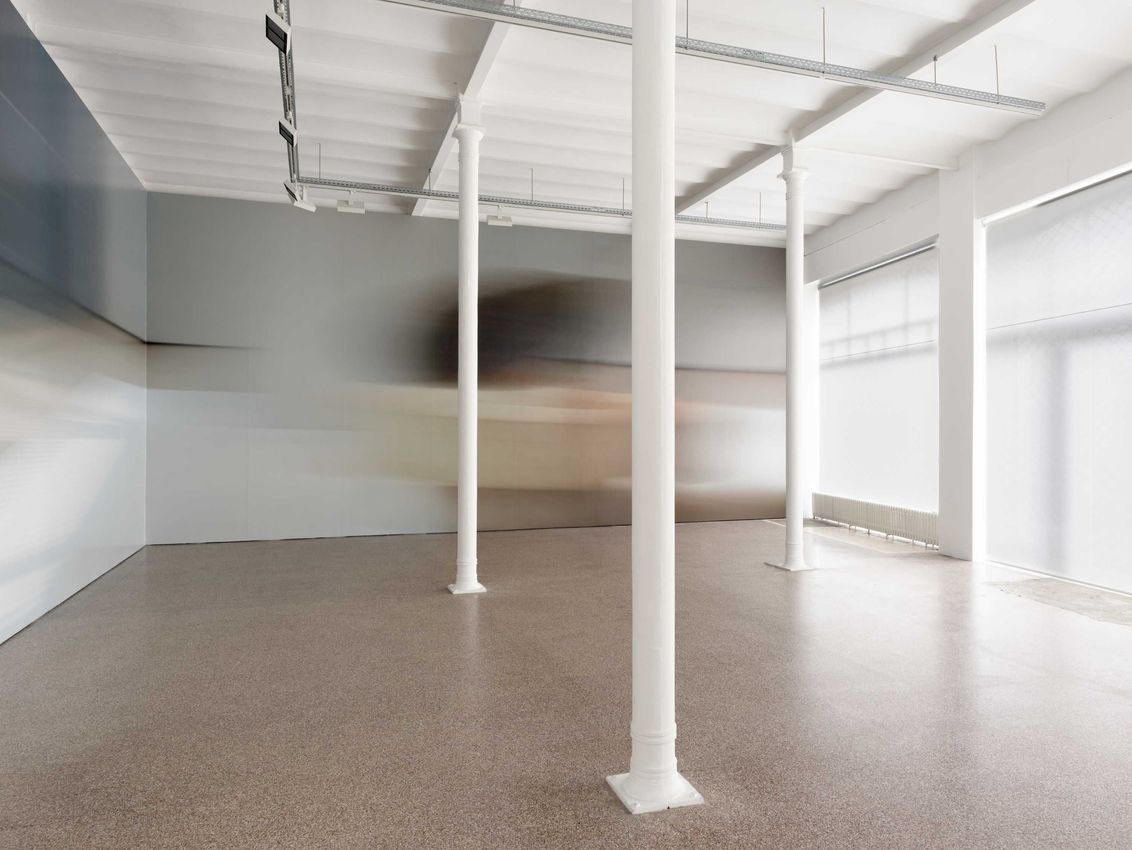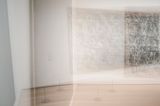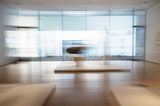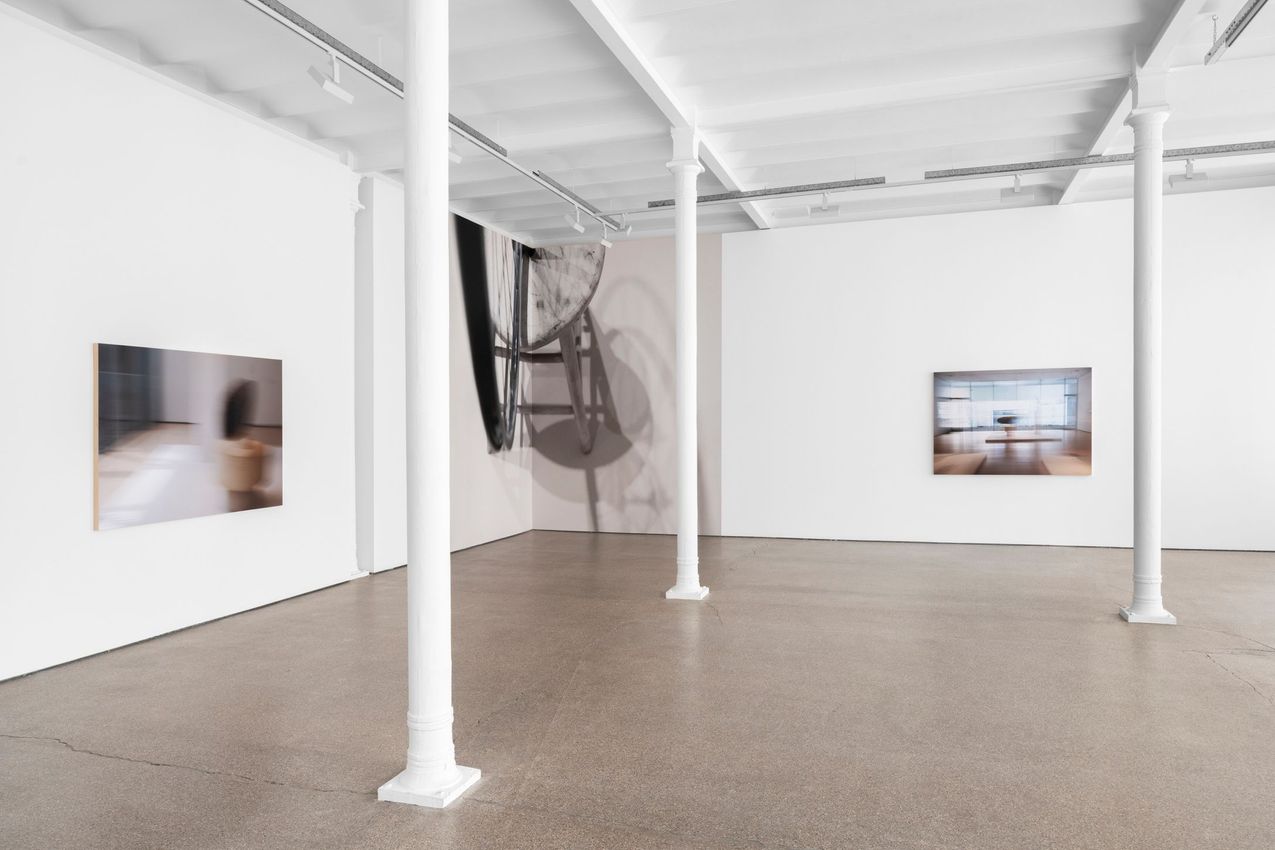
With CORNERED, American artist Louise Lawler shows new works over two floors at Galerie Greta Meert.
Lawler’s work interrogates the conditions, mechanisms and frameworks that operate around art. Her photographic interventions dissect contexts and their creation of meaning. Referring to the exhibition’s title, CORNERED, Lawler presents two large-scale vinyl mural installations, each situated on different floors of the same corner of the building.
On the ground floor, we encounter an installation of It rests on a pivot that once allowed the work to spin (swiped) (adjusted to fit). The artist engages in a dialogue with both art history and her own praxis, questioning the authority inherent in both artistic creation and institutional presentation. An image that manifests as a fleeting memory — a blurred image of a work by Brancusi in a museum space—produces an abstract image where long exposure and rapid camera movements affect what we see, and possibly feel. Things hover between stillness and movement; fixed meaning and confusion. These works transcend their origins, ever blurring and shifting, making the artist’s exploration of the structure and reception of meaning probe new territory.
Louise Lawler operates within and against institutional structures, shifting focus and authority through subtle changes. In a growing number of her works, she reimagines her own images by translating them into various formats and media, with external factors determining their final form. Hence the subtitle adjusted-to-fit of the vinyl on the ground floor—with this Lawler relinquishes control of the original image and digitally manipulates it to fit the dimensions of a specific space. The shape, size and placement of the image are no longer determined solely by the artist, but by the context where it is exhibited. This methodology highlights the multitude of forces—social, institutional, and economic— that determine the method by which art is displayed and received.
The swiped subtitle is also found on all the works on aluminium in the exhibition and adds a layer of ingenuity, possibly referring to her practice of appropriating the work of other artists. These dye sublimation prints also offer a mirror to the mass consumption of digital images; this ‘swiped’ quality evokes a sense of disorientation and loss of clarity often associated with an incessant flow of visual stimuli in our digital age. With the first floor’s vinyl installation, It Spins (cornered), we step back from the swiped series, and the viewer’s regard is overwhelmed, destabilised by the exhibition only crisp image pushed into the gallery corner. Perspective, technique and format divert this well-known work by Marcel Duchamp (Bicycle Wheel, 1951) from its iconic historical character to an almost laconic framing where meaning has quite literally been ‘cornered’.
Louise Lawler’s work puts things in perspective—often multiple and overlapping perspectives—animating the underlying motivations, desires and challenges of the institutional canon. The ambiguous nature of this body of work, never shying from paradox, shows an artist who reflects introspectively and conjunctively.
Louise Lawler has been the subject of numerous international solo exhibitions, including recently: GOING THROUGH THE MOTIONS, Sprüth Magers, Los Angeles (2023); Grand Arles Express, Collection Lambert, Avignon (2023); NOT ENOUGH TO SEE, Marian Goodman Gallery, Paris (2022); Keijiban, Kanazawa, Japan (2022); LIGHTS OFF, AFTER HOURS, IN THE DARK, Galerie Greta Meert, Brussels (2021); DISTORTED FOR THE TIMES, Galerie Greta Meert, Brussels (2021); Andy in Chicago, Art Institute of Chicago, Chicago (2019); She’s Here, Sammlung Verbund, Vienna (2018); WHY PICTURES NOW, MoMA, New York (2017); Adjusted, Museum Ludwig, Cologne (2013); ...
Selected group exhibitions and collections include Fondazione Prada, Milan / Venice; The Metropolitan Museum of Art, New York; Museum Brandhorst, Munich; Walker Art Center, Minneapolis; Institute of Contemporary Art, Boston; MoMA, New York; PS1, New York; MUMOK, Vienna; Hammer Museum, Los Angeles; and the Whitney Museum, New York, which additionally featured the artist in its 1991, 2000, and 2008 biennials. Her work was also included in the 59th International Art Exhibition – La Biennale di Venezia (2022).
American artist Louise Lawler’s practice critically points towards the institution of art and artmaking, creating photography that calls into question its own forms and contexts.
Over the past 30 years, Galerie Greta Meert established itself as one of Brussels’ leading contemporary art galleries. Founded in 1988 as Galerie Meert Rihoux, it was subsequently renamed after its founding director Greta Meert in 2006. Located in the center of Brussels, the gallery occupies a five-story Art Nouveau building designed by Louis Bral and renovated for the gallery by renowned Belgian architects Hilde Daem and Paul Robbrecht. Since 2012 three floors of the building are dedicated to exhibitions, making it possible to maintain an expanded exhibition schedule.

A respected voice in contemporary art discourse.
Focusing on ambitious storytelling and insightful art-world commentary. Ocula Magazine publishes in-depth interviews, critical essays and timely analysis on the artists, exhibitions and ideas driving the global art world.
Learn more about Ocula Magazine
Showcasing the best of the art world.
Ocula partners with galleries from around the world to highlight their artists, artworks and exhibitions. Gallery membership is by application and invitation, with each member vetted by an independent panel.
Learn more about Ocula Membership

Specialises in the sale of major artworks.
Led by a team with deep ties to the world’s leading auction houses, galleries and collectors. Ocula’s advisory team offers bespoke services to high-net-worth clients from around the world who are looking to acquire the best of contemporary and modern art.
Learn more about our team and services