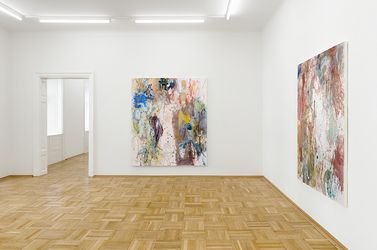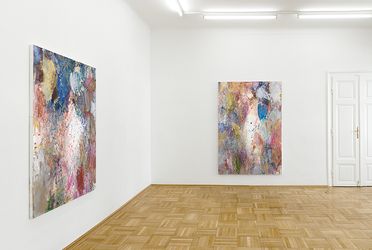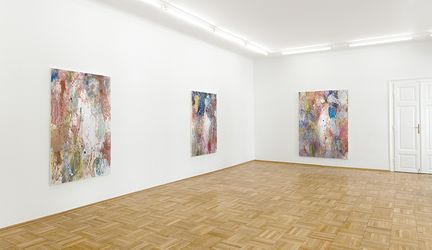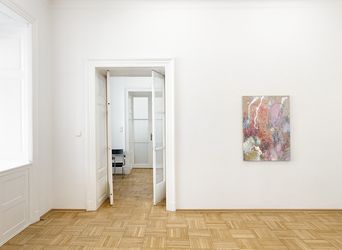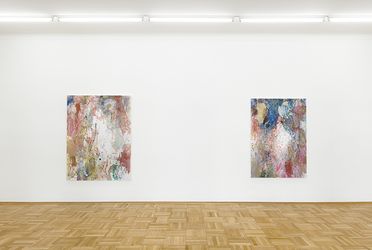




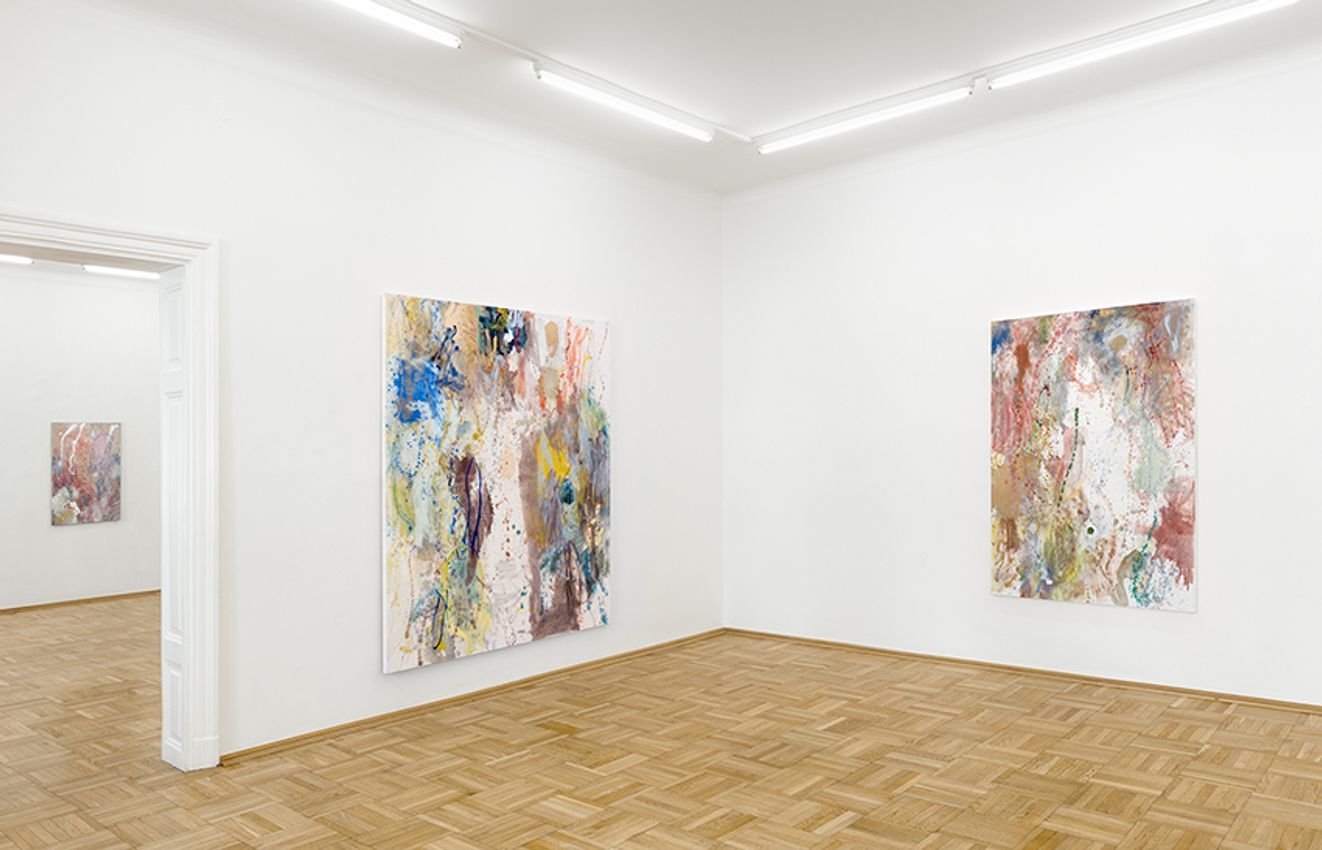
Galerie nächst St. Stephan Rosemarie Schwarzwälder is delighted to present new paintings by Caitlin Lonegan, her third solo exhibition with the gallery. Lonegan continues to make paintings based on her observations of light and color, and how they might be conveyed in a series of overlapping gestures, constantly intersecting the subjective and empirical. This entails her observations of ambient conditions of her studio, her past and ongoing paintings, or a multitude of objects finding her glances. She captures specific visual information from them, reproducing their effects that can be reenacted in a new painting. Lonegan repeats this process ad infinitum, resulting in generative variations at differing scales and painterly approaches.
Lonegan had written almost a decade ago that her process was filled with “hiccups, small repetitions and rhythms,” variations of which continually finding new expression in one series to the next. She builds their inventories in several ways, one of which in her drawings on watercolor paper: They offer schematic or ambient representations of observed color phenomena, which are abstracted into spontaneous gestures in colored pencil or oil pastel. Her studies lean into her growing edge of understanding, skeletally representing what she later actualises in the fluidity of paint. Her attempt to capture subjective observations of prismatic color, and to insist them towards an empirical reenactment, places her work beyond the general associations of abstract expressionism through which her work incidentally takes part. Long undead since the 20th century, its conceit of emotional and material purity is undermined by her insistence on accurately capturing color phenomena. This prevents her submission to unrestrained impulses and oil paint’s obstinate material nature. Which is not to say that Lonegan refuses to use her intuition or impulsivity to plot out her paintings, but she is intensely loyal to the optical data she seeks to represent, for they are foundational to building one painting to the next.
It is here where the fruits of Lonegan’s project are felt viscerally, where her resulting spatial effects, rich in movement, specificity, and depth, offer physical rewards that dance around descriptive language. This is because her paintings do not arise from efficient gestures designed to pin down fugitive color phenomena in one fell swoop; they arise from her stumbles, staccatos, and amendments that slowly build into strangely prismatic accumulations. These owe to material concerns like the careful selection of pigments, or to the drying time required between layers, but also to her delays to find satisfying solutions. They are eventually found as they settle against a bright white ground, which between passages, acts as a porthole through their articulated space.
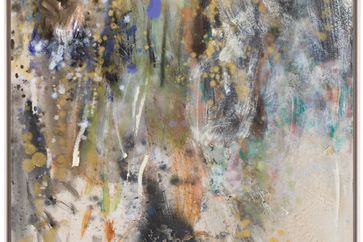
In Untitled (CL 2022.14), 2022, we are witness to a series of predominant colors: golden metallics, dusty blue, naples yellow, and sharper accents of electric violet. They congregate around a white porthole in the painting’s lower center. Lonegan trickled these colors and their dilutions around this otherwise flat expanse of white. These colors unfurl the impression that we are looking through painterly events into the unsettling (or peaceful, depending on your point of view) blankness that harangues and activates even the most experienced of painters. In this spatial movement, they are further affected by the innumerable variables of transparency, impasto, and sheen. They all play a role in modulating the pictorial space around Lonegan’s recurring portholes that anchor each painting.
Other works, fewer in number, demonstrate her use of gold metallic paint as the ground instead of white, whose free electrons vibrate and emit their own strange light alongside passages with more solid hues. In Untitled (CL 2022.11), 2022, the metallic ground serves as an ambient stage over which almost apparitional passages of violet, brick red, crimson and white appear. The edges of the “T” shaped stretcher bars are limned behind the linen, separating the work into four distinct quadrants. In the upper left, there are two snake-like ribbons of white, and on its direct right, a light violet mist. A dry blue line encircles the latter, as if to answer the graphic weight of its neighboring white snakes. One could fixate on endless details such as this, operationalizing them with their neighboring passages, but this is the busy work that is rewarded for our sustained gaze. Our gaze, if prone to this, eventually relaxes, letting these painterly effects wash over our grasp of logic.
In the hundreds of decisions Lonegan makes for each painting, many of which spurned on by curiosity and doubt, there is little visual information that she did not account for. There is a clarity to her paintings that has emerged from a chain of painterly experiments seeking to match visual phenomena. Only she can decide what is the “correct” result of this process, as any painter does, but her claim to fidelity renders the distinction between subject and object a lively game of consciousness and perception. It is a hall of mirrors, whose path towards clarity is a rigorous process expressed in hiccups, repetitions and rhythms.
Max Maslansky


Born in 1982 in Long Island, New York, lives and works in Los Angeles, California

The Galerie nächst St. Stephan represents a living tradition of exploring the art of the modern era. It has been located since the 1920’s in the same place in the centre of Vienna at Grünangergasse.

A respected voice in contemporary art discourse.
Focusing on ambitious storytelling and insightful art-world commentary. Ocula Magazine publishes in-depth interviews, critical essays and timely analysis on the artists, exhibitions and ideas driving the global art world.
Learn more about Ocula Magazine
Showcasing the best of the art world.
Ocula partners with galleries from around the world to highlight their artists, artworks and exhibitions. Gallery membership is by application and invitation, with each member vetted by an independent panel.
Learn more about Ocula Membership

Specialises in the sale of major artworks.
Led by a team with deep ties to the world’s leading auction houses, galleries and collectors. Ocula’s advisory team offers bespoke services to high-net-worth clients from around the world who are looking to acquire the best of contemporary and modern art.
Learn more about our team and services