



Press Release

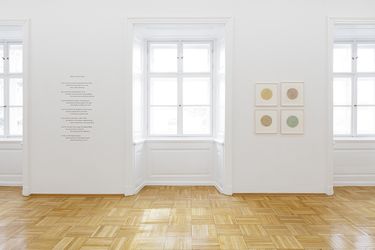
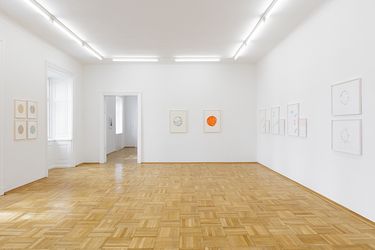
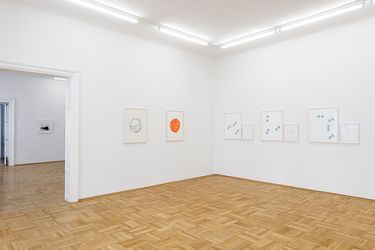
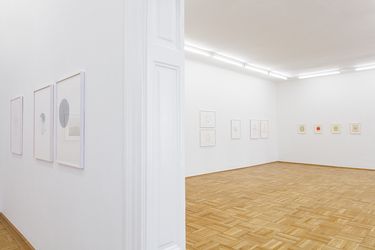
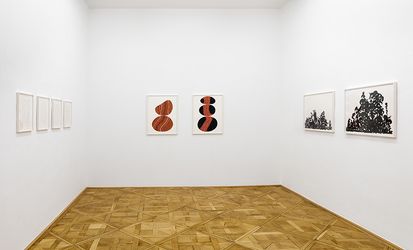
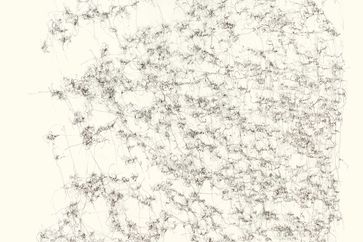
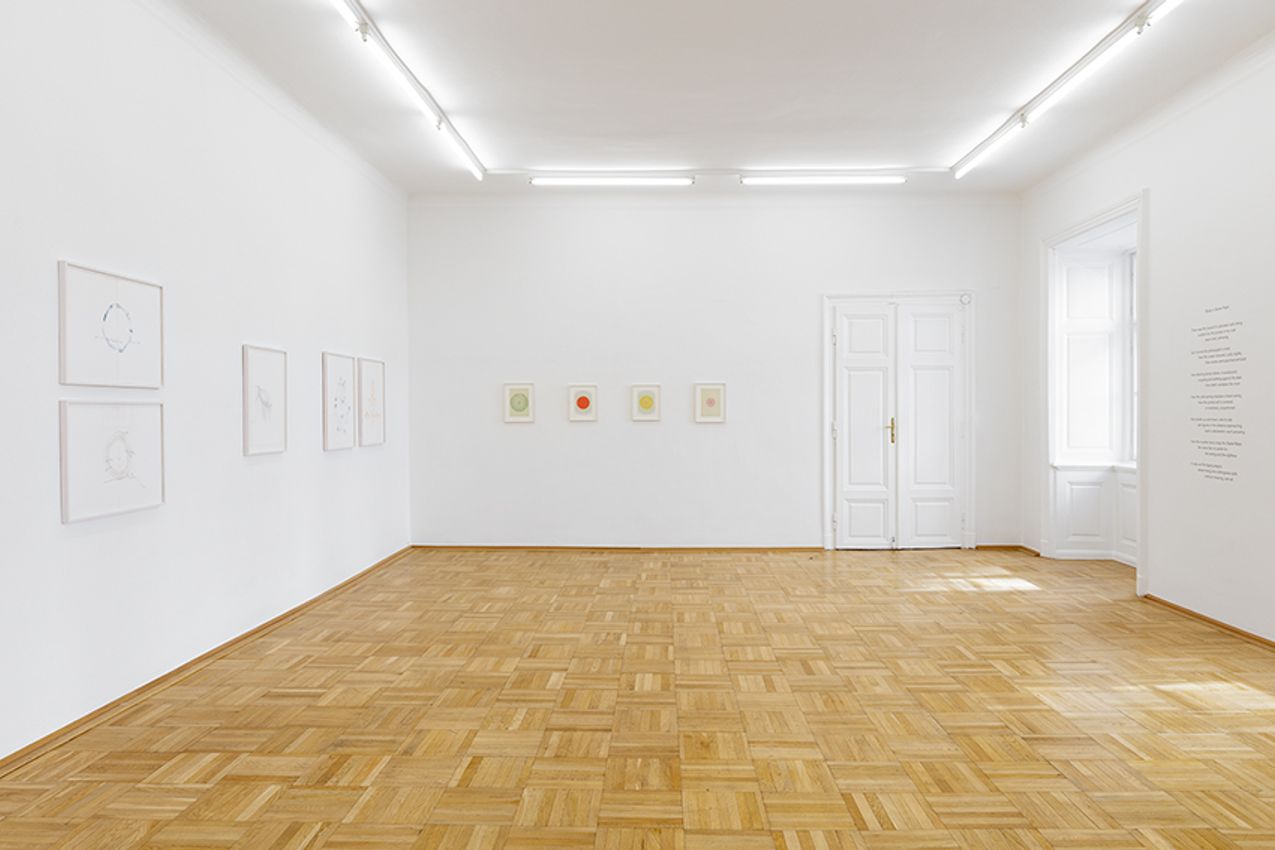
What is paradoxical about a sphere is that its measurable surface area is finite, while its surface is boundless. So how can universal questions regarding boundaries and infinity be represented, and what formal means can be used to conduct this theoretical investigation? The New York-based artist Alice Attie uses the simple geometric form of the circle as a basis for her second comprehensive solo exhibition at our gallery in which she explores these themes from a complex, philosophical, and aesthetic perspective. Her drawings, which are defined by a playful poetics, involve time and space, science and philosophy. The small drawings in ink and colored pencil, with their delicate marks, present a delightful contrast to the large dimensions into which they unfurl. The multifaceted representations sustain their forms through the concentration and repetition of individual, gesturally applied lines or through geometric arrangements. These structures are composed of bits of information, letters of the alphabet, lines, or fractal forms, while their boundaries and transitions are rarely defined. The line is a gesture of inquiry that, as Attie notes, citing Victor Hugo, often pull us towards the infinite. The circle consists of an infinite line, which curls around itself. For Alice Attie “It is a form forming. A mathematical mystery. The circumference limits. The circumference is limitless. Our planet. An orb. Our home. Our lives, living and dying. The cyclical.” Attie’s eye for detail can also be found in six small black-and-white photographs that were taken with a Rolleiflex from 1937 and direct our focus toward seemingly incidental things. These pictures of shimmering landscapes are gestures in themselves. Grass, plants, and waves form delicate lines and structure while creating spaces made of light and shadow that balance precariously between the concrete and the abstract. According to Attie, “The camera has a strange way of calling our attention to everything. We see what we might not see otherwise. We pay attention. The wind was blowing and the flowers were swaying. The modest flowers. These photographs, the first of which I took on a windy summer day in the north of Iceland, then on the Italian coast, upstate New York, and in New York’s Central Park, concern the silent, the breath-taking, the sublime. Roland Barthes wrote profoundly about the notion of contingency and chance in photography. He noted how we find ourselves in what we see, in what the camera helps us to see. The contemplative. The intimate. Proximity and distance.” Language and writing play a huge role in Attie’s visual works. She is also a poet and has published several volumes of poetry. Her works on paper are occasionally based on scientific and philosophical writings. In the works created during the classes of Professor Fred Neuhouser, on the subject of Jean-Jacques Rousseau from her Class Notes series, language acts as a reflexive structure, as the handwritten notes from lectures on the philosopher form long lines and change their direction, bump up against the margins, and bounce back. They enhance an increasingly dense network of thoughts and associations that lends philosophy, and its intellectual concepts, a visual form.

ALICE ATTIE was born in 1950 in New York City, where she lives and works. She holds a PhD in Comparative Literature and an MFA in Poetry and has taught literature throughout the New York area before turning to her own writing, photography and drawing. Her photographs and works on paper are among other in the collections of the Whitney Museum of American Art, Museum of Modern Art, Studio Museum in Harlem, Jewish Museum, all in New York; the Getty Museum, Los Angeles, and the Museum of Fine Arts, Houston.

Her work is also in many major collections including the Margulies Collection, the JoAnn Hickey Collection, the Jorge M. and Darlene Pérez Collection, Miami, the Maxine & Stuart Frankel Foundation, Bloomfield Hills, Michigan and the Werner Kramasky Collection.
Alice Attie has published two books of poems: These Figures Lining the Hills, 2015 (Seagull Books/University of Chicago) and Under the Aleppo Sun, 2018 (Seagull Books/University of Chicago). Bending into the Light will be published in autumn 2022 by Seagull Books/University of Chicago. Her book of photographs documenting the changing face of Harlem, Harlem on The Verge, was published in 2001 by Quantluck Lane/W.W.Norton Press.

Courtesy Galerie nächst St. Stephan Rosemarie Schwarzwälder, Photo: Markus Wörgötter.

Read More

Installation Views

About the Artist

Born in 1950 in New York City, lives and works in New York City, New York.

View Artist Profile Alice Attie contemporary artist
About the Gallery

The Galerie nächst St. Stephan represents a living tradition of exploring the art of the modern era. It has been located since the 1920’s in the same place in the centre of Vienna at Grünangergasse.

View Gallery Profile
Address
Grünangergasse 1
2nd Floor
Vienna
Austria
Opening Hours
Tues - Fri, 11am - 6pm
Sat, 11am - 4pm
(1)
Vienna Grünangergasse 1, 2nd Floor
Galerie nächst St. Stephan Rosemarie Schwarzwälder
Grünangergasse 1, 2nd Floor, Vienna, Austria

Opening hours
Tues - Fri, 11am - 6pm
Sat, 11am - 4pm
The art world in focus