



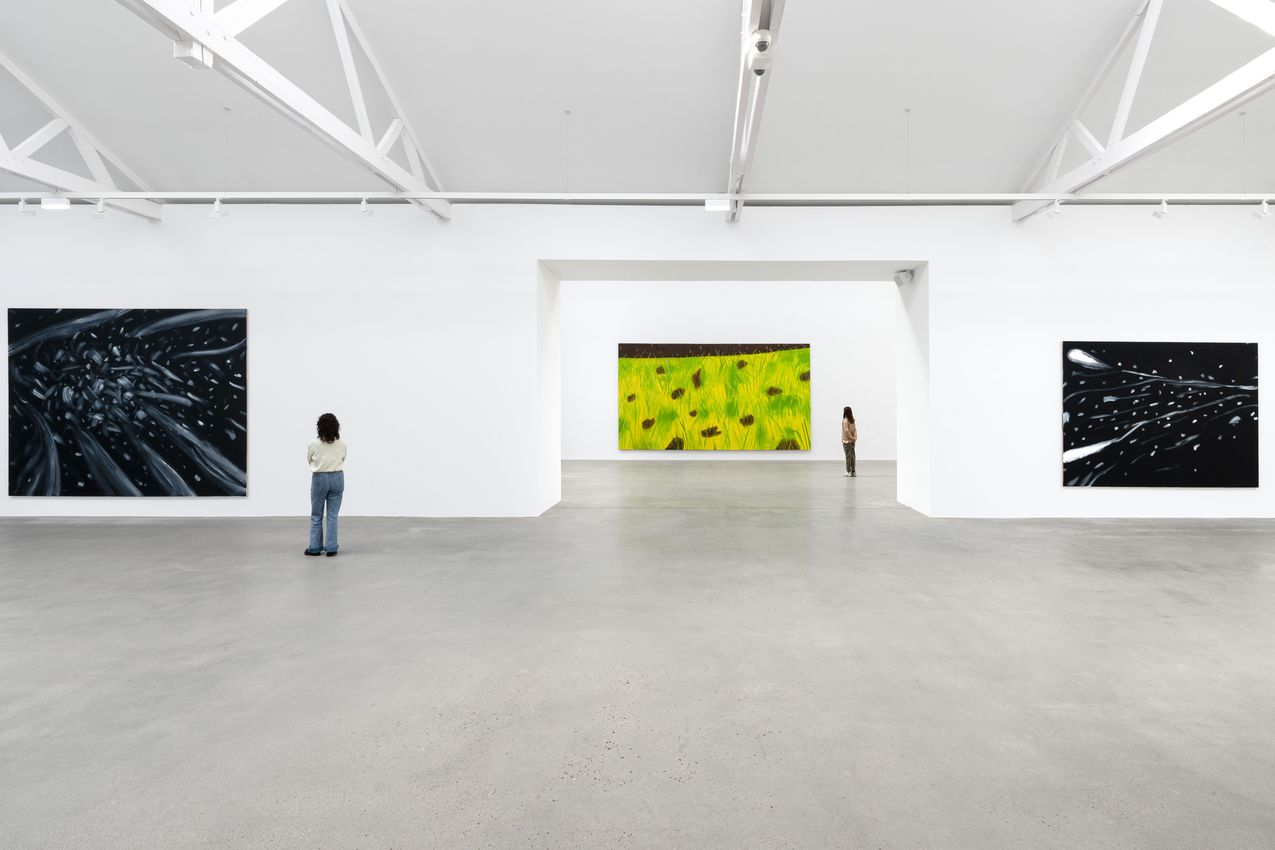
Following Alex Katz’s landmark show at the Fondazione Giorgio Cini during the 60th Venice Biennale in 2024, this exhibition at Thaddaeus Ropac Paris Pantin reunites, for the first time, the works shown together in the City of Water. Spanning three major groupings of work made between 2021 and 2022, the paintings on view represent three key facets of the artist’s practice, the boundaries of which continue to expand seven decades into his career. A group of works based on outfits by mid-century American fashion designer Claire McCardell is accompanied by large-scale close-up depictions of inky-hued oceans, and of grassland in tones of greens and yellows.
Through the late 1980s and 1990s, Katz focused much of his attention on large-scale landscape paintings, which he characterises as ‘environmental’, the evolution of which can be seen in the closely cropped, all-encompassing landscapes and waterscapes on view in the exhibition. As the artist says of these paintings: ‘The close-up gives the painting much more power and energy. With the close-ups, I could make a realistic painting that could compete with a de Kooning or a Pollock.’ It was not until the 2010s that he began painting multiple tightly cropped portraits sequenced across the canvas as if in a strip of film, combining a variety of angles to create the impression of an ‘environmental’ portrait. He has renewed this cinematic compositional logic by applying it to Claire McCardell’s celebrated designs, which are represented in the collections of the Victoria and Albert Museum, London, The Metropolitan Museum of Art, New York, and the Los Angeles County Museum of Art.
Katz has long been interested in fashion design, particularly as it relates to the American vernacular tradition: as early as 1960, he paid homage to the iconic ‘little black dress’ that marked 20th-century fashion in his renowned The Black Dress (Museum Brandhorst, Munich). In the 1980s, his admiration for the work of American designer Norma Kamali, who was herself influenced by McCardell, resulted in the well-known paintings Pas De Deux (1983; Colby College Museum of Art, Maine) and Eleuthera (1984). In a recent interview, Katz described Claire McCardell’s designs as ‘unaffected’: a quality that harmonises with his pared-back painterly style.
Several of the works on view feature bipartite or even tripartite compositions, with fragments of different outfits and models recalling the visual strategies of Cubism, while also emulating cinematic montage techniques. Katz has stated: ‘People see my paintings with eyes trained by seeing movies and photographs in magazines. I try to use the way these things alter the way people see as a key to the way I construct my paintings.’ As a visual device, the splits and crops also resonate with today’s digital framework, demonstrating Katz’s continued awareness of how society looks at images. ‘The temporal and stylistic permanence of Katz’s paintings confront and empathize with the fundamental and structural impermanence of fashion,’ writes curator Éric Troncy. In Katz’s words: ‘Fashion is ephemeral. Any symbol of that thing that is really new in fashion instantly becomes mortal.’
Katz has always defined himself as a painter of ‘the immediate present’, in his landscapes and waterscapes as much as in his portraits. It was with landscapes that Katz found his voice as a young painter, exploring the lakes and forests of Maine while a student at the Skowhegan School of Painting and Sculpture. There, he discovered the freedom that comes with working en plein air, like the Impressionists, painting quick oil sketches in nature which he then turned into large-scale environmental works in his studio. Cropped and painted larger than life, the paintings of grass on view in the exhibition lend the windswept blades a quiet but powerful beauty. Therein lies the power of Katz’s paintings: neither abstract nor realistic, they focus on a small, unmoored slice of life, allowing poetry and abstract thinking to arise from pure perception rather than narrative.
Though water had been a recurring element in Katz’s paintings during his early formative years, it wasn’t until his retrospective at the Whitney Museum of American Art, New York in 1986 that it became a subject in its own right. Starting in the 1980s with his ongoing Black Brook series, works from which are held by Tate, London, and the Fondation Louis Vuitton, Paris, Katz continued exploring the effects of light and reflection on the surface of water over the course of the decades that followed with works such as Dark Reflections (1995; Whitney Museum of American Art, New York) or Grey Marine (2000; Tate, London). The exhibition highlights this aspect of Katz’s practice with a group of oceanscapes, rendered in monochrome with expressive white brushstrokes landing on dark grounds to suggest waves breaking or moonlight catching on the surface of a fathomless sea.
It is these fleeting patterns of glinting light on dark, rather than colour, that is most important to Katz. ‘Colours are irrelevant,’ he stated in a recent interview. ‘I can change the colours as long as I’ve got the light.’ The artist works fast, adopting a wet-on-wet technique, whereby the entire composition must be finished before the first layer has time to dry. This has led him to develop a quick, syncopated brushwork, which encapsulates his fleeting impression of the scene. The result is, as the director of Paris’s Institut national d’histoire de l’art, Éric de Chassey, describes it, ‘a kind of precipitate (in the chemical sense) of perception and sensation,’ where the artist does not so much seek to describe what he sees as to capture the power and feeling of water.
The works on view are the subject of a catalogue, published on the occasion of the exhibition at the Fondazione Giorgio Cini, which also features a conversation between Katz and Luca Massimo Barbero, curator of the Cini exhibition.
Emerging in the 1950s in New York at the height of Abstract Expressionism, Alex Katz developed a distinctive style that proposed a return to representational art. Katz’s portrait and landscape paintings, characterised by flattened subjects and a bright colour palette, capture the sense of now—a state of being in the moment.

Founded in 1983, Galerie Thaddaeus Ropac has galleries across Europe, in London, Paris and Salzburg, and an expanding team in Asia. Specialising in contemporary art and representing over 60 artists, the gallery supports and showcases the careers of some of the most influential artists today with a wide-ranging programme of over 40 exhibitions each year across its five extensive and historic gallery spaces.
A respected voice in contemporary art discourse.
Focusing on ambitious storytelling and insightful art-world commentary. Ocula Magazine publishes in-depth interviews, critical essays and timely analysis on the artists, exhibitions and ideas driving the global art world.
Learn more about Ocula Magazine
Showcasing the best of the art world.
Ocula partners with galleries from around the world to highlight their artists, artworks and exhibitions. Gallery membership is by application and invitation, with each member vetted by an independent panel.
Learn more about Ocula Membership

Specialises in the sale of major artworks.
Led by a team with deep ties to the world’s leading auction houses, galleries and collectors. Ocula’s advisory team offers bespoke services to high-net-worth clients from around the world who are looking to acquire the best of contemporary and modern art.
Learn more about our team and services