Press Release

In his upcoming exhibition in Salzburg, RichardDeacon will present sculptures from six groups ofworks, each characterised by the distinct use of adifferent material, ranging from steamed wood toglazed ceramic to stainless steel. The sculptures areinvariably marked by the artist’s experiments withdiverse materials and his deep-rooted interest intheir specific consistencies and qualities. Deaconremains faithful to the principles of craftsmanshipthat have driven his practice since the beginningof his career and constitute an integral part of hisaesthetic.

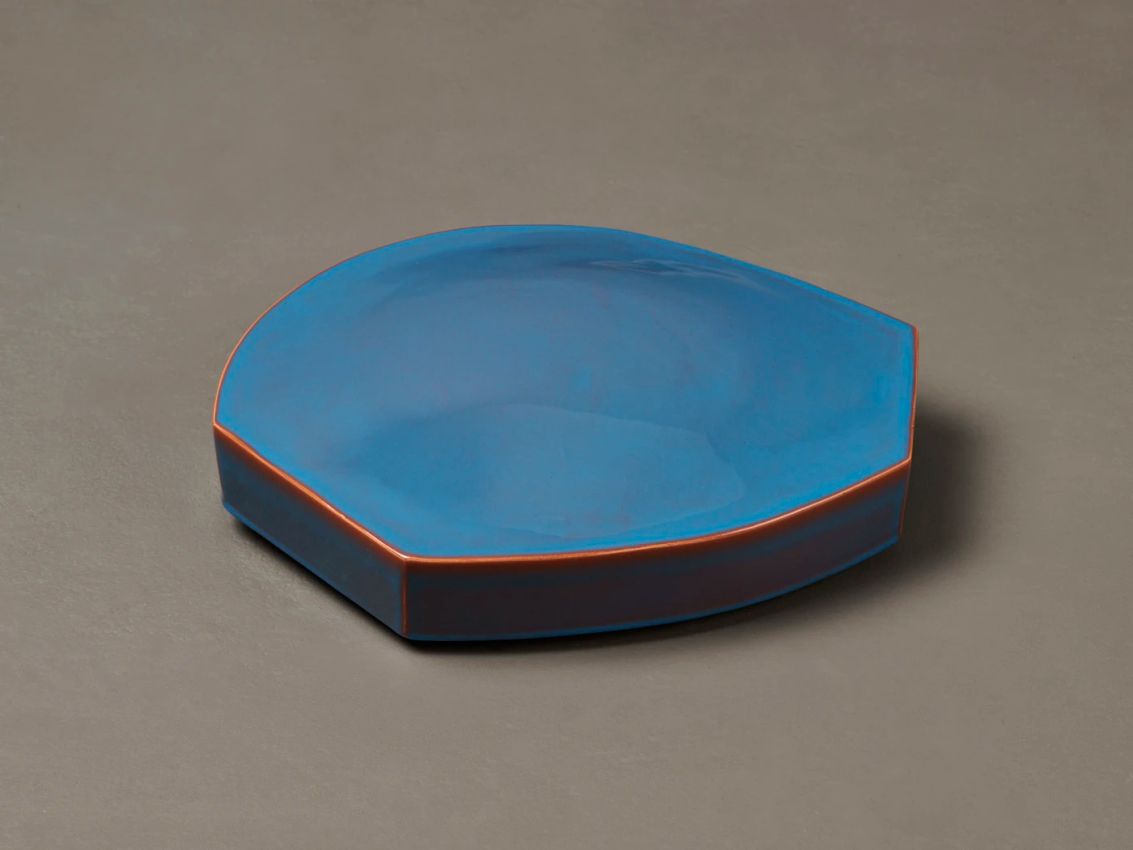
Among his most recent works are a group of small-scale ceramic sculptures, a medium Deacon hasbeen associated with for over 20 years. Marked bytheir shiny, glass-smooth finish, these works manifestthe artist’s preoccupation with surface, form andcolour. The polygonal shapes are accentuated byprominently coloured rims, some of which have beenrendered in contrasting hues. The final effect ofthe glazed surfaces is only revealed after the firingprocess, introducing an element of chance to hispractice, otherwise usually governed by control.The artist explains: ‘Colour is part of the process, but you can’t tell what the glaze will look like onceit is fired. What you see is never what you get andthat is liberating.’ Presented on low pedestals, theworks initiate a sense of uncertainty, highlighting theviewer’s position in relation to the object throughtheir reflective surface.

Glazing ceramics heightened Deacon’s interestin the treatment of other surfaces, including thepossibilities for colour in metal sculptures. A groupof painted and lacquered, stainless steel works showthe influence of a single colour, creating a unified butsimultaneously disguising effect on the monumentalsculptural form, vaguely reminiscent of freestandingfolding screens. Formerly viewed as an integralcomponent of the material, colour has become anaddition in these works, accentuating the relationshipbetween components and the whole. ‘I’d like to thinkthat the surfaces not only fit the works, but are theworks,’ says the artist.

Deacon’s large-scale but delicate wooden sculpture Under The Weather #3 constitutes a precisely engineered, intricate construction, characterised by its twisting and sensuous composition. Seeming at once fixed and fluid, the complex shape created by steamed wood components explores the physical qualities of the material, testing out the potentialforms that can be achieved through the act offabrication. One of the sculpture’s tail ends stopsshort of the ground, creating a sense of levitationor a fluid motion suddenly frozen mid-flow. Here,too, the effect of the surface is of vital importanceto the work and the holes created by screws havebeen fitted with wooden pins, achieving the effectof patterns of tiny circles that interrupt the effectof the wood’s natural grain. ‘Gradually the surfacehas become important and I have come to think thatit should be unbroken, not that I want the trace ofwork done removed, but rather that it all happenson the surface,’ says the artist. Oscillating betweenorganic and structural, the associations of rainfallor towering clouds evoked by the work’s title arelikewise echoed in the cursive forms of the sculpture.The first sculpture of the Under The Weather series,from which this work was developed, is currentlypart of the collection of the San Diego Museum ofArt.

A group of small-scale stainless steel works fromDeacon’s Tread series are distributed rhythmicallyaround the gallery space. Consisting of round,organic shapes, featuring a distinctive wave-shapedsurface, the works are characterised by both theirsoft curves and their sharp cut edges, which, togetherwith the highly polished surface, gives the works aworkable, almost malleable quality. Deacon choosestitles to complement the associative potential of hisworks. This series lends the exhibition its title, and,typical of Deacon’s enigmatic titles, Tread can beinterpreted in a number of different ways.

It brings to mind the idiom of treading lightly, meaningto proceed with caution, the action of treading ingeneral – walking or proceeding along – but alsodescribes the upper horizontal surface of a step.Often playful, deliberately ambiguous or strikinglyassociative, they are nevertheless never intended asdescriptions or explanations.

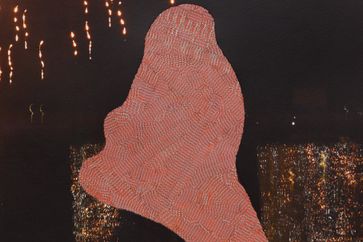
The sculptures are accompanied by a new andunprecedented series of drawings, which the artistcreates on a tablet computer. Restless when itcomes to drawing, the artist is particularly interestedin finding new ways in which the surface and themeans of making the marks interplay. In the case ofthis new series, the unforgiving surface of a tabletscreen and the artist’s bare finger were ‘an interestingcombination and sparked a development.’ Thedesigns are then applied to polyester fabric, whichlends the drawings materiality and results in hapticand unconventional wall objects. ‘They are pulledaway from the digital into the world,’ he explains.Deacon’s drawings – a constant in his practice –are autonomous from his sculptures in the sensethat they are experiments to the artist, and do notnecessarily have a direct preparatory function. Heexplains that not knowing exactly where one is goingis one of the main drivers in the act of drawing. Theartist relates these works to the idea of compressionand expansion, offering perspectival clues and ‘thesense of pushing and pulling against the idea ofspace.’

The diverse selection of sculptures in this exhibitionhighlights Deacon’s use of a variety of recurringelements in different groupings and orientations.

In the juxtaposition of multiple sizes, forms andmaterials, this exhibition highlights the range ofDeacon’s creative work and sculptural language,which is nonetheless permeated by a common bondthat constitutes the core of the artist’s œuvre.

Read More
About the Artist

Sinuous, angular, interlocking, or compact, Richard Deacon’s abstract sculptures and installations are constructed from various materials encompassing laminated wood, steel, marble, clay, foam, and leather, among others. A leading figure of British sculpture since the 1980s, Deacon was the winner of the prestigious Turner Prize in 1987.

View Artist Profile Richard Deacon contemporary artist
About the Gallery

Founded in 1983, Galerie Thaddaeus Ropac has galleries across Europe, in London, Paris and Salzburg, and an expanding team in Asia. Specialising in contemporary art and representing over 60 artists, the gallery supports and showcases the careers of some of the most influential artists today with a wide-ranging programme of over 40 exhibitions each year across its five extensive and historic gallery spaces.

View Gallery Profile
Address
Mirabellplatz 2
Salzburg
Austria
Opening Hours
Tuesday – Friday, 10am – 6pm
Saturday, 10am – 2pm
(1)
Salzburg Mirabellplatz 2
Thaddaeus Ropac
Mirabellplatz 2, Salzburg, Austria
+43 662 881 3930

Opening hours
Tuesday – Friday, 10am – 6pm
Saturday, 10am – 2pm
The art world in focus