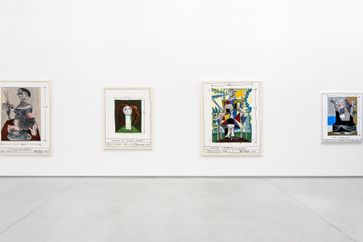
Thaddaeus Ropac Seoul presents Tom Sachs’s investigation into the Modernist painter and sculptor Pablo Picasso. The exhibition centres around a group of new sculptures, which Sachs created in a bricolage of found objects after the Spanish artist’s originals before casting them in bronze. The sculptures are accompanied by painted and drawn reimaginings of Picasso’s works in Sachs’s own distinctive pictorial language, which provoke visitors to reflect on what makes a painting.
A relentlessly innovative and subversive sculptor, Sachs is best known for his elaborate bricolage recreations of masterpieces of art, design and engineering. In the 1990s, he spent days studying Piet Mondrian’s paintings at The Museum of Modern Art, New York, using duct tape on plywood to recreate several of them. It was through these early explorations that he began to develop his methodology, and in the years since, he has continued engaging with the masters of Modernism, notably exploring the architecture of Le Corbusier for the 2010 Venice Biennale of Architecture. His works are conspicuously handmade and heighten our awareness of production techniques, in a reversal of modernisation’s trend towards cleaner, simpler and more perfect machine-made items.
In recent years, in his New York studio, Sachs has surrounded himself with the work of Pablo Picasso, whose name is, for Sachs, ‘synonymous with art’. As well as sculpting according to traditional methods, such as carving from wood or modelling in clay, Picasso spearheaded a new approach to making sculpture from diverse found materials. These assemblages resonated with Sachs’s process of reconstructing objects he desired with the materials that were available to him and intentionally revealing his process, with all its challenges and imperfections. Reinterpreting Picasso’s sculptures through a contemporary bricolage – replacing Picasso’s chicken wire and nails with car parts and a Nerf football – Sachs takes up the gauntlet of the challenge his predecessor mounted against conventional artistic practices by bringing it into a contemporary context. Though he constructs them like Picasso did, Sachs then casts his sculptures in bronze using the ancient lost wax technique before giving them each a meticulous paint or patina finish, reversing the direction of the Modernist tradition to solidify the position of each of the works on view as an art object in the classical sense.
The paintings and works on paper exhibited at Thaddaeus Ropac Seoul represent the continuation of a period of focus on painting, drawing and colour for the artist, and stem from his fascination with Picasso’s ‘War Years’, between 1937 and 1945. Exploring the lines and forms used by the Spanish painter during this period in his output, Sachs found parallels with his own practice. The thick lines that recur in Sachs’s work, originating from the influence of American graffiti and street art, mimic the solid black linework that delineates many of Picasso’s figures from that period. Sachs leaves traces of the works’ creation apparent through visible measurement lines and dimensions: where previous examples from the series recreated Picasso’s works at their original scale, in these recent examples, Sachs dramatically scales up some of the paintings, drawing attention to the process of reproduction. As the artist says: ’“Painting” is a verb. It’s an action, it’s an activity. All these paintings are about the process of making them more than the finished product.’ By encouraging visitors to engage with this process, Sachs invites them to examine their own relationship to art-historical artefacts.
The exhibition at Thaddaeus Ropac Seoul brings Sachs’s explorations of Picasso across mediums – sculpture, painting and drawing – into dialogue, but, for the artist, all the works on view are sculptures. As he explains: ‘I always think about sculpture first. And these, sure, they’re paintings, it’s paint on canvas, but really they’re built the way a sculpture is built. And I don’t really make a distinction between a painting and a sculpture or a shoe or a video [...]. It’s all sculpture to me, in that it’s built. The evidence of the making is always in the finished product.’
On the occasion of the exhibition at Thaddaeus Ropac Seoul, a fanzine will be published featuring documentation from Tom Sachs’s studio and an essay by art historian Sébastien Delot. The exhibition at Thaddaeus Ropac Seoul will run concurrently with the presentation of his Space Program: Infinity, on view at Dongdaemun Design Plaza (DDP), Seoul, from 25 April to 7 September 2025.
A relentlessly innovative and subversive sculptor, Tom Sachs is best known for his elaborate, bricolage recreations of masterpieces of engineering and design. Humble foam core and plywood replace the gleaming aluminium and polycarbonate of mass-produced items, fabricated with the combination of industrial vigour and handmade artistry that have become his trademark. The themes central to his universe focus on American culture and society, which he treats with a heavy dose of humour and irony. He playfully engages with the corporate ecosystem and the idea of ‘brand image’ by riffing on luxury consumer items and global brands, which are transformed through their inclusion in an art context.

Founded in 1983, Galerie Thaddaeus Ropac has galleries across Europe, in London, Paris and Salzburg, and an expanding team in Asia. Specialising in contemporary art and representing over 60 artists, the gallery supports and showcases the careers of some of the most influential artists today with a wide-ranging programme of over 40 exhibitions each year across its five extensive and historic gallery spaces.
A respected voice in contemporary art discourse.
Focusing on ambitious storytelling and insightful art-world commentary. Ocula Magazine publishes in-depth interviews, critical essays and timely analysis on the artists, exhibitions and ideas driving the global art world.
Learn more about Ocula Magazine
Showcasing the best of the art world.
Ocula partners with galleries from around the world to highlight their artists, artworks and exhibitions. Gallery membership is by application and invitation, with each member vetted by an independent panel.
Learn more about Ocula Membership

Specialises in the sale of major artworks.
Led by a team with deep ties to the world’s leading auction houses, galleries and collectors. Ocula’s advisory team offers bespoke services to high-net-worth clients from around the world who are looking to acquire the best of contemporary and modern art.
Learn more about our team and services