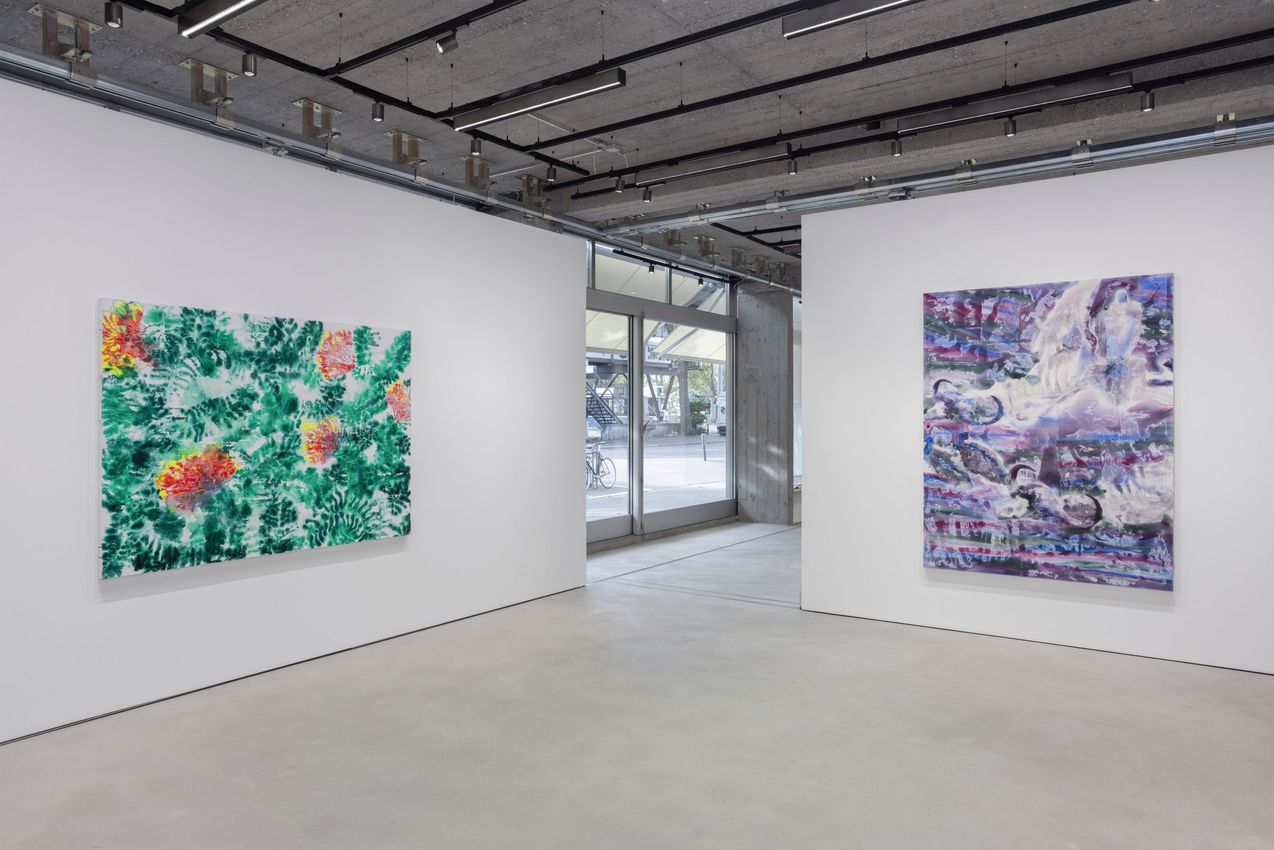
The Galerie Urs Meile is pleased to announce des chromosomes dans l’atmosphère, our third solo show of works by the artist Rebekka Steiger (*1993 in Zurich, currently working in Lucerne). It follows theexhibitions 猫头鹰–virages nocturnes at the Beijing gallery in 2018 and wild is the wind in early 2019 at thegallery in Lucerne.
The current exhibition is inseparable from the experiences Steiger had during her month-long residency at the Galerie Urs Meile in Beijing in 2018. Her study of both Mandarin and Cantonese, as wellas the impressions she gathered while in China, have had a lasting influence on Steiger’s artisticdevelopment.
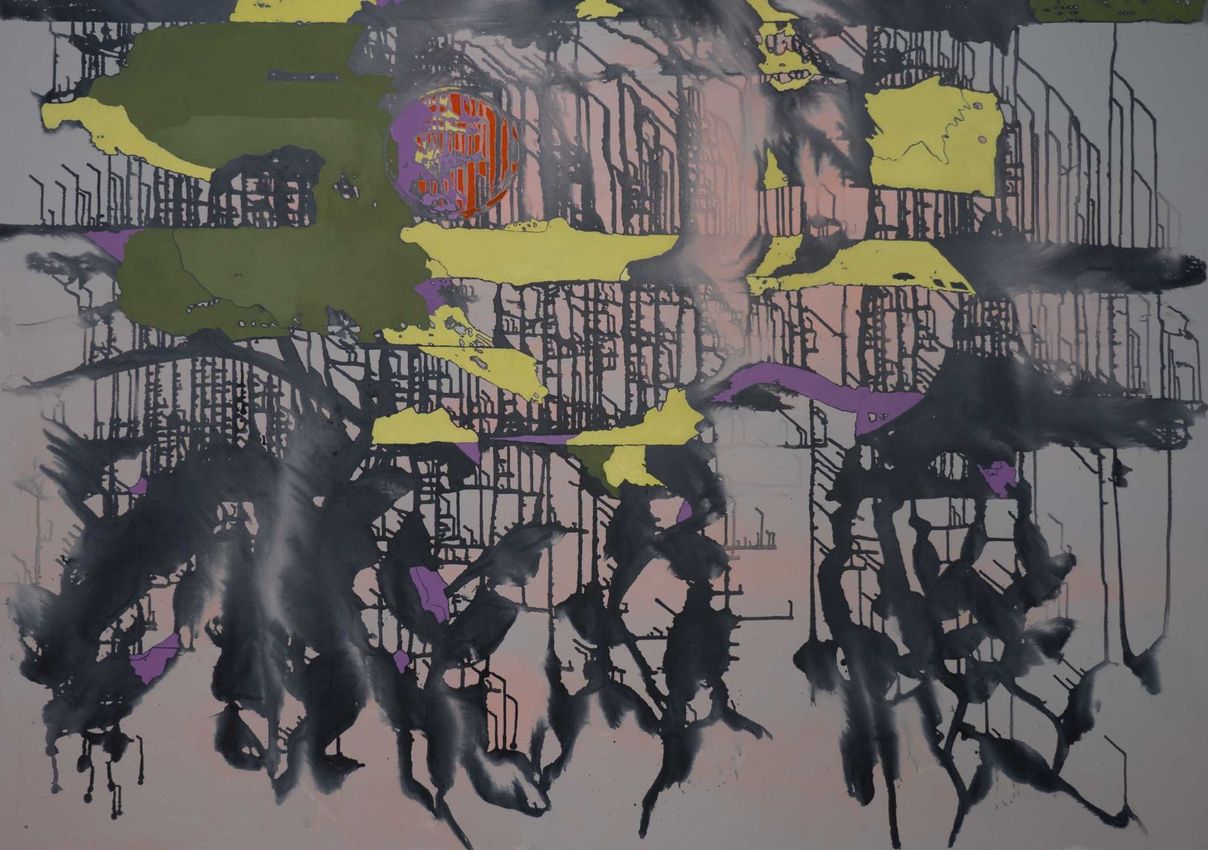
Works on display, such as 翻風 (Faanfung; 2020, tempera, ink, and oil on canvas, 170 x 240 cm) or bridge over troubled waters (2020, tempera, ink, and oil on canvas, 200 x 240 cm) are part of a new seriesthat began with the painting noise (2019, oil and gouache on canvas, 180 x 240 cm), one of the last worksshe produced in Beijing, in December 2019. While Steiger was working on a large-format painting, thecanvas only absorbed the water-soluble paint in stripes. Through this accident, the landscape (inspired bytraditional Japanese ink painting) unexpectedly and surprisingly took on abstract, rhythmic qualities.Instead of correcting the mistake, Steiger adopted this effect and continued to use the pattern in the restof her work on the painting.
Oscillating in the broadest sense between landscape and abstraction, the paintings in the current show further another one of Steiger’s series, which deals with this theme. The meeting of ink, tempera,and oil paints creates new effects based on the materials’ various characteristics, leading to a fascinatingblend of forms and colours.
Steiger’s new paintings are generally developed in two steps. Balancing on long, narrow metal slats above the canvas lying on the ground, the artist glides along the slats with a brush dipped in ink,moving it across the canvas. She adds water to the rhythmic stripes thus created, then tilts the canvas sothat the pure inks begin running together. The painter manipulates the liquid colours until the rhythm ofthe composition forms a coherent starting point for her. As soon as the colours are dry, a slow and lessintuitive process begins: the artist works her way across the surface of the painting, centimetre bycentimetre, carefully inspecting what has happened on the canvas. In the attempt to find and highlightthe most beautiful details, no matter how small, Steiger emphasises different spots, paints over others, orfills empty surfaces with oil paint. Like the painting process, the task of titling the work later is alsointuitive and associative.
Translated literally from Cantonese,翻風 (fan feng) means ‘recurring wind.’ In Hong Kong the expression is used to describe a developing typhoon. When choosing a title, the artist is concerned aboutthe dynamics of the composition as well as the landscape aspect of the painting. Like many of RebekkaSteiger’s titles, muddy waters (2020, tempera, ink, and oil on canvas, 300 x 240 cm) has several meanings.The title literally refers to the dirty water from the soaking brush that was used to paint the picture, aswell as to the painted landscape itself, which, for the artist, could be either an ocean or underwater scene.At the same time, it is a tribute to the musician whose jazz she listened to on her headphones on her wayhome, as she thought about the title for this painting.
In other paintings, such as des chromosomes dans l’atmosphère (2020, tempera, ink, oil, 240 x 200 cm), which lent its name to this exhibition, a line from one of the artist’s favourite songs functions as atitle. Upon closer inspection of this work, a recurring figure in Steiger’s oeuvre appears: the gallopingrider. Here, however, the figure seems to be dissolving, although its remaining components carry enoughbasic information to make it recognisable. Steiger creates this unusual effect by taking a photograph ofthe painting, then editing it on her mobile phone with the edit and erase functions, and finally using it asa template. Her direct adaptation of digital sketches is a surprise to Steiger herself, since up to now shewould have described herself as an ‘analogue person.’ However, using the telephone as a sketch pad or a drafting tool as an independent form of art does not interest the artist; rather, it serves to expand her repertoire of ways to discover forms for her paintings, while also making them more abstract. It remainsto be seen whether this method will become an established part of her work process in the future orevolve into a new approach that is independent of the digital world.
The poetic ambiguity of the Chinese language and the ambiguity of the translation continue to be an important source of inspiration for Steiger’s works. Depending upon how it is pronounced, onesyllable in Chinese can have different meanings. ‘The Chinese language is almost like an exegesis of mywork,’ the artist once noted.
The title 山水花 (2020, tempera, ink, and oil on canvas, 200 x 240 cm) refers to the name for traditional Chinese landscape painting: 山水画 (shanshuihua). However, the artist replaces the character画 (hua: painting) with the similar sound 花 (hua), which means ‘flower.’ Hence, translated literally, thetitle is ‘mountain water flower.’ Mountain, water, and flowers are, in turn, a description of what isdepicted in the painting.
Rebekka Steiger was born in Zurich in 1993. She studied art at the Lucerne School of Art and Design from 2013 to 2016. In 2016 she was awarded two prizes: the Exhibition Prize from the KunstgesellschaftLuzern and the Advancement Award from the zeugindesign-Stiftung. Among her most prominent soloshows are Rebekka Steiger–boxing the compass at the Kunsthaus Grenchen (2020), the Werkschau Zürich2020 at the Museum Haus Konstruktiv (Zurich), and the group show Zentral! at the KunstmuseumLuzern.
Rebekka Steiger (born 1993, Zurich, Switzerland) lives in Zurich and works in Lucerne, Switzerland and Beijing, China. In 2016 the artist completed a BA (honours) in Fine Arts, Lucerne University of Applied Sciences and Art, Lucerne, Switzerland.
Since its establishment in 1992, Galerie Urs Meile has contributed to the presentation and dissemination of contemporary art, from painting and sculpture to photography, installation and video. The gallery is working from two locations: Lucerne (Switzerland) and Beijing (China). While its center of operations is based in Switzerland, the Beijing gallery has established itself as an international meeting place for collectors, curators, artists and aficionados of the arts.

A respected voice in contemporary art discourse.
Focusing on ambitious storytelling and insightful art-world commentary. Ocula Magazine publishes in-depth interviews, critical essays and timely analysis on the artists, exhibitions and ideas driving the global art world.
Learn more about Ocula Magazine
Showcasing the best of the art world.
Ocula partners with galleries from around the world to highlight their artists, artworks and exhibitions. Gallery membership is by application and invitation, with each member vetted by an independent panel.
Learn more about Ocula Membership

Specialises in the sale of major artworks.
Led by a team with deep ties to the world’s leading auction houses, galleries and collectors. Ocula’s advisory team offers bespoke services to high-net-worth clients from around the world who are looking to acquire the best of contemporary and modern art.
Learn more about our team and services