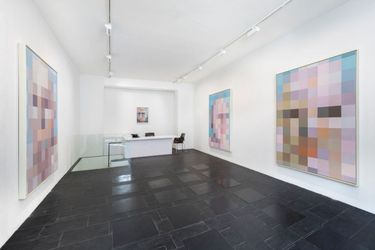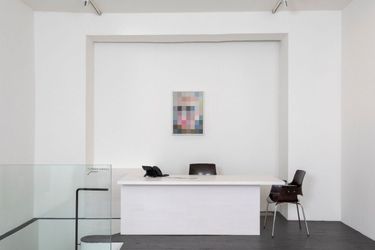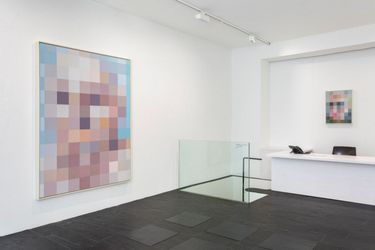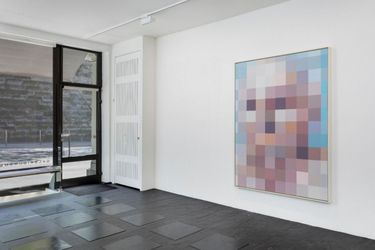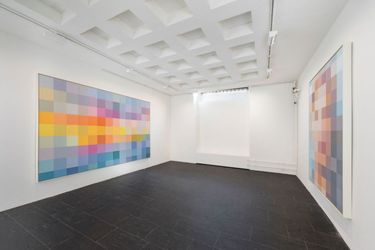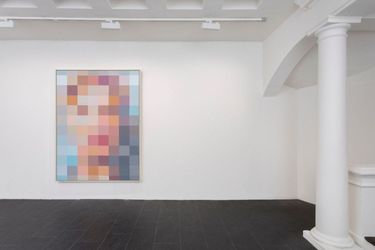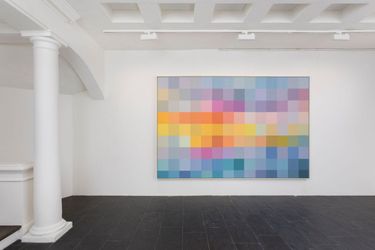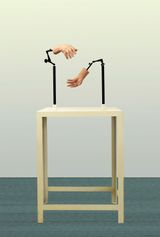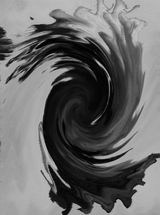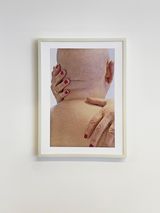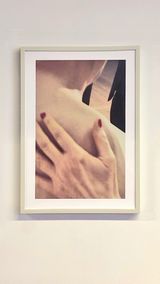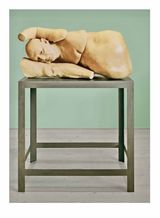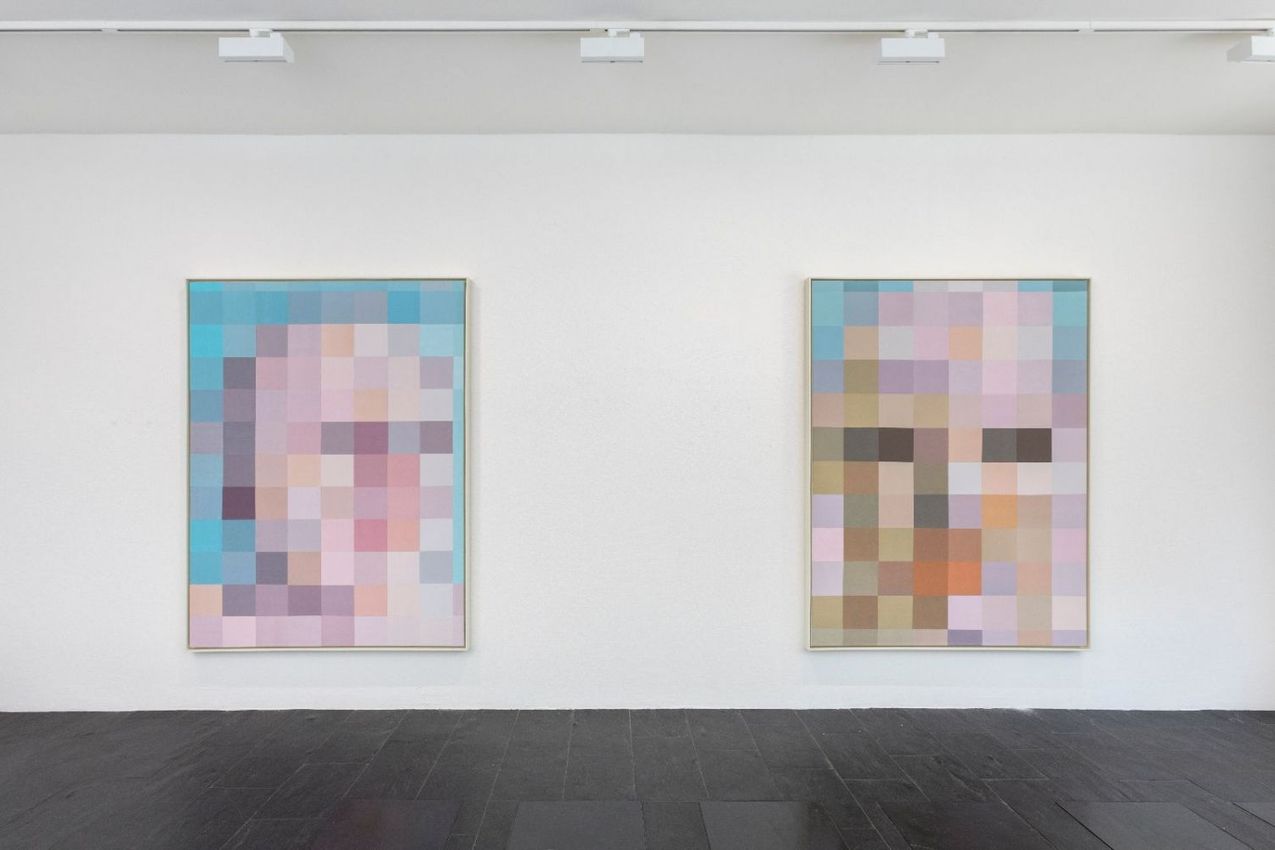
With his solo exhibition LONTANO IL REALE TEMPO UMANO (Hommage to Pier Paolo Pasolini) at Galerie Urs Meile Zurich, Swiss artist Urs Lüthi (born 1947, Kriens) once again invites you to make yourself comfortable in an uncomfortable world. The constant reference to his person and biography is characteristic of his work—his self-portraits create an almost classicist and hyperrealistic aura. The dialectical play of form and content invites the viewer to a distanced, emotional and, at the same time, intellectual experience crucial to his work. Also the case with the works presented in the exhibition including the current self-portrait series, “LONTANO IL REALE TEMPO UMANO”, which is his latest work on the subject of self-portrait forms.
Precise squares painted on canvas line up geometrically in delicate, pale colours and fit together in a harmonious composition like the pixels of a subsequently censored photo. On the one hand, the work presents itself as an abstract, constructivist painting, but on the other hand—seen from a distance—a figurative, naturalistic portrait can be seen. This ambivalence forms one of the basic components of Lüthi’s work.
Through the conscious decision to implement this series of works in the medium of painting, the artist gives the works a personal component and although he consciously breaks down the motif into its pixels, they still bear his characteristic signature. Upon close inspection, subtle imperfections can be identified on the painted surface to indicate human imperfection. These paintings subtly reflect human nature, rather than presenting a perfected image, as would be possible through photography and on the basis of which the works were created. Just like classic portrait painting, the works are created using time-consuming craftsmanship and attempt to capture the essence of their counterparts. The paintings are self-portraits, only they are now so alienated—at first glance they could be anyone—and so raise the question: What actually makes us unique when we disappear in such a radical way?
With the resolution of the motif, the series follows Lüthi’s last work series Selfportrait (TRANSMISSION ERROR) from 2022, in which the artist has already photographed his self-portrait led to another level through targeted and tactical digital processing to create complete anonymisation. In the self-portrait “LONTANO IL REALE TEMPO UMANO”, however, the artist initiates an unprecedented interplay between recognition and non-recognition by consciously juggling with the autofocus of the human eye. As with many of Lüthi’s works, he addresses deep, human emotions here, and not just through the chosen colours of the squares or the technical execution of the painting, which are reminiscent of human skin in their colours and texture. Also the search for the answer to the question: What do I perceive? triggers a possible emotional reaction in the viewer and a subtle irritation is definitely intended.
The works SUNSET 1-3 “LONTANO IL REALE TEMPO UMANO” (2023) differ from their predecessors in their colour and supposed motif, but not in their implementation and message. The artist chooses the warm colours of various sunset scenarios to immerse the viewer in his world. For him, they are just as much a part of his self-portrait series as the other works in the Lontano series. This is also about the ambivalence of disappearing, of fitting in, of becoming one with the bigger picture and the resulting emotions such as safety and security. In this way, Lüthi manages to create a conceptual sentimentality and to tell his story again and again from different perspectives.
The subtitle of the series of works shown, which also forms the title of the exhibition—“LONTANO IL REALE TEMPO UMANO”—refers to a line of the poem Le ceneri di Gramsci (1954) by the Italian poet and film director Pier Paolo Pasolini (1922-1975) and translated, this means “a real human time is far away”. Pasolini, who for Lüthi represents a kind of father figure of his youth and is known, among other things, as the author of profound works, inspires him here not for the first time: in 1987 he created a large work based on the same Pasolini quote (From the series of swapped dreams, 1987). In _Le ceneri di Gramsci, _Pasolini presents a bleak view of life in urban outskirts, where, despite suffering and desolation, moments of joy and happiness can still be found. While working on the current series of works, this particular line kept coming to mind and it seems to him to be enormously visionary in its scope.
Playing with art historical references is also intentional. At first glance, the paintings are reminiscent of the Zurich Concretes around Max Bill, but at second glance they appear to be figurative. Urs Lüthi intends to reveal how different and yet the same we humans are, in keeping with his belief that “there is no one truth”.
Urs Lüthi was born in Kriens, Switzerland, in 1947. He lives and works in Munich, Germany. His works are represented in numerous public and private collections, such as the collection of the Kunstmuseum Luzern, Lucerne, Switzerland; Bern Art Museum, Switzerland; mamco, Geneva, Switzerland; Kunsthaus Aarau, Switzerland; Kunsthaus Zurich, Switzerland; Kunsthaus Glarus, Switzerland; Chur Museum, Switzerland; Musée Rath Genève, Geneva, Switzerland; Museum Winterthur, Switzerland; Museum Stuttgart, Germany; Hamburg Art Museum, Germany; Falkenberg Collection, Hamburg, Germany; Museum Kassel, Kassel Germany; Center Pompidou, Paris, France; moma New York, USA; moma San Francisco, USA; Fondazione Brodbeck, Catania, Italy; Arte Moderna Roma Museum, Rome, Italy;Museum Dell’ Novencento, Milan, Italy and many others.


Urs Lüthi, who holds major international acclaim, is known for his uncanny self-staging photographs and sculptures. He has a rigorous art practice in which he assembles a unique visual language that cannot be categorized by any isms. His artistic practice appears uncompromising and incompliant, including sculptures, photography, body art and happenings, which all in their eclectic manner intend to irritate and fool the viewer. Since his mid-20s, at the end of the 60s, the artist began photographing himself and decided to turn his own person into the protagonist of his creations because all perceptions are bound to subjective experiences. Thus, he not only remains faithful to his investigations on identity, the physical body, emotions, longings, and illusions but also explores the social and ontological side of being in the world.


A respected voice in contemporary art discourse.
Focusing on ambitious storytelling and insightful art-world commentary. Ocula Magazine publishes in-depth interviews, critical essays and timely analysis on the artists, exhibitions and ideas driving the global art world.
Learn more about Ocula Magazine
Showcasing the best of the art world.
Ocula partners with galleries from around the world to highlight their artists, artworks and exhibitions. Gallery membership is by application and invitation, with each member vetted by an independent panel.
Learn more about Ocula Membership

Specialises in the sale of major artworks.
Led by a team with deep ties to the world’s leading auction houses, galleries and collectors. Ocula’s advisory team offers bespoke services to high-net-worth clients from around the world who are looking to acquire the best of contemporary and modern art.
Learn more about our team and services