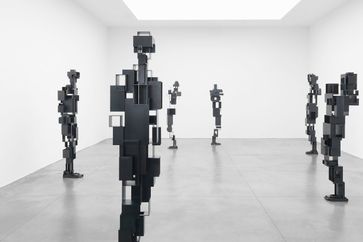
Galleria Continua is pleased to present Body Buildings, Antony Gormley’s third solo exhibition at the 798 Art District in Beijing following ‘Another Singularity’ (2009) and ‘Host’ (2016). ‘Body Buildings’ interrogates our species’ relationship to the built environment, an increasingly high-rise world we rarely escape. In a significant group of recent sculptures and drawings, Gormley uses clay and iron, two ubiquitous materials of the built world, ‘to think and feel the body in this condition’.
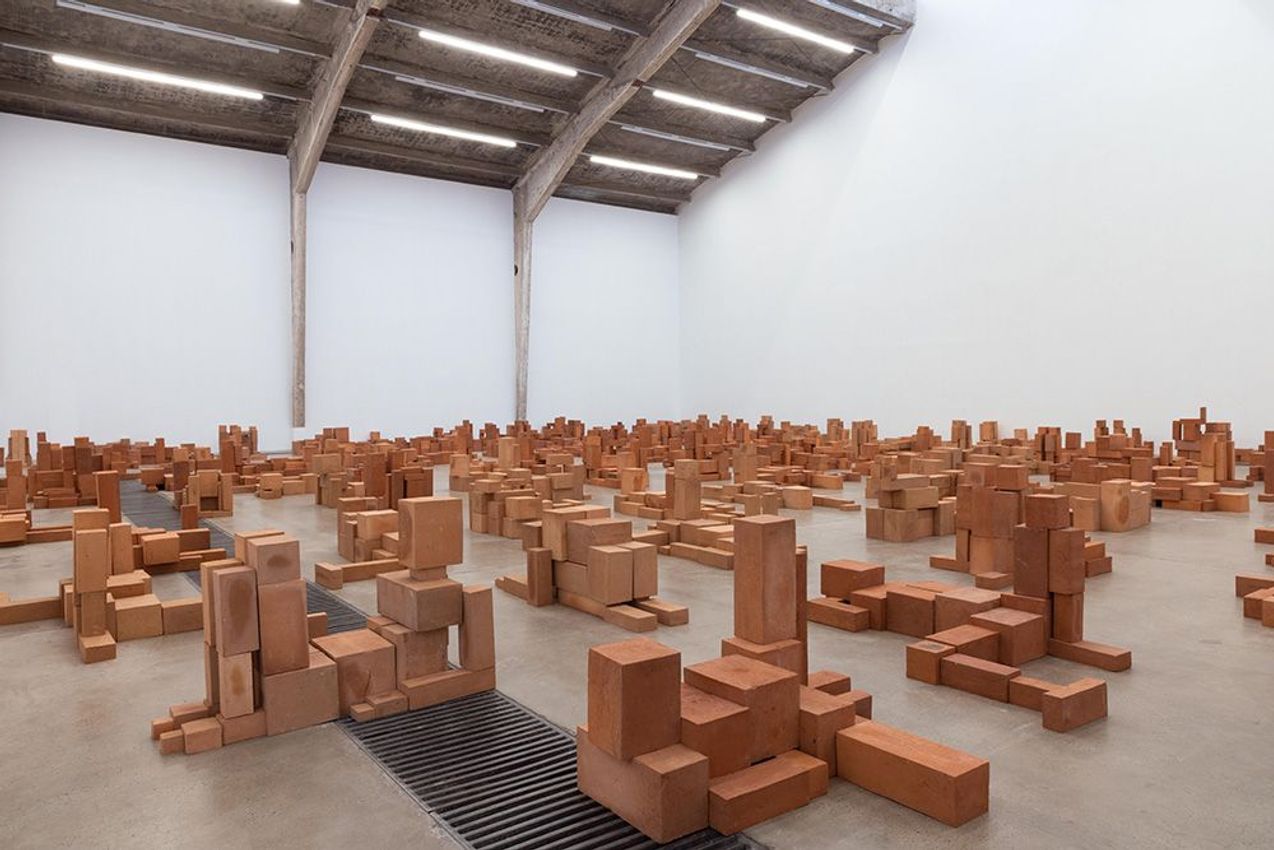
The central work in the exhibition, Resting Place II, conjures a dense labyrinthine terrain that viewers are invited to enter and navigate. This field of 132 life-size bodies, each built from fired clay bricks stacked atop one another, investigates the body at rest as our primary dwelling place. For the artist, the brick is a ‘physical pixel’ that plays an important role in Chinese culture.
Constructed in different orthogonal yet precarious positions, the bodies evoke a range of conditions, from splayed relaxation to foetal self-protection. When viewed from the gallery’s first and second-floor balconies, the interplay between moving visitors and horizontal clay bodies creates a dynamic field in which the particularity of subjective experience is at work.
As Gormley has said: ’Resting Place II evokes the human body’s relationship to the ground, the surface of the earth. It refers to two very different kinds of abandonment: the relaxed abandonment of the body on the beach, the place to which we return in childhood play and relaxation, and another, that of the migrant who has either forcibly or freely sought a new home. What at first looks like a chaotic display of building materials might resolve into the model of a city and further resolve into the invitation to empathise with the body as a place of indwelling, some evoking states of deep relaxation and contentment, others of retreat and defence.’
Accompanying Resting Place II are sculptures cast in iron, such as Circuit and Ally, which explore parallels between urban infrastructure— roads, electrical circuits, plumbing—and human relationships. Circuit transforms these networks into a circulatory system shared by two bodies, while Ally uses stacks of massive cast iron blocks to test how two bodies can find mutual stability through a shared centre of gravity. These explorations of proximity and intimacy ask to what extent the urban environment shapes and mirrors human connections.
On either side of Circuit are Short and Shame, two works that treat the body as an independent energy field in which the body veers from its centre of gravity, purposefully avoiding the stability associated with statues of power. In a series of tight knots, Shame identifies places of tension within the body— ankles, knees, pelvis, head and hands— while Short escapes the bounding condition of the skin as the iron lines move from inside the body to beyond its apparent surface.
On the gallery’s top floor, Rule III and Buttress transform body space into latticed scaffolding, familiar to us in the skeletons ofcontemporary high-rise architecture. In doing so, the works materialise the way that having made a world, it now makes us. The two rusting bodies are placed directly against the walls, implicating the architectural context and making visitors aware of their relationship to the built environment.
The sculptures are accompanied by a series of drawings. Singularity X and Event VII evoke the luminous beginnings of astral matter. They are complemented by a series of layered ‘Lux’ drawings that refer to apertures or sources of light glimpsed from within interiors. Other drawings made using inkcap mushroom ink as well as carbon and casein examine darkness as experienced inside the body and in proximity to another.
Body Buildings is an interrogation of the state of our species. Gormley offers these sculptures as diagnostic tools to examine our present condition.
Antony Gormley is a renowned British artist. At the centre of his sculptural practice lies a concern with the subjective space of the human body and its relationship with the objective space of the collective environment that surrounds it.

It was in the year 1990 that three friends, Lorenzo Fiaschi, Mario Cristiani and Maurizio Rigillo, decided to open a gallery in a quite unexpected location, far from the big cities and smoothly running art circuits – in San Gimignano, a town steeped in history and somehow out of time, in the heart of Tuscany. Over these 25 years of activity, generosity and altruism have formed the basis for numerous and multifaceted artistic collaborations.

A respected voice in contemporary art discourse.
Focusing on ambitious storytelling and insightful art-world commentary. Ocula Magazine publishes in-depth interviews, critical essays and timely analysis on the artists, exhibitions and ideas driving the global art world.
Learn more about Ocula Magazine
Showcasing the best of the art world.
Ocula partners with galleries from around the world to highlight their artists, artworks and exhibitions. Gallery membership is by application and invitation, with each member vetted by an independent panel.
Learn more about Ocula Membership

Specialises in the sale of major artworks.
Led by a team with deep ties to the world’s leading auction houses, galleries and collectors. Ocula’s advisory team offers bespoke services to high-net-worth clients from around the world who are looking to acquire the best of contemporary and modern art.
Learn more about our team and services