



Press Release
Gallery Baton is pleased to present the solo exhibition of Kim Sang Gyun (b.1967) from 11th December to 20th January 2016.

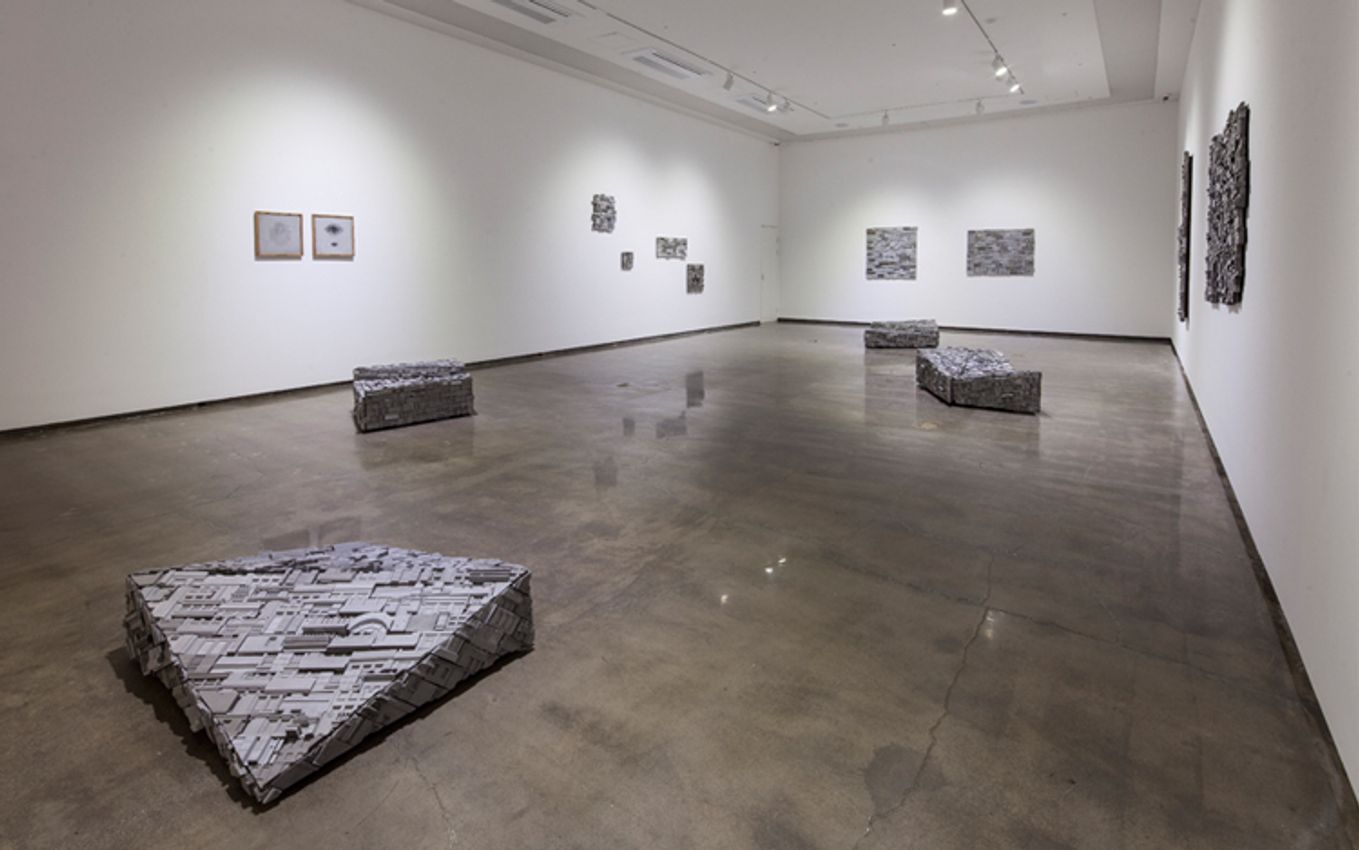
This solo show will reveal new sculptures and installations based upon external features of colonial architecture appeared in Gyeongseong (京城) during the Japanese occupation period, Seoul at present. Major government offices and commercial buildings of Neoclassicism style constructed by colonial rulers at city centres one after another not only had functional values and also played a visual role of propaganda monuments implying that Japanese imperialism with an advanced Western culture has led a separation from the old era. Such as Bank of Joseon supported by Ionic columns, Hwasin department emphasizing on the beauty of moderation and a sense of volume created by steel- concrete and stone and old Joseon hotel, these buildings made a stark contrast to Joseon Dynasty’s architecture represented by a tiled roof and timber and unintentionally operated as a social sign standing for the advent of a new epoch.

Kim pays attention to that photographic materials and actual colonial buildings rarely existing in old city centres evoke and represent painful recollections and traces of the totalitarian power’s invasion and exploitation that swept through East Asia including Korea in the beginning of 20th century. The artist initiates the work by sketching facades of the target buildings which are characterised as a decorative composition and design. On the basis of the sketches, he makes up the polystyrene moulds and pours grout into them. A piece is extracted throughout the casting process and the final work is completed by assembling the pieces. Due to the various forms of the facades, the outcome assumes the shape of cement relief in which high relief and low relief coexist.

The artist intends to explain how people recognise the past and systemise it through his working process in which a single sculpture is created by artificially arranging the pieces derived from outward appearances of diverse buildings. The visual mode of his artworks has a methodological similarity to the human cognition system; people memorise fragments of images randomly absorbed from various media as blurred shapes, instead of accurately ideating a specific era by projecting each individual clear imagery onto a mental picture in serial order.

While Gordon Matta-Clark(1943 - 1978, American), a pioneer in the field of contemporary art using architecture as a medium, tried to deconstruct the authority of city spaces and buildings in a perspective of Situationism by acts of “Building Cuts”, Kim’s works attempt to awaken people of the present-day to the appearance of the buildings that have disappeared by expansion of cities, industrialisation, and a loss of relative values. However his distinct strategy, “Magnification–Arrangement: adopting certain parts of facades and vertically and horizontally arraying them in a random way”, shares Gordon’s philosophy since it dismantles the identity of the buildings and disobeys the authority of them rather than provoking nostalgia of the privileges which the buildings possessed at that time. In addition, employing concrete underlines the fact that buildings existing in current places are also artificial products inherently destined to have the same consequence with the buildings of the past.

Kim Sang Gyun completed BA and MA in Sculpture at Seoul University and also MFA at The State University of New York. He has actively kept presenting his works at main museums and galleries such as National Museum of Modern and Contemporary Art, Seoul Museum of Art, SungKok Museum and Ilmin Museum of Art.

Installation Views

About the Artist

Kim Sang Gyun focuses on architectures which were built in the colonial style during Japanese occupation and now stand as historic sites that evoke of the past in the heart of an ultra-modern city. He presents the works that compellingly integrate the spirit of the times, the hegemony of power, and detailed form of expression in the buildings with his own artistic methodology In his works, Kim appropriated façades of colonial buildings and created concrete panels reduced in size to a precise scale, which were then divided into countless pieces and put back together again, creating flat and sculptural works combining high relief and low relief. Such works attempted to deconstruct the temporary past identity given to the buildings that were forcefully constructed by the other, and to deny the authority endowed upon them. Along with such external feature, the use of concrete as the main material of the work is evocative of Brutalism, an architectural style that emerged in Britain in the modern era. Kim’s work reflects such architectural style in its non-formality, coarse formation, rejection of balance and aestheticism, and deliberate exposure of the inner material. Considering the fact that Brutalism began in opposition to modernism architecture that ruled the times of imperialism, it’s interesting to note that the artist explores the building that were born through the modernism style which was the architectural basis of imperialism, not only as an external source of chaos (through unnatural arrangement of concrete pieces), but as a way of discussing the form of trend and normative characteristics that came about in order to overcome it.

View Artist Profile Kim Sang Gyun contemporary artist
About the Gallery

Since its founding in 2011, Gallery Baton has gained international recognition as a leading contemporary art gallery in Korea. Distinguishing itself with a dynamic and refined program, Baton consistently strives for an in-depth understanding of current paradigms within the complex and ever-changing landscape of contemporary art.

View Gallery Profile
Address
116, Dokseodang-ro
Yongsan-gu
Seoul
South Korea
Opening Hours
Tuesday – Saturday
10am – 6pm
(1)
Seoul 116, Dokseodang-ro, Yongsan-gu
Gallery Baton
116, Dokseodang-ro, Yongsan-gu, Seoul, South Korea

Opening hours
Tuesday – Saturday
10am – 6pm
The art world in focus
