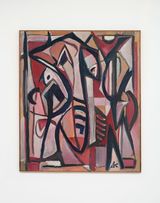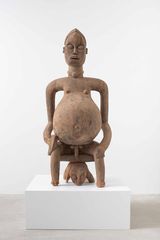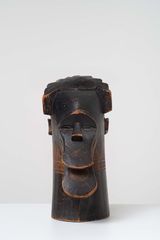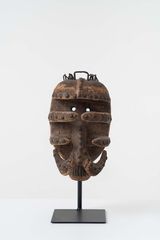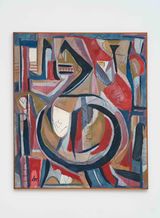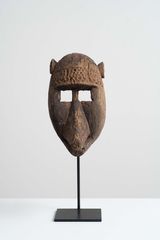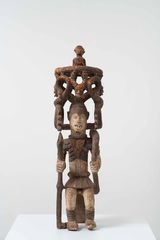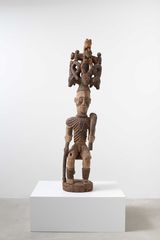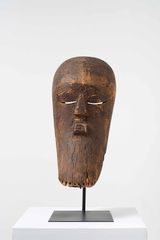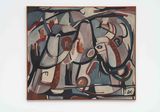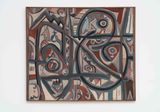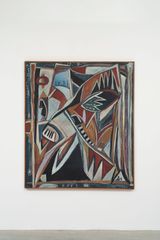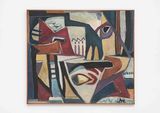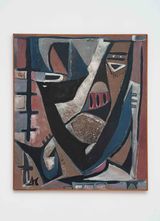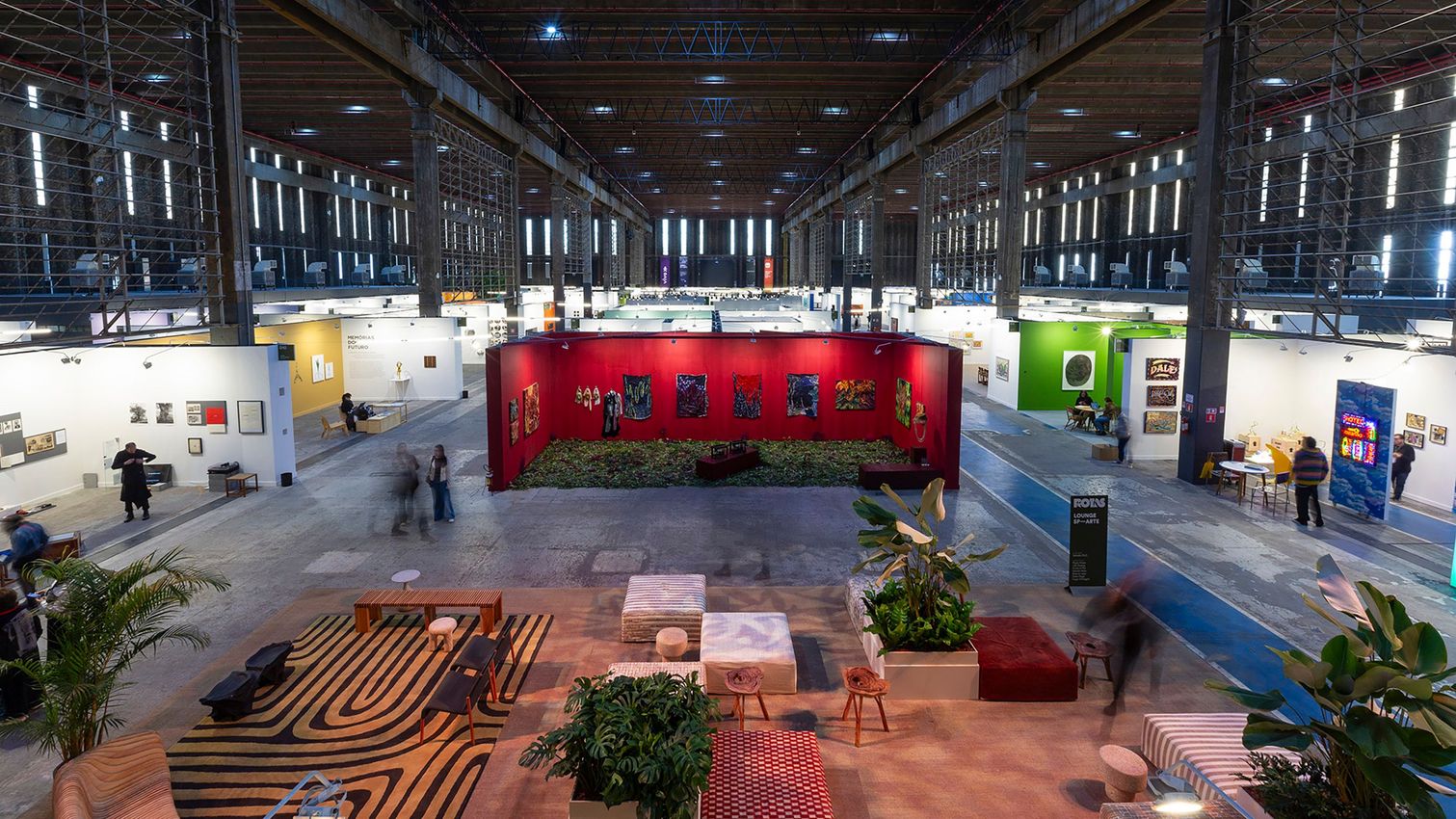
For the 2026 edition of SP-Arte Rotas, Gomide&Co presents a project organised around two distinct nuclei. The first brings together a group of paintings by Nicolai Dragos (1931–2020), a Romanian artist who settled in Brazil and whose production, although recognised by important institutions and interlocutors throughout his career, still occupies a position at the margins of the canon within Brazilian art historiography. The second presents sculptures and masks produced by peoples from different regions of West Africa, Central Africa, and the Great Lakes region during the first half of the 20th century, assembled over decades in an international collection.
The intention is not to bring these two groups together through formal affinities or a narrative of influence. On the contrary, the proposal is to preserve the specificity of each, recognising their own historical and cultural contexts and offering visitors the possibility of observing them within the same space, without reducing their differences.
The trajectory of Nicolai Dragos intersects with some of the major political and cultural events of the 20th century. Born in 1931 in Cetatea Albă, then part of Soviet Bessarabia, he moved as a child to Bucharest, where he began his artistic training after abandoning his piano studies due to a hand injury. He attended the studio of Rudolf Schweitzer-Cumpana and established contact with Corneliu Baba, two of the central figures of Romanian painting at the time. Alongside his artistic education, he graduated in medicine, a profession he pursued throughout his life and which coexisted, in a singular way, with his work as a painter.
A decisive moment in his formation occurred in 1952, during a study trip to Brussels. There, he encountered firsthand the propositions of the CoBrA group, whose final exhibition had taken place shortly before in Liège. For Dragos, this contact meant less an adherence to a specific movement than the discovery of a new possibility for painting. As Laymert Garcia writes, “the experience of CoBrA represented for the artist a “brutal experience,” revealing “an opportunity, previously unsuspected, to break all constraints, a total freedom in the search for a wild painting, without rules, without law.”1 The valorisation of experimentation, spontaneity, and the singularity of gesture would become permanent elements of his practice.
Over the following decades, Dragos developed a consistent international career, exhibiting in cities such as Paris, Brussels, Düsseldorf, Cologne, Istanbul, and Warsaw before emigrating to Brazil in 1976, during the tightening of Nicolae Ceaușescu’s regime. Established in São Paulo, he combined an intense career as a pathologist with a continuous artistic production, although often distant from the commercial circuit. His work entered the collections of institutions such as the Pinacoteca de São Paulo, the Museu de Arte Moderna de São Paulo – MAM-SP, the Museu de Arte Brasileira of Fundação Armando Álvares Penteado, the Museu de Arte de Brasília, and several other Brazilian museums, demonstrating institutional recognition of an oeuvre whose critical circulation remains under development.
It is precisely the internal logic of this painting that constitutes the focus of Laymert Garcia’s reading of the artist. Rather than understanding Dragos’s canvases through the representation of a subject or motif, the author identifies in them a continuous effort to make visible the very process through which the image comes into being. According to Garcia, “the object of painting is not external to it, it is its immanence”; it consists of painting “the creative act, that is, the generation of its matrix.” What interests the artist is not the finished figure, but the instant in which it begins to emerge from the indeterminate.
This understanding is reinforced by a statement from Dragos himself, quoted by Garcia, in which he affirms that “the epigenetic concept of evolution from the amorphous and undefined toward the structured and particular was my creative path.” The reference to epigenesis is not merely metaphorical. As both physician and artist, Dragos deliberately connected the formation of living organisms and the emergence of painting, understanding both as processes of progressive differentiation. In another statement, also cited by Garcia, he observes: “The artist discovers colours and forms in the same way that the scientist discovers the laws and sciences of nature.” His painting thus becomes a field of investigation in which gesture, matter, colour, and time jointly participate in the emergence of the image.
This operation also redefines the physical relationship between the artist and painting. In keeping with practices developed by certain strands of postwar painting, Dragos abandoned the easel and frequently worked with the canvas placed directly on the floor. Garcia relates this procedure to Gilles Deleuze’s reading of Jackson Pollock, for whom this shift corresponds to a passage “from the optical horizon to a ground of the foot”–,2 transforming painting into a field of bodily action. In Dragos’s canvases, the surface ceases to function as a window and becomes instead a space of confrontation between matter, gesture, and colour. The forms often remain in a state of emergence: presences that are suggested without ever becoming fully stabilised as figures.
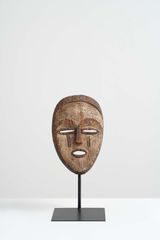
The second nucleus presented by Gomide&Co brings together sculptures and masks produced by different African peoples, including the Dogon, Bamileke, Bamum, Hemba, Songye, Bété, Bembe, Tsogo, and Vili/ Vuvi. Its presentation requires recognising, above all, that there is no homogeneous category called “African art.” The works gathered here belong to distinct societies, located in different regions of the African continent, produced within specific historical, religious, and political contexts, and connected to equally diverse functions.
The complexity of relations between different cultural matrices also marked the trajectory of modern artists who sought to articulate diverse repertoires without reducing them to a single origin. A significant example is Wifredo Lam (1902–1982), whose work combined his training in European modernism with Afro-Caribbean references and elements from Yoruba- based spiritual traditions. His production demonstrates how different cultural histories can coexist within a single artistic language while preserving the specificity of their contexts of origin.
Originating primarily from West Africa, Central Africa, and the Great Lakes region, these peoples developed sculptural traditions deeply connected to their own social structures, systems of belief, and communal practices. Among the Dogon people, established in the Bandiagara cliffs in present-day Mali, sculptures and masks are associated with complex cosmological systems, funerary ceremonies, and narratives concerning the origins of the world and humanity. Masks, particularly those used in Dama cycle ceremonies, bring together dance, performance, and the transmission of collective knowledge.
Among the Bamileke and Bamum peoples, located in present-day Cameroon, sculptural production was historically connected to the political structures of the kingdoms of the Grassfields region. Masks and wooden figures often express relations of power, ancestry, and belonging, being associated with royal courts, secret societies, and rituals affirming the authority of traditional rulers. In the case of the Bamum, one should also highlight an artistic tradition marked by the production of objects linked to the court of Foumban, where sculptors developed forms of great technical and symbolic elaboration.
Among the Hemba people, established mainly in the southeast of present-day Democratic Republic of the Congo, sculpture was strongly associated with the representation of ancestors. Anthropomorphic wooden figures, often characterised by serene faces, idealised features, and particular attention to the representation of dignity and spiritual presence, participated in practices related to lineage memory and continuity between generations.
The Songye, also from the Democratic Republic of the Congo, developed one of the most recognised sculptural traditions of Central Africa. Their power figures, known as mankishi (singular nkishi), were conceived as objects endowed with spiritual force, whose efficacy depended both on the carved form and on materials subsequently added by ritual specialists. Nails, metallic elements, medicinal substances, and other components could be incorporated into these sculptures, emphasising that their meaning was not limited to visual appearance but involved processes of activation and relationships with invisible forces.
The sculptures of the Bembe people, located in the eastern region of present-day Democratic Republic of the Congo, also present a close relationship with ancestry and collective memory. Their figures, often associated with the representation of ancestors, participated in practices dedicated to protection, the transmission of knowledge, and the maintenance of relationships between the living and those who came before them.
Among the Bété, from present-day Côte d’Ivoire, masks display distinctive formal characteristics, with expressive volumes, pronounced contrasts, and an intense visual presence. Primarily associated with ceremonies and communal performances, these masks were not conceived as isolated objects, but rather as elements within ritual systems in which movement, music, dance, and collective participation were fundamental.
The Tsogo and Vili/Vuvi peoples, located in Gabon and neighbouring regions of Central Africa, developed sculptural traditions connected to initiation practices, religious societies, and systems of knowledge transmission. Among the Tsogo, sculptures and masks were often related to the Bwiti tradition, a spiritual practice that brings together ancestry, cosmology, and rites of passage. Among the Vili and Vuvi, carved figures and ritual objects participated in relationships with ancestors and in different forms of mediation between the visible and invisible worlds.
The diversity of these groups demonstrates that these works cannot be understood through a single aesthetic category or through a general notion of “African art.” Each object belongs to a specific history, connected to particular communities, territories, and distinct ways of understanding the relationship between body, society, nature, and spirituality.
It is also essential to recognise that the international circulation of these objects is deeply connected to histories of colonialism, ethnographic collecting, the art market, and the formation of Western collections. As Emanoel Araújo observes, the history of these works’ reception in Europe was marked by violent displacements and successive processes of redefinition of their meanings.3 In recalling the incorporation of objects from the former Kingdom of Dahomey and Benin into European museums, the author draws attention to the many “setbacks surrounding the art of the many countries of Africa.” At the same time, he recalls Abdou Sylla’s observation that, for many African societies, “art, in particular, makes it possible to bridge the gap that separates the real (...) from the unreal (...),” indicating that these productions cannot be reduced to exclusively formal or aesthetic categories.
It is within this framework that this group of works is presented: not as an illustration of a supposed origin of Western modernity, nor as a uniform repertoire of forms, but as a constellation of objects whose meanings remain inseparable from the histories, cosmologies, and practices of the communities that produced them.
The coexistence of these two nuclei does not seek to establish equivalences or to explain one through the other. Rather, it proposes a situation of observation in which different ways of producing images, objects, and presences share the same space while preserving their singularities. If Nicolai Dragos’s painting continuously investigates the emergence of form, the sculptures and masks gathered in this project refer to systems of thought, ritual uses, and specific traditions that exceed any exclusively aesthetic reading.
The project presented by Gomide&Co at SP- Arte Rotas 2026 thus becomes a space for the exercise of attention to difference, recognising that distinct histories of art can coexist without being subjected to a single narrative.
1 All quotations from Laymert Garcia included in this text are taken from the essay written by the author on the occasion of the exhibition of Nicolai Dragos and Seyni Awa Camara, held at Gomide&Co in the winter of 2024.
2 Gilles Deleuze, Sur la peinture: Cours mars-juin 1981, ed. David Lapoujade (Paris: Les Éditions de Minuit, 2023).
3 Araujo, Emanoel. “Uma coleção de arte africana.” In Fetiches: diário de uma coleção de arte tribal, by Christian-Jack Heymès, 165–166. São Paulo: Edição do Autor, 2019.
A respected voice in contemporary art discourse.
Focusing on ambitious storytelling and insightful art-world commentary. Ocula Magazine publishes in-depth interviews, critical essays and timely analysis on the artists, exhibitions and ideas driving the global art world.
Learn more about Ocula Magazine
Showcasing the best of the art world.
Ocula partners with galleries from around the world to highlight their artists, artworks and exhibitions. Gallery membership is by application and invitation, with each member vetted by an independent panel.
Learn more about Ocula Membership

Specialises in the sale of major artworks.
Led by a team with deep ties to the world’s leading auction houses, galleries and collectors. Ocula’s advisory team offers bespoke services to high-net-worth clients from around the world who are looking to acquire the best of contemporary and modern art.
Learn more about our team and services