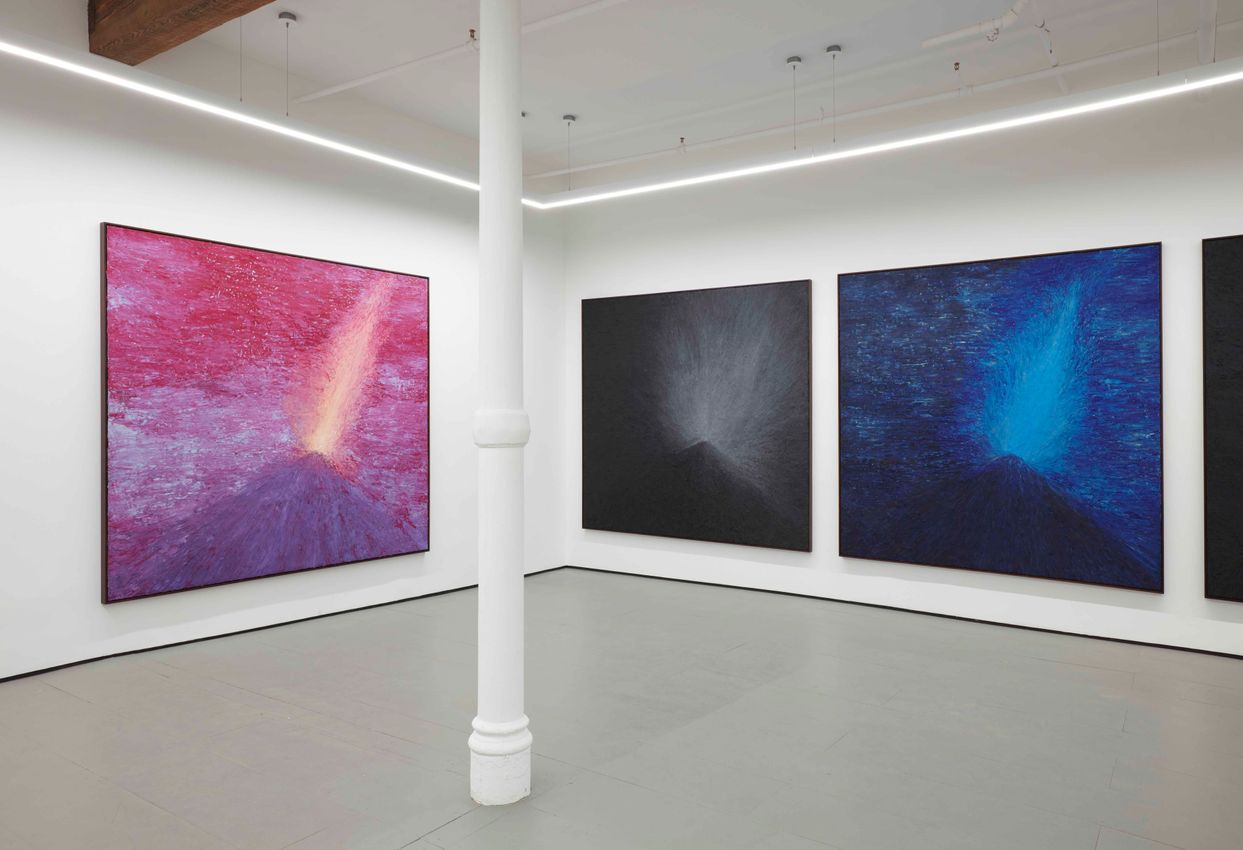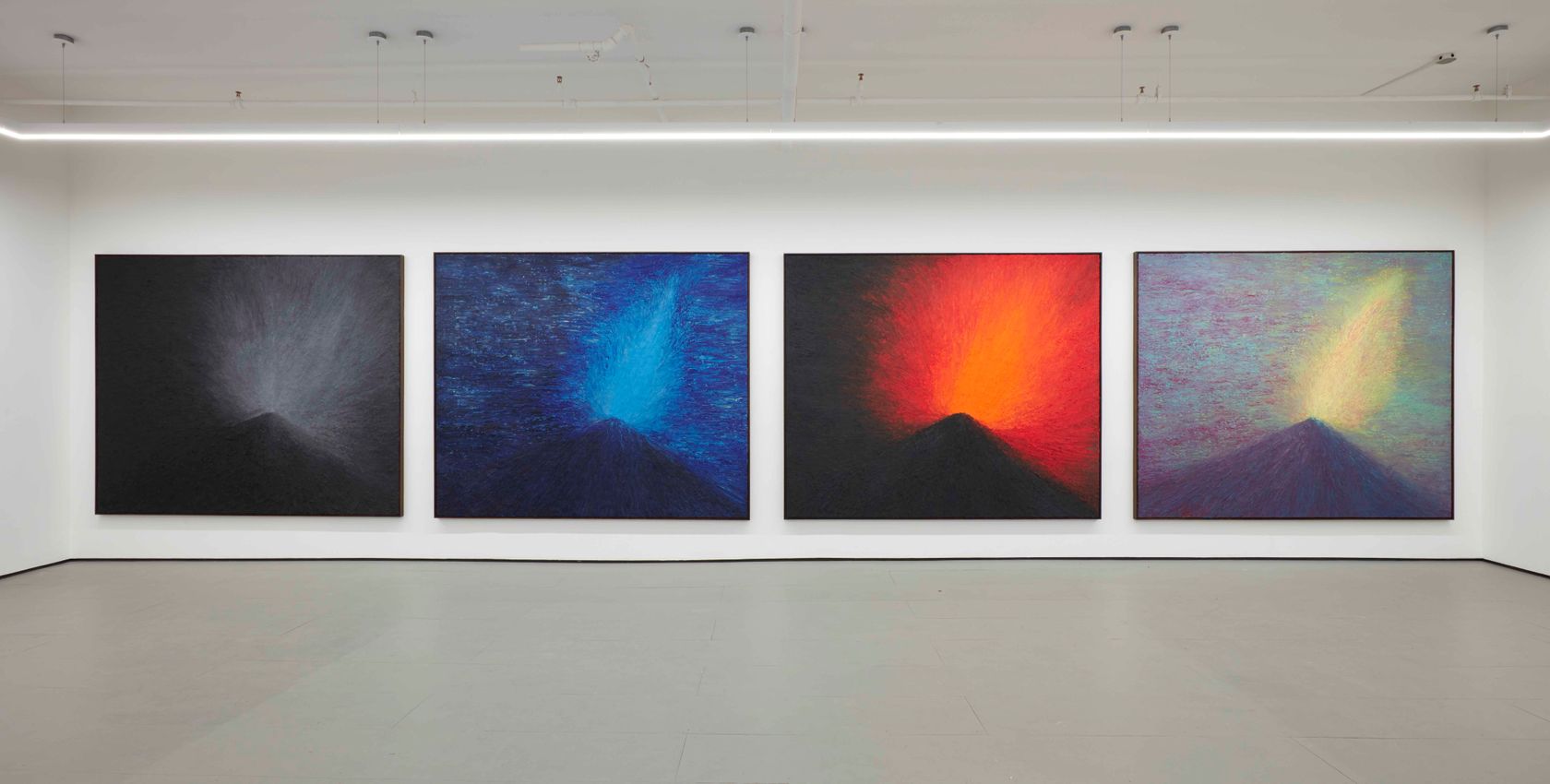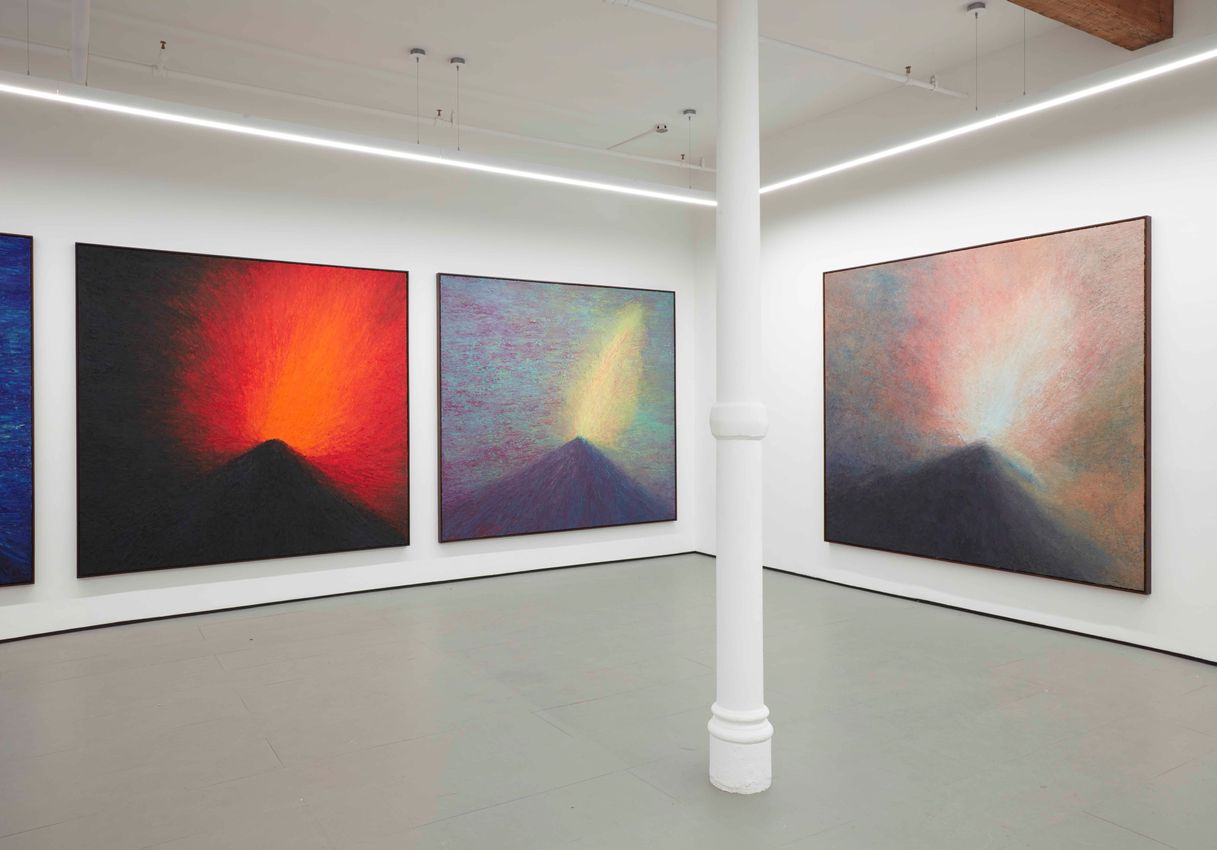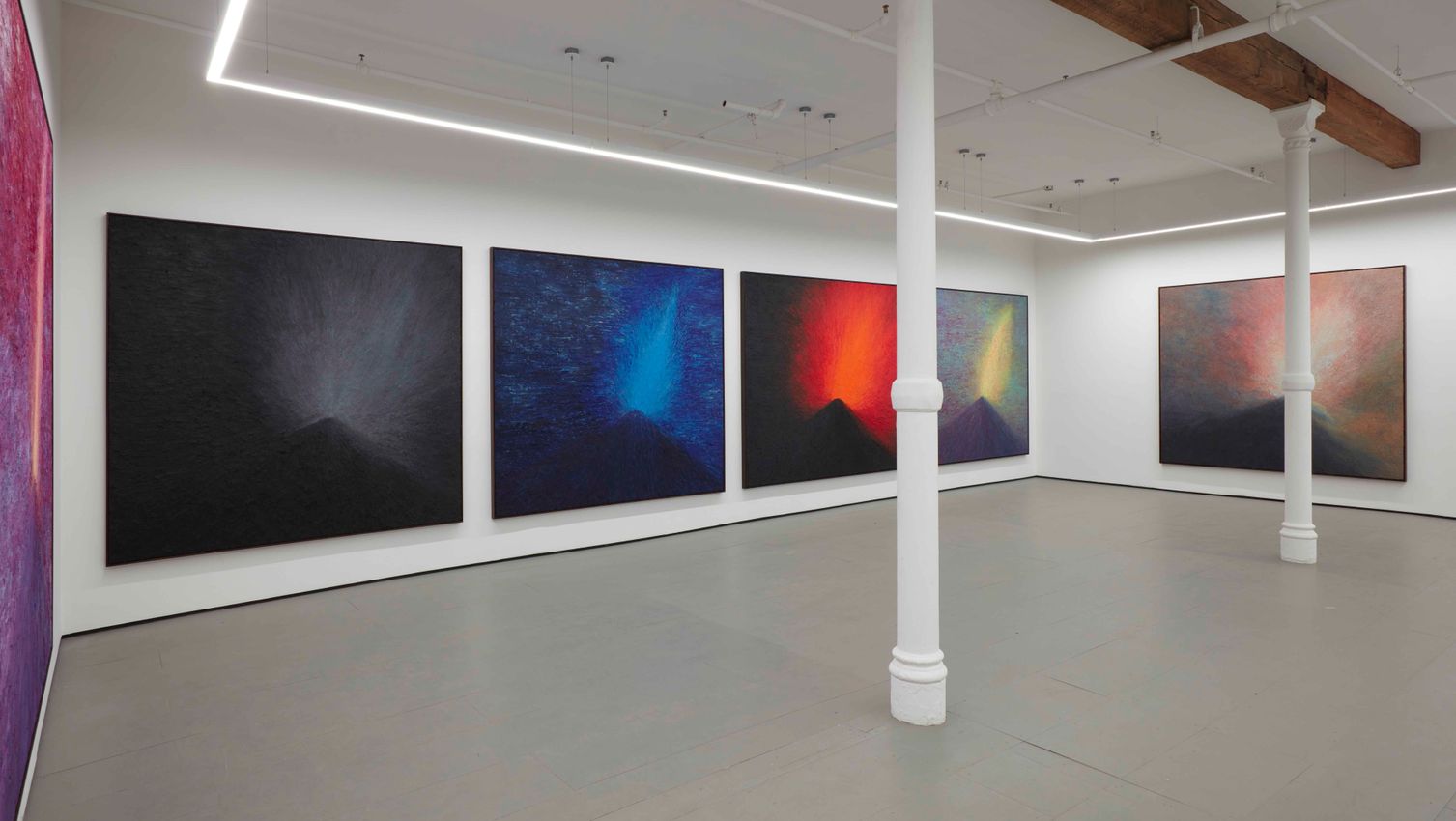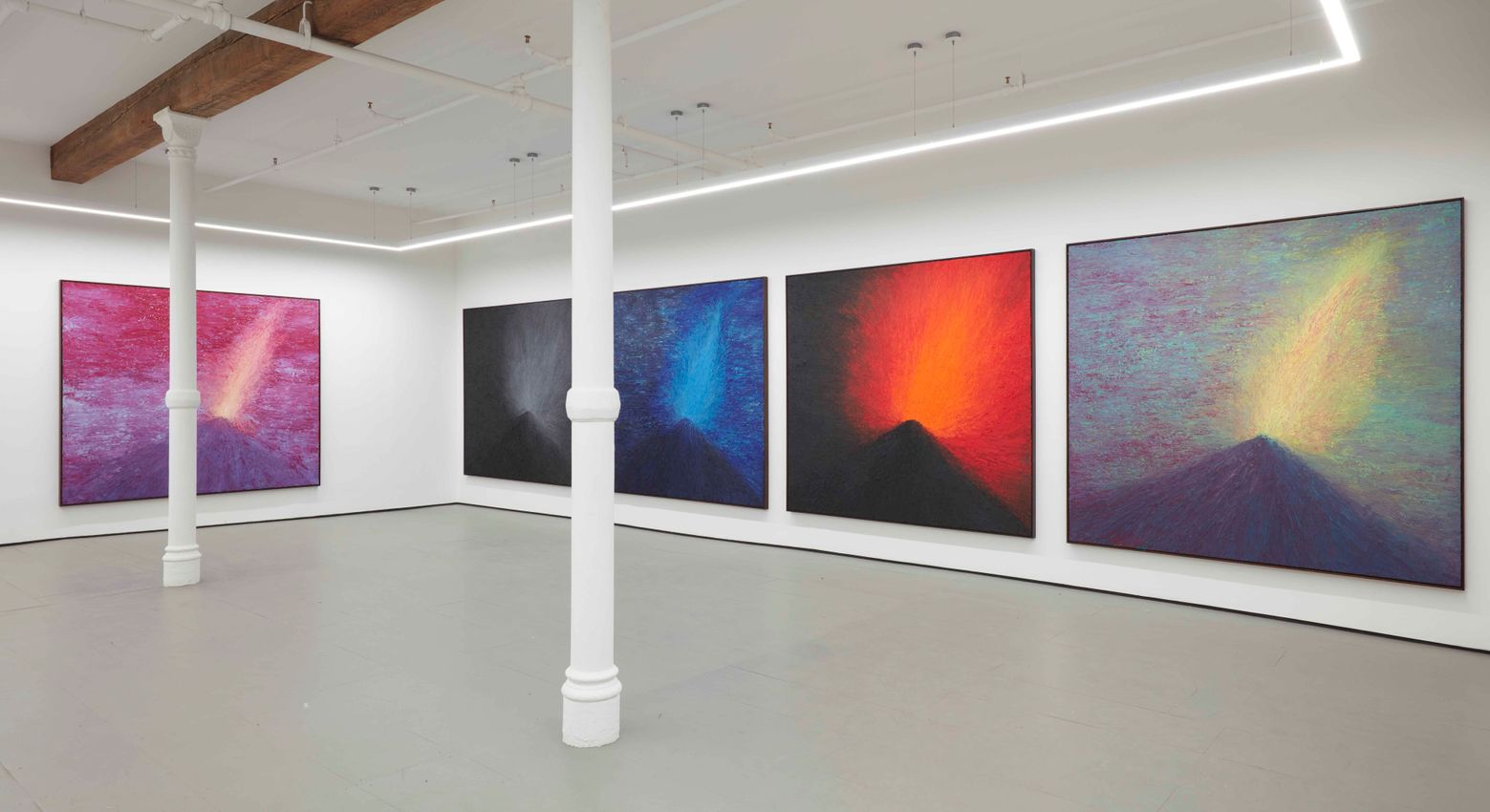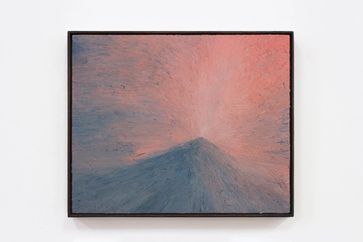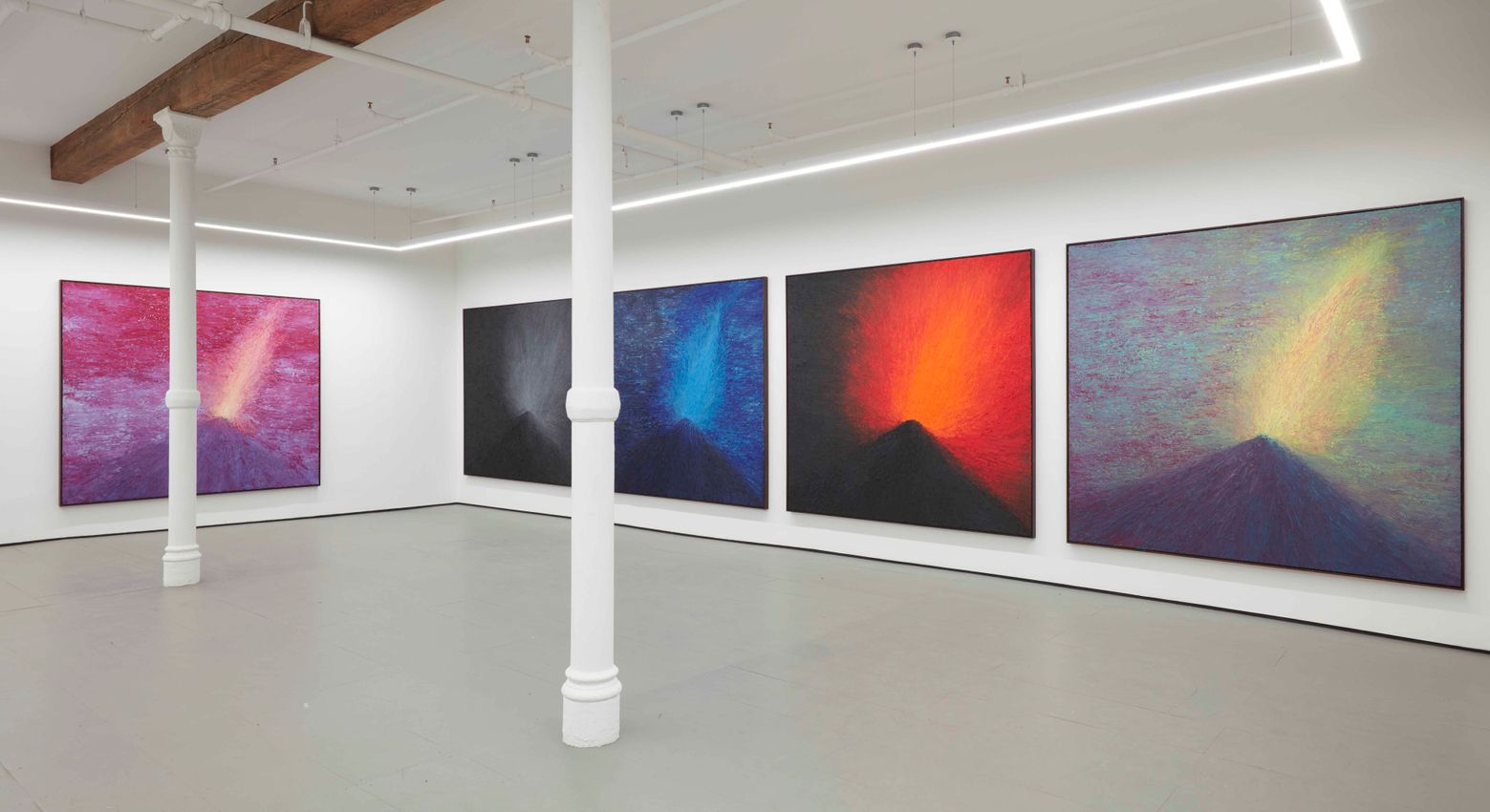
Brice Guilbert’s solo exhibition Foc Foc explores the artist’s enduring fascination with volcanoes and the unrestrained force of their eruptions. Working with thick layers of oil stick, Guilbert applies pigment in sweeping, gestural movements that evoke the visceral spontaneity of spurting lava. While the silhouette of the volcano recurs throughout the works, each iteration emits volatile colour dynamics and a sense of momentum that is unique to each one.
In Malcolm Lowry’s Under the Volcano, perhaps the greatest tale in the Brits-South-of-the-Border canon, our Mexico-based hero Geoffrey Firmin, the Consul, skulks in mezcalerias reading about the Nazis taking the Sudetenland, dealing with the booze-soaked dissolution of his marriage. Rarely mentioned, existing out of frame, are the titular craters: Popocatépetl and Iztaccíhuatl, one active and one dormant, a constant reminder that a mountain can explode at any moment.
In Foc Foc, Brice Guilbert’s first solo show in New York, the subject is the volcano, in a quite visceral way. For the last decade, Guilbert has developed an ingenious conceptual practice, one that uses repetitions like Andy Warhol did with Shadows, the 102-panel investigation into the shape that shade takes when light moves. Guilbert grew up on Reunion Island, a French territory east of Madagascar, watching as the extremely active Piton de la Fournaise loomed in the background. In 2016, while working in Belgium, he started to daydream about the fire-geyser. It haunted him. It was a presence, or as he put it, “more of a mystical thing—this feeling that you’re near something”.
Armed with self-cooked oil sticks, Guilbert started bringing the volcano to canvas, intent on channeling the lava of his childhood while living in the low countries. One show was all volcanoes, and then the next was, too. Soon it was all he painted. It was a religion. There was variation: Big volcanoes, small volcanoes, surreal volcanoes. They started off great—are you going to tell me you don’t like awesome paintings of a volcano exploding?—and as the years passed they transcended the subject, grew richer in texture via obsessive layering. These new ones, especially, quiver with the unholy—the sight of red-hot subterranean innards spewing out into the real world, violently, all at once, without warning. And then you go to the next painting and it happens again.
For this brawny, ambitious, and sneakily brilliant new show at Gratin, Guilbert wanted to fixate on a specific vantage point, a real one, a spot where you can see the Piton de la Fournaise in full, a secret place to watch an ancient act of molten rock flying in the air. It’s where the name comes from. “Foc Foc” is a perch not found on a map, a highland plateau accessible only from difficult-to-traverse pathways, a platform to really see the volcano.
That’s not to say these are painted from life. It’s rare to see a full-blown eruption—in a fit of coincidence, as the show was set to open, the Piton de la Fournaise blew up big enough to reach the Indian Ocean for the first time in nearly two decades. Guilbert told me he’s never seen it erupt. He was always away when the big one hit. That doesn’t matter. Malcolm Lowry never saw Popocatépetl burst. We still have the book he wrote. It’s a classic.
Text by Nate Freeman. Courtesy Gratin, New York,


French artist Brice Guilbert draws on his Creole roots, meditating on memories of home through his lyrical volcanic paintings and narrative music.


A respected voice in contemporary art discourse.
Focusing on ambitious storytelling and insightful art-world commentary. Ocula Magazine publishes in-depth interviews, critical essays and timely analysis on the artists, exhibitions and ideas driving the global art world.
Learn more about Ocula Magazine
Showcasing the best of the art world.
Ocula partners with galleries from around the world to highlight their artists, artworks and exhibitions. Gallery membership is by application and invitation, with each member vetted by an independent panel.
Learn more about Ocula Membership

Specialises in the sale of major artworks.
Led by a team with deep ties to the world’s leading auction houses, galleries and collectors. Ocula’s advisory team offers bespoke services to high-net-worth clients from around the world who are looking to acquire the best of contemporary and modern art.
Learn more about our team and services