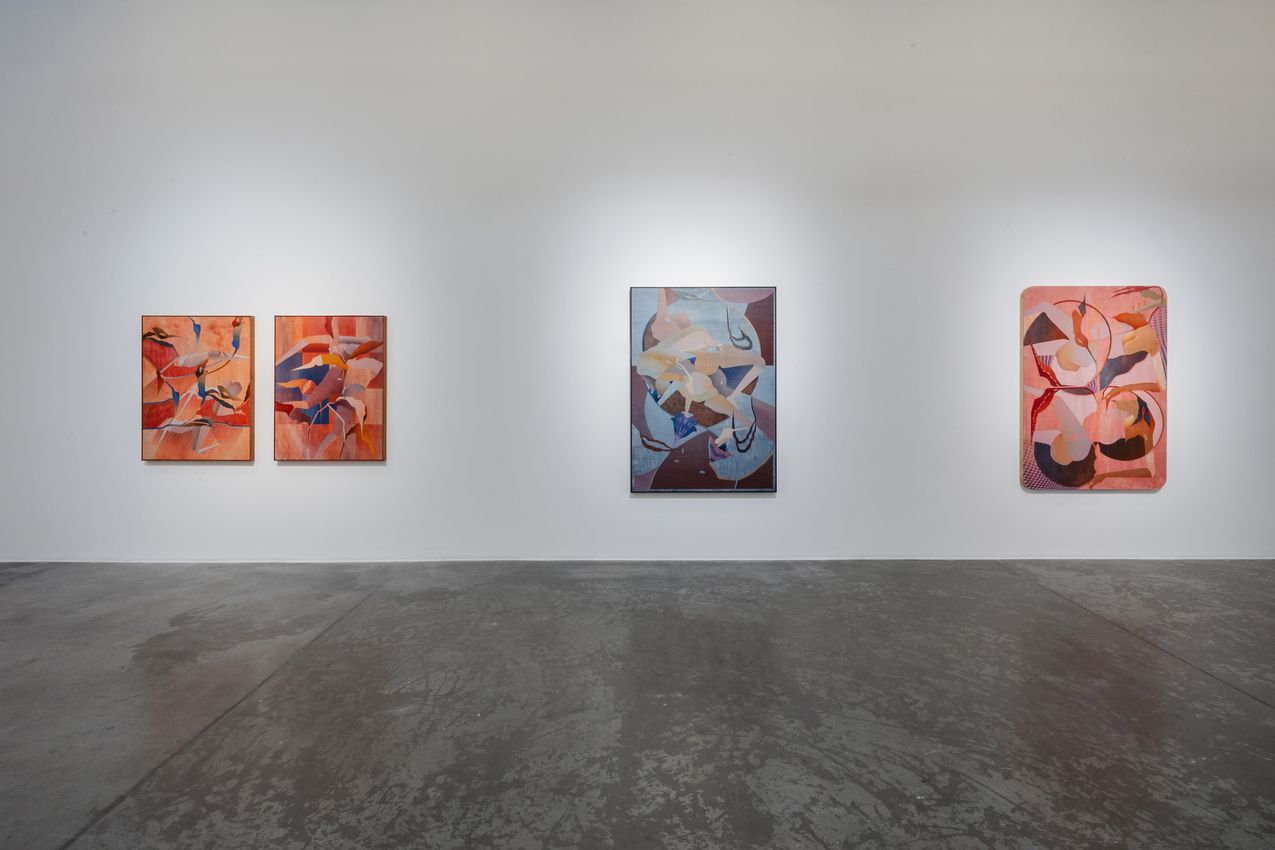
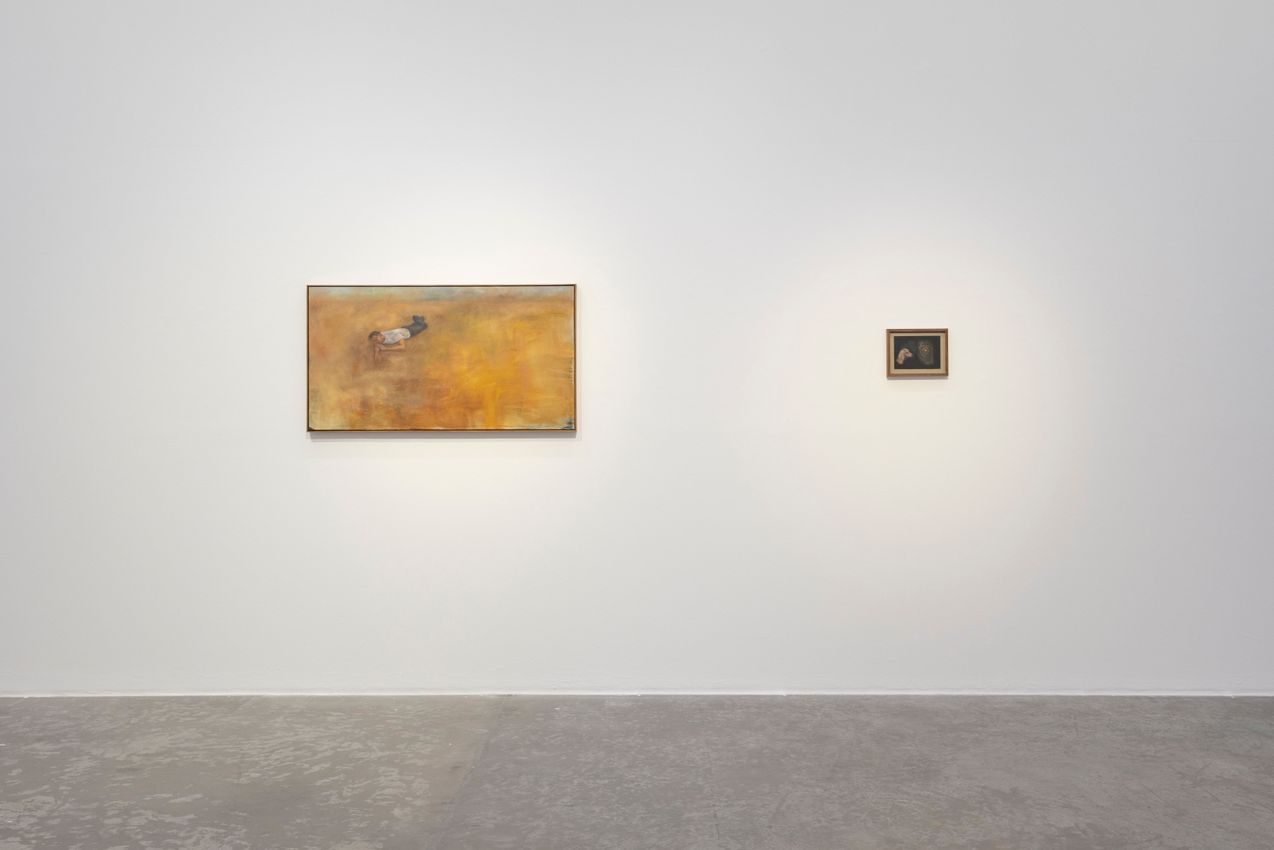
Green Art Gallery is delighted to present Swells, the second solo exhibition by Iran-born, New York-based artist Maryam Hoseini.
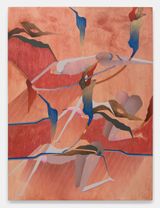
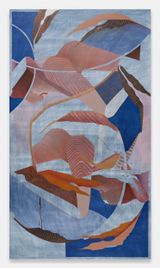
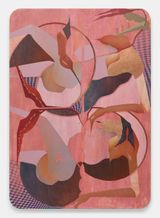
If previously, in Maryam Hoseini’s practice, the panels were stretched and extended, joined and folded, to become extended architecture, the new paintings in Swells create portals of the interior. Every component in the work revels in transplanting itself within itself. The flat figure expands and multiplies in rounded limb, breast, buttock, organ, and thigh—as motif—throughout the work, liquidly moving across it. Ground, now rectangular, sometimes rounded, is repossessed by this swell. It grows as if vegetal. Devouring itself, boring into the wood panel’s visible, soaked, grain like a termite, the figure makes of such pictorial amplification a carnal feast. Hoseini says ‘the figures have moved from architecture to landscape.’ The dish eats itself.
Hoseini seals the grain of wood with shellac, pouring liquid and soaking it meticulously with rags layer, upon layer. Large swirls, drawn sometimes from exploratory drawings on loose sheets of paper in graphite and color pencil, scratch and divide the ground into various component units. Such containment, the line’s proportioning of the ground, festers. Memories of the drawings cede to painting. The line loosens. The soaked ground becomes digitized with high-flow acrylics, colored pencils, gold leaf, and metal powders, which Hoseini mixes in rows and rows of plastic cups in their studio. The materials and the lines and the memories come to, as the artist says, tessellate. Hoseini recalls that it is a counterscopic effect honouring the interstices of Persian tilework, gouache, and textile.
It is a feeling of liquid gone sharp. Fluid is torn, wrenched, squeezed, and cut into; it is made crystal. In many cases this is shown in the works as the body’s actual lactation. Breasts at various scales cut into the ground, they are crowned by spikes, whirlpools, lighter flames, and calligraphic nibs, and they drop their liquid diamonds slowly into chalices, or directly into the ground itself, watering it. The female body, across its ruined space, is feral, ruthless, abject. In its sharpness, it recalls the loss, in the early twentieth century, of what Rosalind Krauss has called, in Picasso’s breasts, a lost ‘carnality’ of physical volume. It devours this loss, raising it to production. For each time there is a splayed or devastated body part, three crop up. Alert guardians stay on their haunches. For every corpse, a Hydra.
Hoseini’s work, in its relationship to Surrealist fixations with marionettes, mannequins, splayed legs, sharp insects, and things with teeth, commingles the two primal drives: pleasure and death. At the same time, the two merge and are overcome, and it all becomes something like love. Tenderness radiates in the delicacy of every visible mark, and particularly in the feathered joy of the color pencil. It is what mystic poetry may call the surfacing of ishq, a devouring and annihilating love found in union, at the edges of things and within their containment. Every division is a rubbing multiplication, each a portal to a “diasporic consciousness,” Hoseini’s recalling of Édouard Glissant. There is a long corporeal memory, carpet sprays becoming hair, the black tufts for armpits in Mughal and Deccan painting, the two-dimensionality of Neo-Assyrian relief. There is equally a refusal of clues. We are meant to pour over.****

In their work, Maryam Hoseini explores the concept of ruins in a politicized social space. Hoseini captures empty historical echoes as bodies walk among the literal and figurative, the visible and invisible ruins of objects and architectures. In the context of the censored female figure, Hoseini presents their subjects as nude, cast simultaneously as unrealistically flattened diagrams of the human body, and hyperrealistic disembodied limbs covered in hair. Their recent work is made up of multiple fragments, strategically balanced upon one another and anchored into the wall behind at a single point, where they build their ongoing curiosity in space and sequence as a formula for a narrative where they confront their viewers’ perception, preoccupation, and projections of identity. These interjections within the gallery’s white cube serve as a way in which the artist rebuilds and elevates these fractured stories, now sturdily supported with weighted columns of opaque color.

Green Art Gallery is a contemporary art space featuring a multi-generational mix of artists whose practices are rigorously researched, idea-led, and representative of our current moment. The gallery now represents a multi-generational mix of artists from the Middle East, North Africa, South Asia and beyond, including Turkish artists Hale Tenger and Hera Büyüktaşcıyan; Iranian artists Kamrooz Aram and Nazgol Ansarinia; and Shadi Habib Allah, Seher Shah, and Alessandro Balteo-Yazbeck, who are Palestinian, Pakistani and Venezuelan respectively. In this geographic mix, the gallery reflects Dubai’s position as a cosmopolitan—as well as artistic—entrepôt, even as it boasts of a strong parallel Arab Modernist program.

A respected voice in contemporary art discourse.
Focusing on ambitious storytelling and insightful art-world commentary. Ocula Magazine publishes in-depth interviews, critical essays and timely analysis on the artists, exhibitions and ideas driving the global art world.
Learn more about Ocula Magazine
Showcasing the best of the art world.
Ocula partners with galleries from around the world to highlight their artists, artworks and exhibitions. Gallery membership is by application and invitation, with each member vetted by an independent panel.
Learn more about Ocula Membership

Specialises in the sale of major artworks.
Led by a team with deep ties to the world’s leading auction houses, galleries and collectors. Ocula’s advisory team offers bespoke services to high-net-worth clients from around the world who are looking to acquire the best of contemporary and modern art.
Learn more about our team and services