Press Release

A fearless interdisciplinary artist (working across drawing, sculpture, installation, architecture, and video), Nazgol Ansarinia brings together a compelling set of practices converging toward a new stream of critical materialism (and minimalism) in contemporary art from the Global South. Her work opens new fields of investigation on the complexities of public infrastructure development. It also evokes the subjective memory—visual forms appealing to the viewer’s touch or bodily presence—hidden behind different strategic raw materials. By proposing new dialectics of materialism (a backlash to the idea that we would live in a dematerialized world and economy) and minimalism (more political, intimate, and resilient than Western 1960–70s minimalism), her work reveals contested spaces and memories, bearing witness to the city and its evolution—mainly Tehran, in Iran.

Nazgol Ansarinia’s project or psychovisual complex Instruments of Viewing and Obscurity begins with a meticulous inquiry into the mass housing brutalist architecture and buildings of Tehran ––—with its extensive use of concrete and fossil fuels energy to toxic effect. She specifically looks at the subversive role of window structures and the issue of social control through official building codes and regulations. What are the tensions and relations between seeing and being seen in such a context, where the surrounding architecture feels almost anachronistic or outdated? How can we account for their formal manifestation in the built environment—namely the house as an extension of the body and the window as that of the eye?

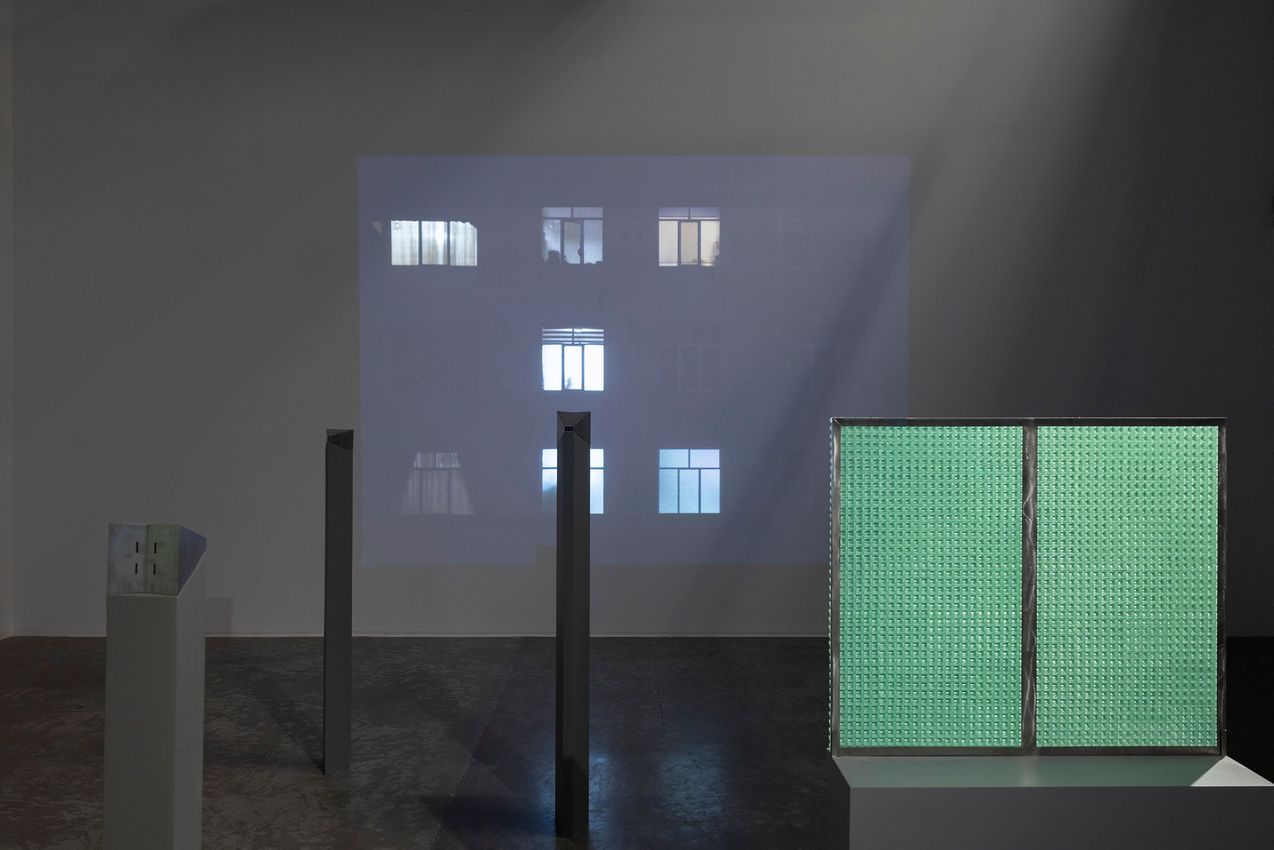
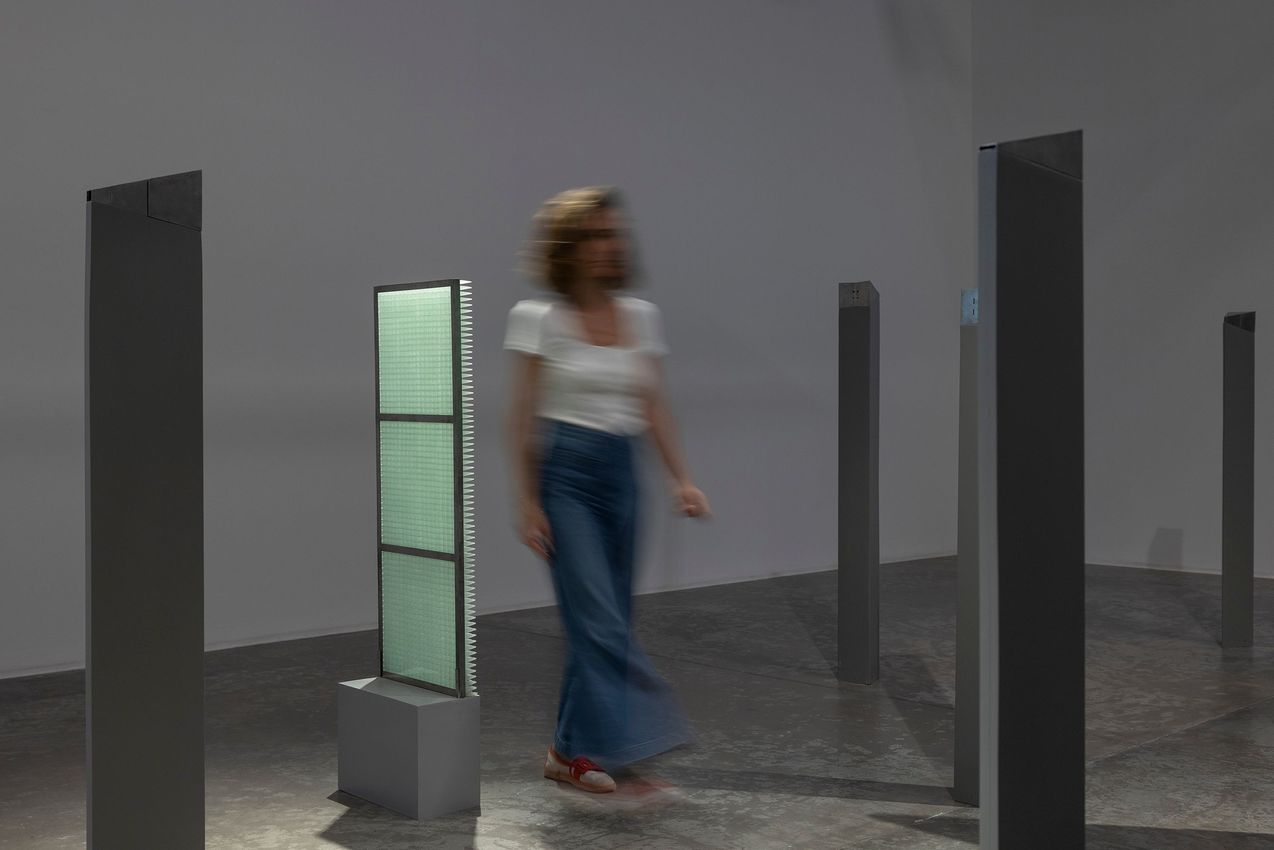
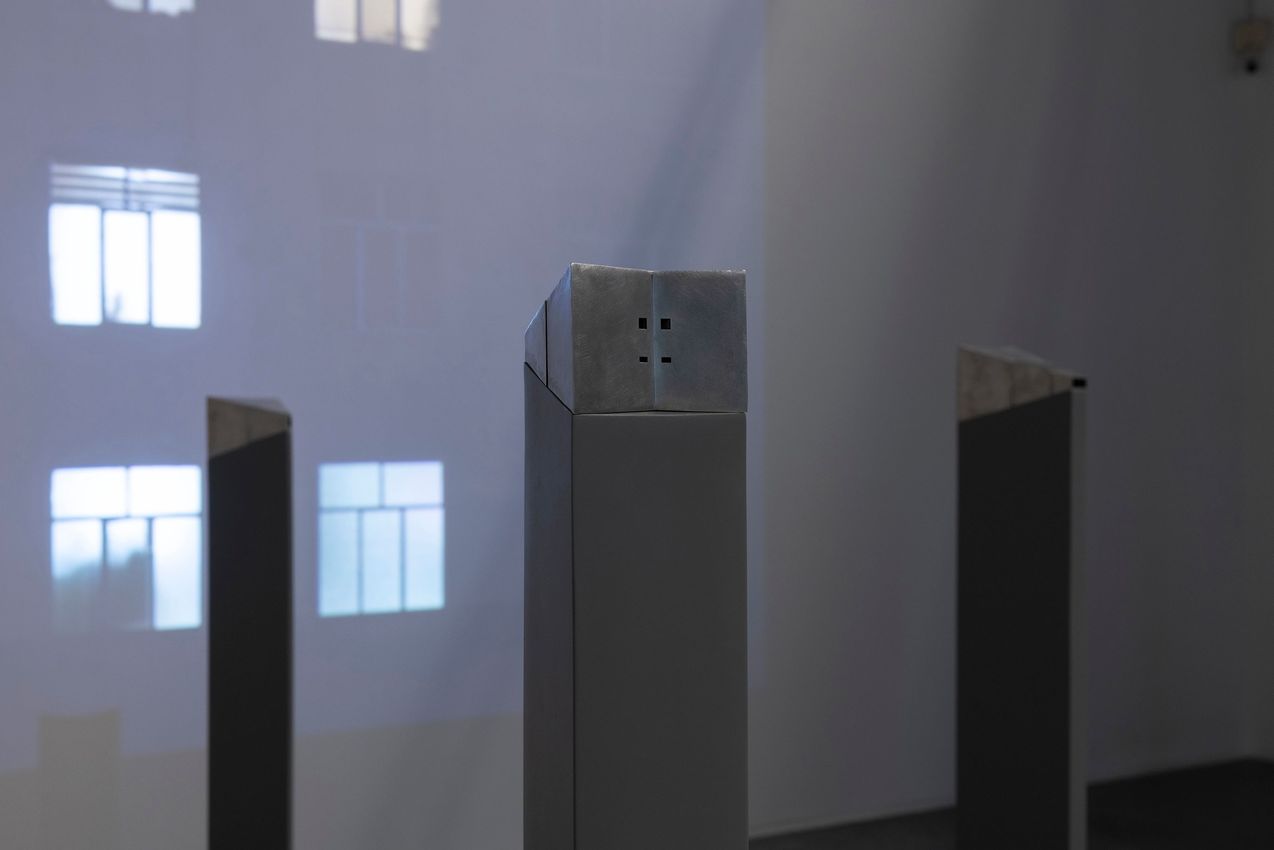
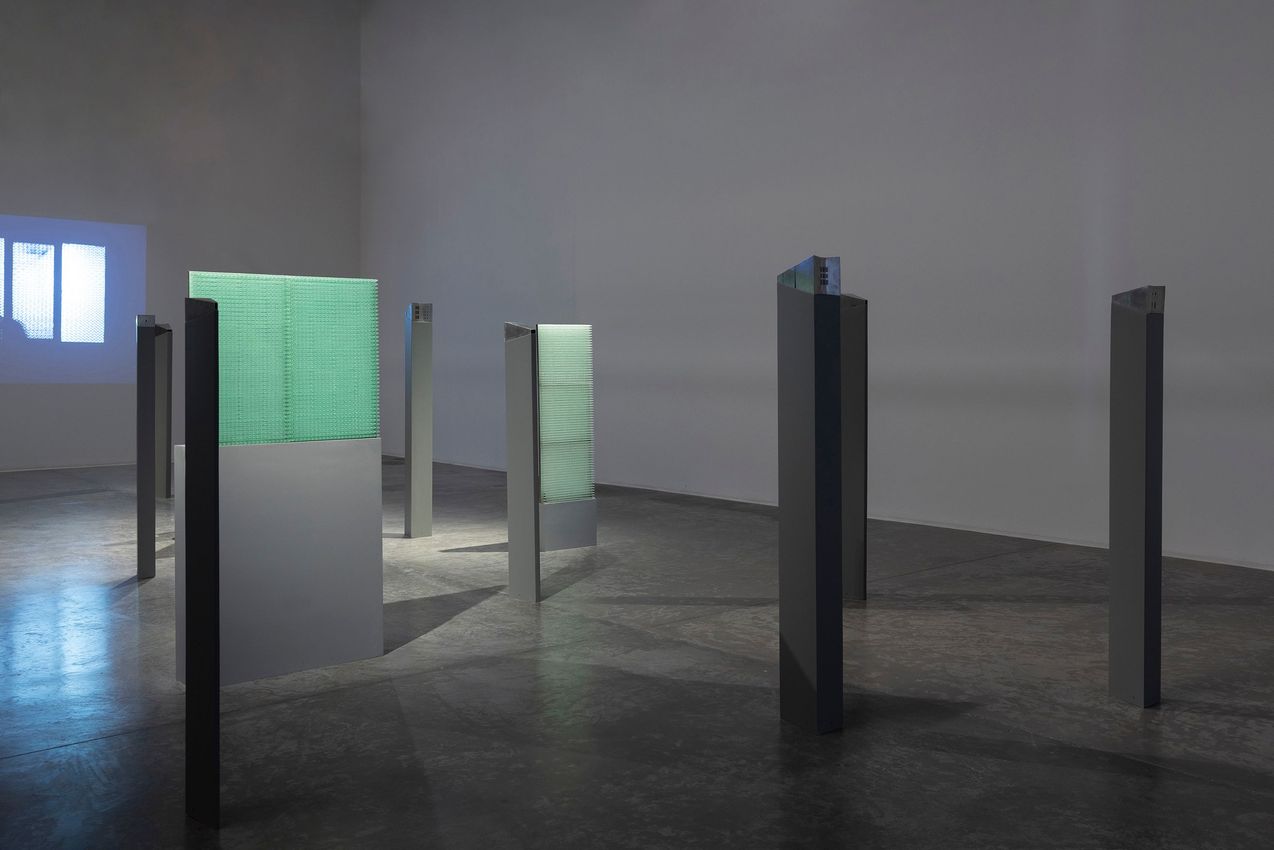
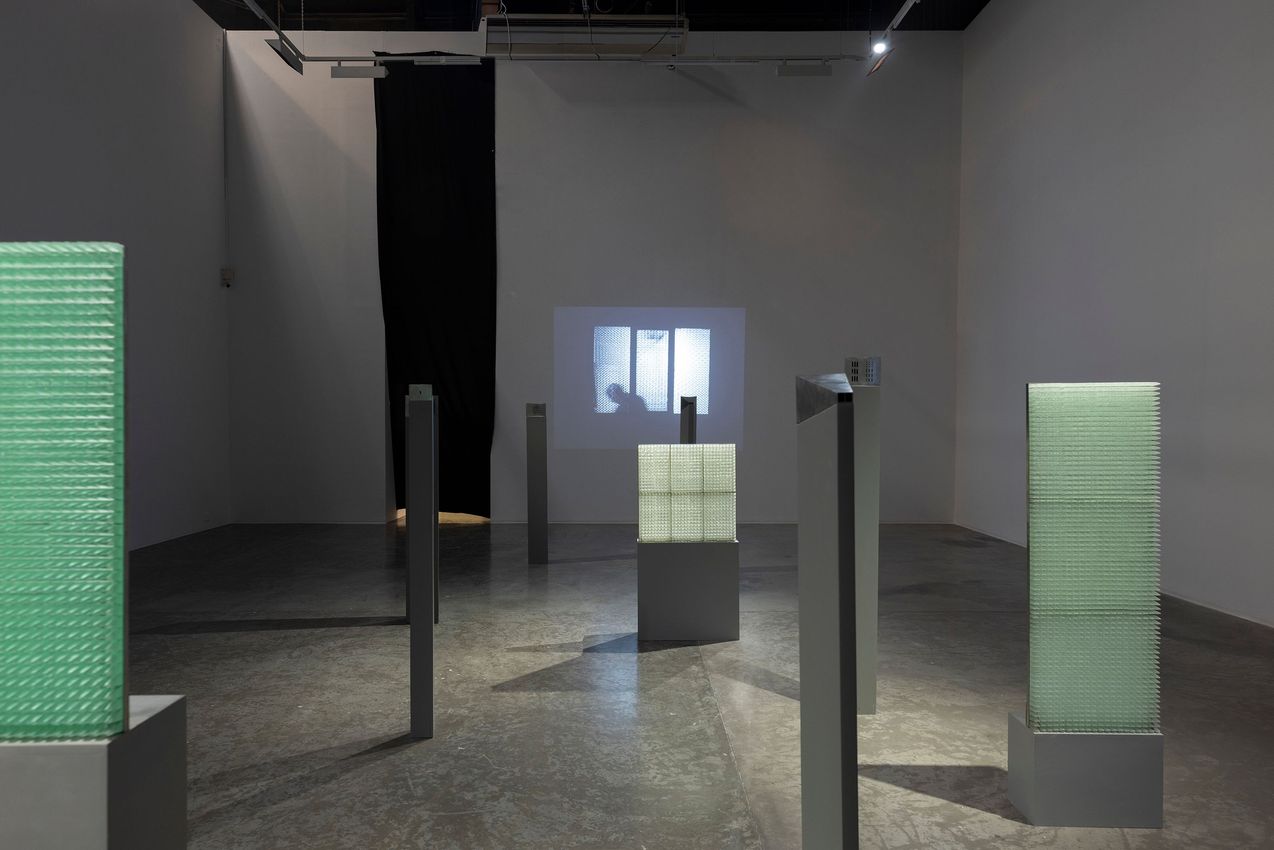
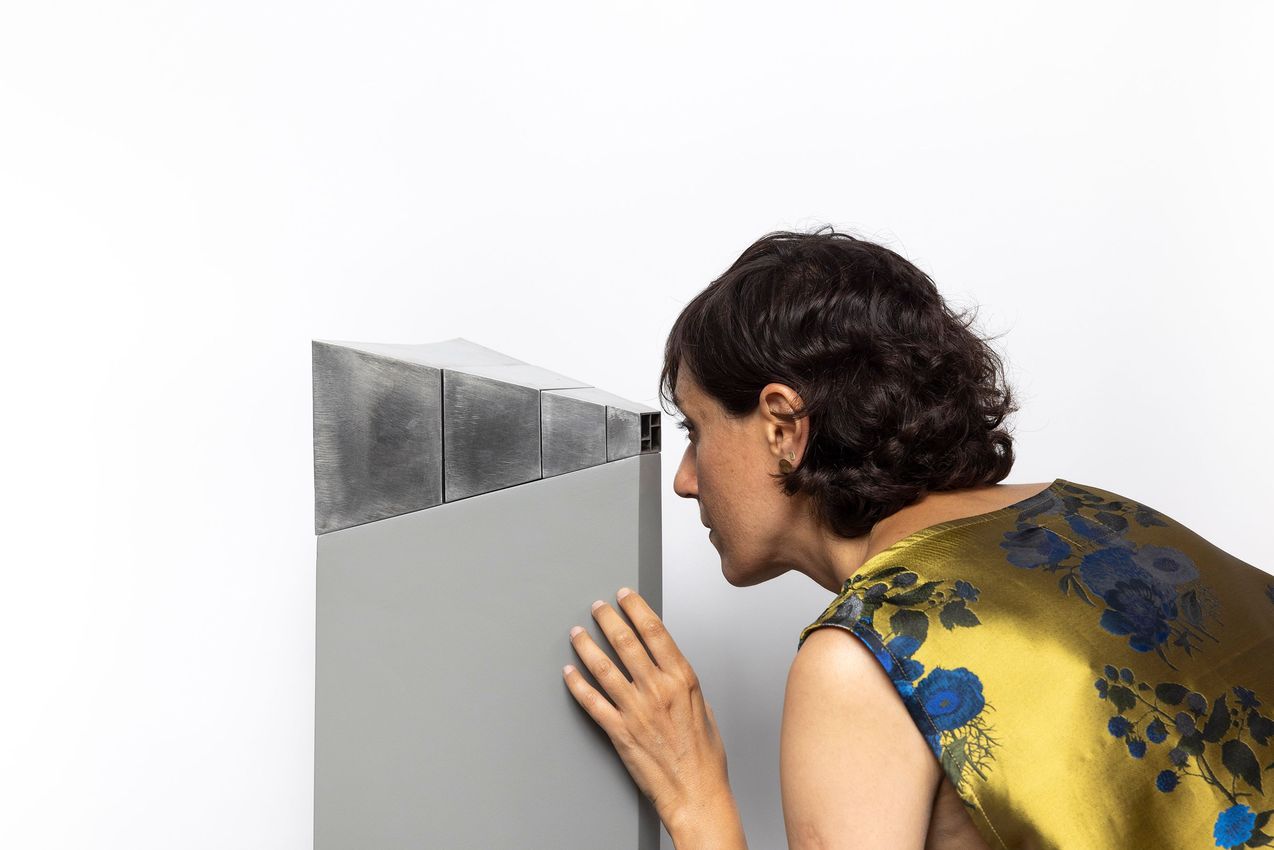
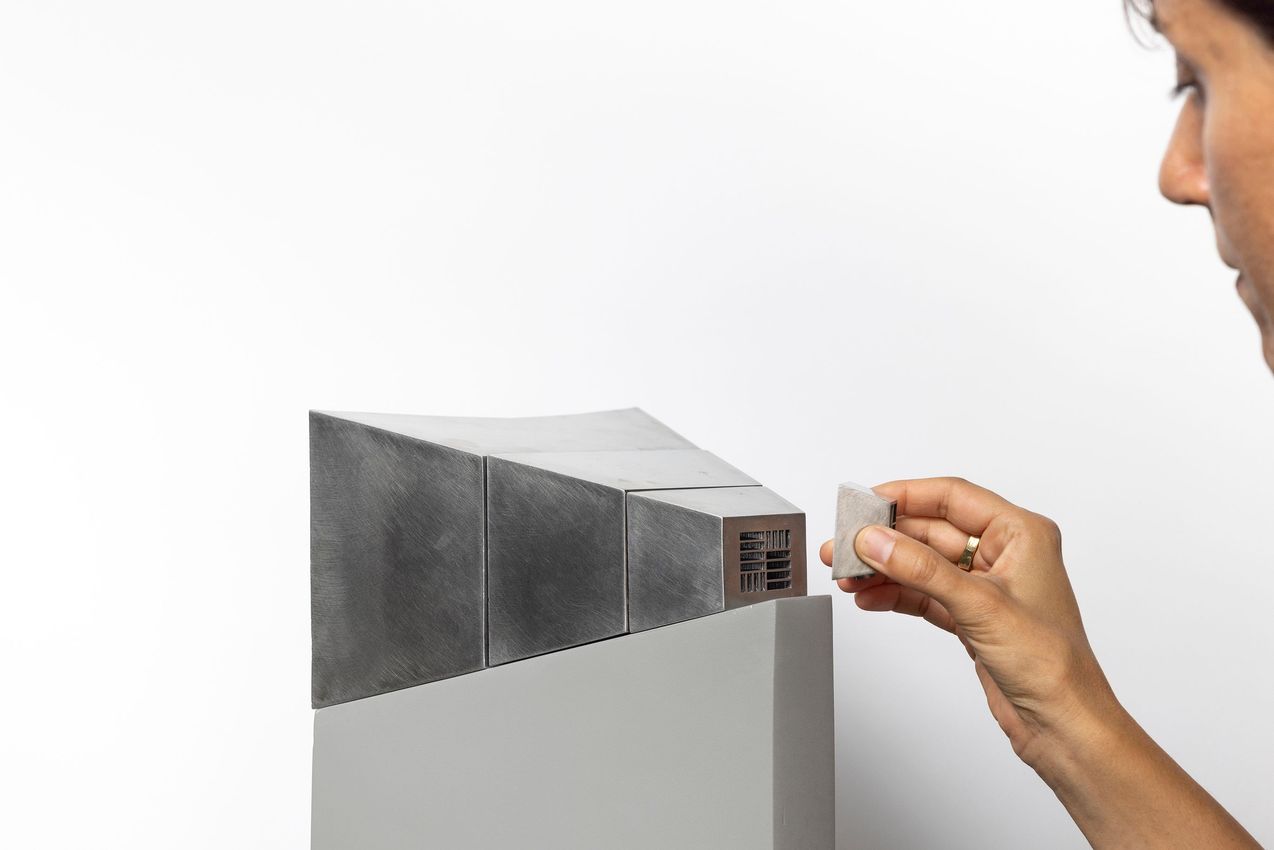
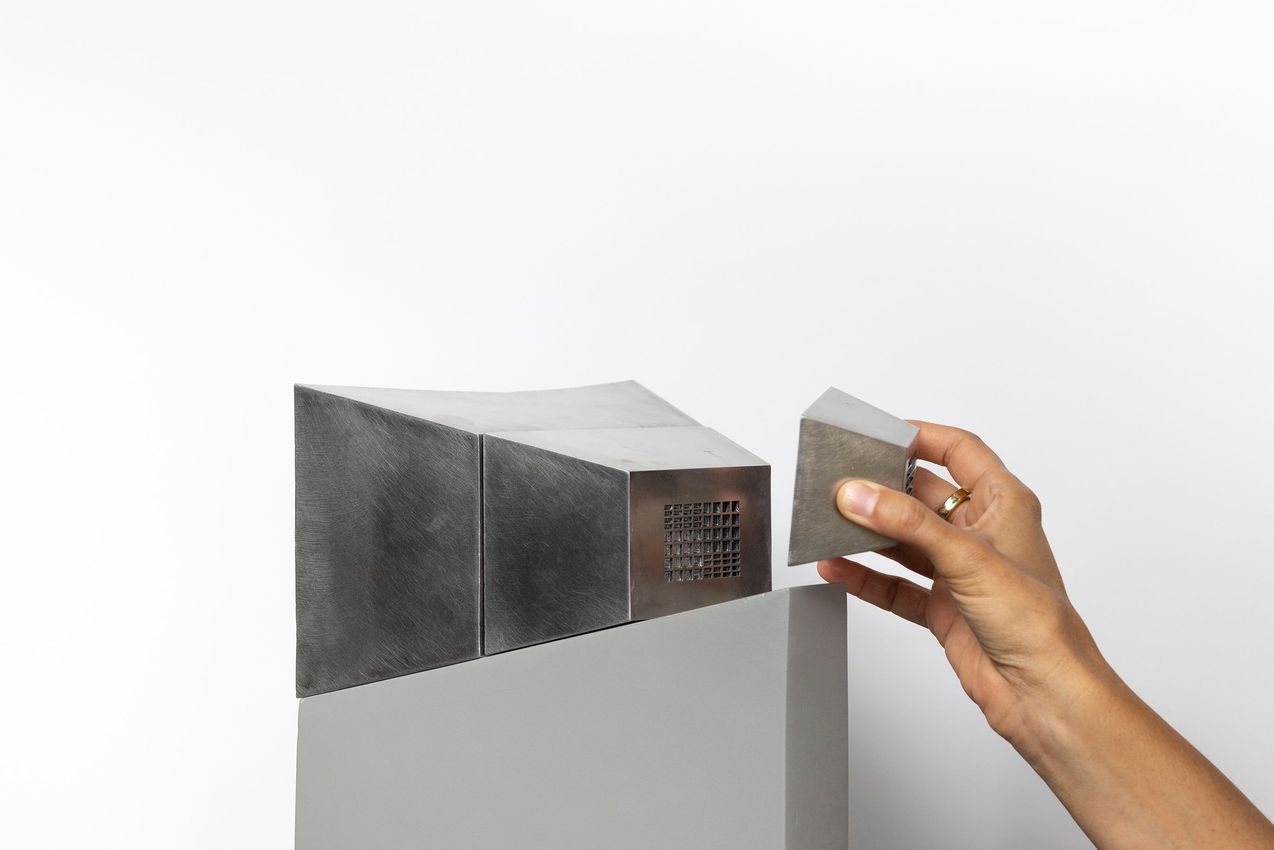
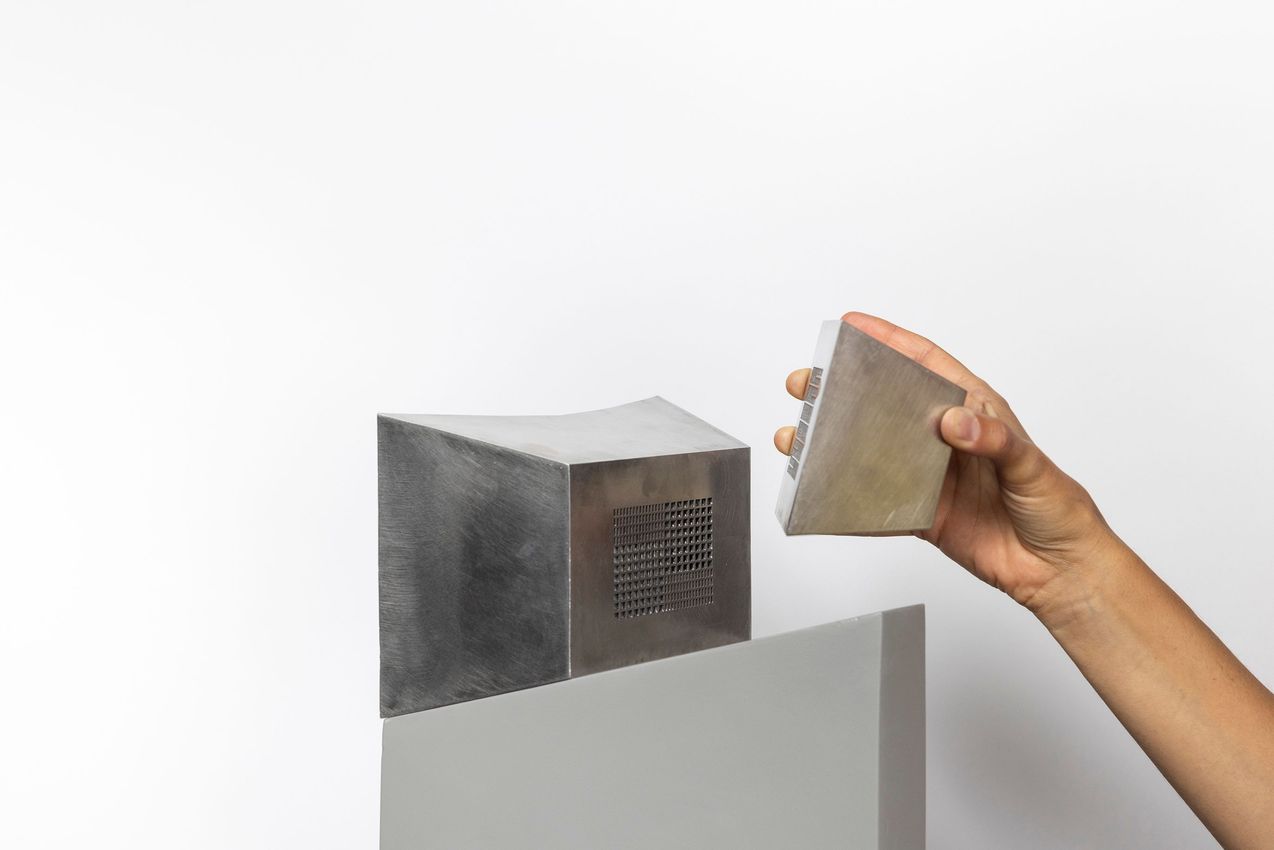
In this latest body of work the installation is organized almost as a human-scale city maquette or maze that is a mechanism of defense against being seen: A series of glass-like surfaces formed from the negative space of the extruded window frames and a multi-sited set of watchtowers paradoxically putting us under surveillance. Our visual and physical experience becomes both fragmented and synthesized through the presence of the large video projections on each side of the room, showing the building façade and windows shifting from daylight to nighttime obscurity. The viewer can actively wander through these mysterious lines of utopian architecture in steel, stone, and glass in the exhibition space or the secret geometries activated by the windows’ combinations on screens—like a chessboard blinking between abstract landscapes and musical notes. At one point when the camera zooms in on a particular window, bringing us to the edge of the private and intimate space, the architectural infrastructure and social control suddenly vanishes. A contact is established between the woman who stands up at her window looking—and us.

In this reversed gaze, challenging the boundary of public and intimate, Nazgol Ansarinia’s installation feels like a ghostly construction site or a manufactured labor allegory provoking both instability and resilience. While her work expresses a kind of legacy or formal and optical genealogy with the aforementioned Western minimalist artists, Ansarinia seems to approach minimalism in a diagonal way, diverting its aesthetics from its standardized and liberal—or anti-socialist—roots, reframing it through the uncharted territories of post- Revolution Iranian urbanization bureaucracy and policies, and shifting the postmodern mindset of Western minimalist art to enhance a postcolonial and materialist critique of modernist architecture’s (toxic) legacy in the Global South.

Instruments of Viewing and Obscurity manifests itself through dusted visions, sedimented forms, and ethereal apparitions—tracing invisible connections between brutalist architecture in Iran, post-minimal art, psychology of the masses, and Michel Foucault’s panopticon surveillance model. The installation questions the invisible disruptions of global infrastructures, shedding light on the interdependence of our resources, urbanization, and habitats.

  • Morad Montazami, director of Zamân Books & Curating, excerpt ”Nazgol Ansarinia: Between Critical Materialism and Critical Minimalism”
Read More

Installation Views

About the Artist

Nazgol Ansarinia’s work examines the systems and networks that underpin her daily life such as everyday objects, routines, events and experiences, and the relationship they form to a larger social context. Born and raised in Tehran, Ansarinia’s practice reflects upon tensions between private worlds and the wider socioeconomic realm, and how local iterations of a culture might act as a site for the hopes and fears of those living in a(faltering) globalised word.

View Artist Profile Nazgol Ansarinia contemporary artist
About the Gallery

Green Art Gallery is a contemporary art space featuring a multi-generational mix of artists whose practices are rigorously researched, idea-led, and representative of our current moment. The gallery now represents a multi-generational mix of artists from the Middle East, North Africa, South Asia and beyond, including Turkish artists Hale Tenger and Hera Büyüktaşcıyan; Iranian artists Kamrooz Aram and Nazgol Ansarinia; and Shadi Habib Allah, Seher Shah, and Alessandro Balteo-Yazbeck, who are Palestinian, Pakistani and Venezuelan respectively. In this geographic mix, the gallery reflects Dubai’s position as a cosmopolitan—as well as artistic—entrepôt, even as it boasts of a strong parallel Arab Modernist program.

View Gallery Profile
Address
8 17th Street, Al Quoz
Alserkal Avenue, Unit 28
Dubai
United Arab Emirates
Opening Hours
Monday – Saturday
11am – 7pm
(1)
Dubai 8 17th Street, Al Quoz, Alserkal Avenue, Unit 28
Green Art Gallery
8 17th Street, Al Quoz, Alserkal Avenue, Unit 28, Dubai, United Arab Emirates
+971 4 346 9305
http://www.gagallery.com/

Opening hours
Monday – Saturday
11am – 7pm
The art world in focus