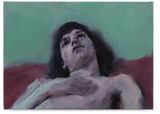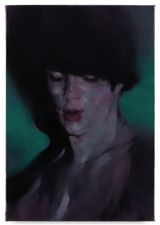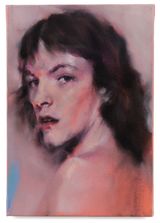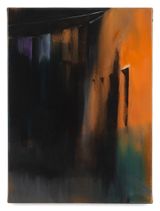
Paul P.‘s work puts the viewer on intimate terms with the codes of queer representation. Sibilant Esses marks his debut at Greene Naftali, featuring new and previously unexhibited works that span his varied yet kindred themes. Accompanied by a forthcoming catalogue with an original essay by Kenneth Silver, this focused presentation mines the formal vocabulary P. has honed over two decades, drawing on both what is explicit and what is hidden in plain sight.
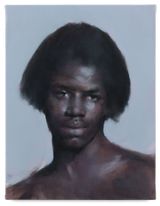
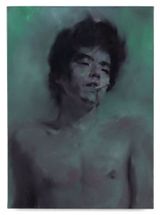
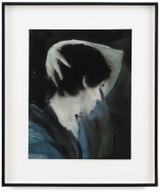
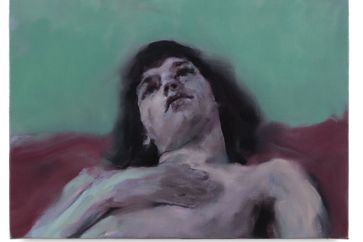
P. emerged in the early 2000s as one of the leading artists of his generation. His bracing meld of sensuality and conceptual rigour has centred on the painted portrait, with pictures of young men cropped to the neck or chest and rendered in a jewel-toned palette. The faces are not taken from life but lifted secondhand from the archive, copied from a cache of gay pornography that dates to the 1970s—a bright yet fleeting period bracketed by Stonewall and the onset of the AIDS crisis. The head-and-shoulders view P. favours constricts the libidinal pull of the source image, training attention instead on the models’ parallel expressions of youthful reticence and carnal knowledge. His ease with Beaux-Arts technique also nods to the tacit homoerotics of that earlier period, channeling the “panache and glamour” of Sargent’s portraits, the “mist and murk” of Whistler’s nocturnes. P.‘s work embraces refinement and even startling beauty, but that desire is edged with doubt: the men’s fates are unknown, and their existence a reminder that certain freedoms may be cyclical, not permanent. P. thus positions his figures, Janus-like, toward layered histories and an uncertain future. “I am searching for analogies,” he has said, “and the touching of hands between past and present.”
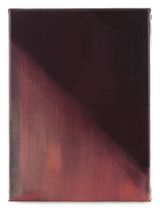
Those analogies extend to P.‘s work across a wider range of materials and genres, finding cognates for queerness and its subtle expression during eras of criminalisation. Oils and watercolours of Venice channel the psychological effects of that sinking city—once a place of refuge for those on the fringes that promised moral abandon and transformation. P.‘s Venice is all stucco alleyways strung with clotheslines, cast shadows and dark corners, charged with what he calls a “figurative essence” that saturates the built environment. These twilit depictions of portals and doorways can verge on near-total abstraction: “atmospheres condensed into window-like panels describing an area of light itself.”
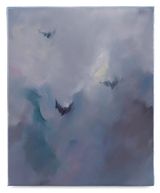
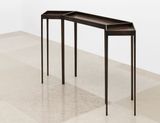
Other ethereal monochromes resemble cloud studies flecked with bats in fight. Like the Symbolist poet and arch dandy Comte de Montesquiou, who adopted the bat as his personal emblem, P. has long been intrigued by this symbol of transience and wayward desire. Inverted, nocturnal, and vaguely threatening, this winged mammal offers him “a metaphor for queer people’s dexterity and irreconcilable difference.” A similar troubling of categories obtains in the artist’s three-dimensional work: sculptures in the form of furniture that resist definitions of each. His finely milled, spindly objects might pass for end tables, yet their scale belies that function, suggesting both the social realm of the interior and other ways it might be occupied. P.‘s sculptures derived from the decorative arts look to bohemian designers in Interwar Paris, whose Deco geometries tapped a non-austere vein of modernism. His paired and tripartite pieces can fit together and come apart at will; as with each of his enduring motifs, they “traffic in nebulous sensations of attraction and longing.”
Paul P. (b. 1977) lives and works in Toronto. Recent solo and two-person exhibitions of his work have been held at KW Institute of Contemporary Art Berlin (2024); the National Gallery of Canada, Ottawa (2023); Hordaland Kunstsenter, Bergen, Norway (2022); and Oakville Galleries, Ontario (2022). He was included in the 2014 Whitney Biennial and the 2018 FRONT International Cleveland Triennial for Contemporary Art. Other significant group exhibitions have been held at the Vancouver Art Gallery (2024); Brooklyn Museum, New York (2023); Hammer Museum, Los Angeles (2021); Martin Gropius-Bau, Berlin (2011); and The Museum of Modern Art, New York (2009).
His work is in the collections of The Museum of Modern Art, New York; National Gallery of Canada, Ottawa; Los Angeles County Museum of Art; San Francisco Museum of Modern Art; Brooklyn Museum, New York; Art Gallery of Ontario, Toronto; Hammer Museum, Los Angeles; Henry Art Gallery, Seattle; Princeton University Art Museum, New Jersey; Rhode Island School of Design Museum, Providence; Speed Art Museum, Louisville, Kentucky; and the Whitney Museum of American Art, New York, among others.
Paul P. (1977, Canada). P. makes sensitive painting and drawing studies, taking young men as his predominant subject matter. The figures in these intimate portraits appear as if from another time or place.


A respected voice in contemporary art discourse.
Focusing on ambitious storytelling and insightful art-world commentary. Ocula Magazine publishes in-depth interviews, critical essays and timely analysis on the artists, exhibitions and ideas driving the global art world.
Learn more about Ocula Magazine
Showcasing the best of the art world.
Ocula partners with galleries from around the world to highlight their artists, artworks and exhibitions. Gallery membership is by application and invitation, with each member vetted by an independent panel.
Learn more about Ocula Membership

Specialises in the sale of major artworks.
Led by a team with deep ties to the world’s leading auction houses, galleries and collectors. Ocula’s advisory team offers bespoke services to high-net-worth clients from around the world who are looking to acquire the best of contemporary and modern art.
Learn more about our team and services