





Filipino Artists’ Collective Protests ‘Devastating’ Impact of AI Hub

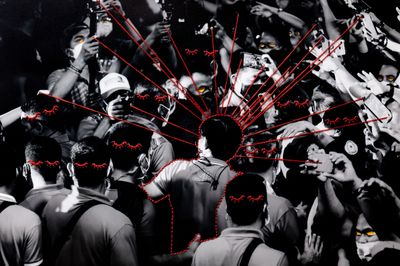
Artists joined hundreds of people from allied organisations at a rally culminating at the project’s intended site. Photo: Noah del Rosario.
Filipino artists campaigning against a proposed 1,600-hectare AI and advanced manufacturing hub have warned that the US-backed project could have a “devastating effect on land, environment, labour and [the] livelihoods of the Filipino people”.
Artists Unite Against Pax Silica (AUPAX), a new coalition of visual artists, designers, writers and photographers, has begun organising exhibitions, workshops and protests against the international initiative, which is intended to secure supply chains for computer chips, semiconductors and critical minerals.
A statement setting out the group’s principles and plans said: “Today’s artists face a threat on multiple fronts. Not only are we faced with the never-changing neglect of the government, but we are also faced with the threat of AI taking over our jobs, livelihood, and, bigger than that, the inherent creativity of humanity.
“…Art cannot be truly free while farmers are evicted from their lands, workers are exploited, and Indigenous peoples are driven from their ancestral domains in the service of foreign capital.”
AUPAX launched on 6 September with the exhibition ALL CAPS: Art, Land and Labour—Creatives Against Pax Silica at Sampaguita Projects in Quezon City. The exhibition links the appropriation of artists’ work by generative AI with the conversion of agricultural land for AI infrastructure.
“When AI crops out artists from art-making, steals works to train AI and takes over agricultural land,” the organisers asked in an Instagram post promoting the show, “what are they expecting to harvest but resistance?”
On 11 September the artists joined hundreds of people from allied organisations at a rally culminating at the project’s intended site. A further protest is planned in Quezon City, alongside the launch of the newly formed League of Anti-Imperialist Artists, which will present its own anti-Pax Silica exhibition.
The Philippines joined Pax Silica, which is billed as the US Department of State’s “flagship effort” on AI and supply chain security, in April. Under the initiative, a proposed industrial zone in the 9,450-hectare New Clark City in Tarlac would host companies involved in the scheme’s goals to “address AI supply chain opportunities and vulnerabilities”, and “establish a durable economic order to drive AI-powered prosperity across partner nations”.
Australia, Israel, Japan, South Korea, Singapore and the United Kingdom were founding members of the programme, which is intended to limit China’s dominance in AI development and infrastructure. The European Union became a signatory in June this year.
The Philippine government has said the New Clark City hub could attract between $40 billion–$70 billion in investment and create up to 200,000 skilled jobs. Officials have promoted it as a means of moving the country beyond raw-material exports and lower-value electronics assembly into advanced manufacturing and research.
In a statement on 16 September, Ceferino S Rodolfo, undersecretary at the Philippines’ Department of Trade and Industry, clarified that the development will not include a datacenter, but will include factories for manufacturing the components of the controversial AI housing facilities. “The Pax Silica Industrial Hub will create an ecosystem that will have AI at its core,” Rodolfo said, adding that the water and power supplies of local people will not be impacted by the plans.
AUPAX has disputed this vision of progress and argued that the development threatens agricultural land and the livelihoods of farmers and Indigenous Aeta communities in Capas, where the zone is planned. The coalition has also linked the insecure conditions of cultural work to its broader critique of development.
“We artists are not separate from the land, the people, and the communities that are now threatened by Pax Silica,” the group said in a statement. “Many artists and creatives survive on unfair wages, making ends meet through irregular work, while lacking state support and having little to no social protection.
“The arts will never truly be free if our farmers, our workers, and our Indigenous communities are continuously exploited and oppressed.”
AUPAX grew from the campaign group Sama-samang Artista para sa Kilusang Agraryo (SAKA), an alliance of cultural workers campaigning for land reform and food security, and Bulacan Collective, which supports emerging artists in the province north of Manila.
Their action comes amid an increased international focus on the possible harms and benefits of AI, following warnings and calls for third-party regulation from several senior researchers and company founders.
On 12 September the chief executive of AI giant Anthropic appealed for the industry to “slow down”. The following day, president Donald Trump said the US is “leading China in AI”, adding that “whoever wins AI, wins”.
Ocula contacted the Philippine Department of Trade and Industry and the US Department of State for comment.







A respected voice in contemporary art discourse.
Focusing on ambitious storytelling and insightful art-world commentary. Ocula Magazine publishes in-depth interviews, critical essays and timely analysis on the artists, exhibitions and ideas driving the global art world.
Learn more about Ocula Magazine
Showcasing the best of the art world.
Ocula partners with galleries from around the world to highlight their artists, artworks and exhibitions. Gallery membership is by application and invitation, with each member vetted by an independent panel.
Learn more about Ocula Membership
Specialises in the sale of major artworks.
Led by a team with deep ties to the world’s leading auction houses, galleries and collectors. Ocula’s advisory team offers bespoke services to high-net-worth clients from around the world who are looking to acquire the best of contemporary and modern art.
Learn more about our team and services