Midway upon the journey of our life
I found myself within a forest dark,
For the straightforward pathway has been lost.
— Dante Alighieri, The Inferno
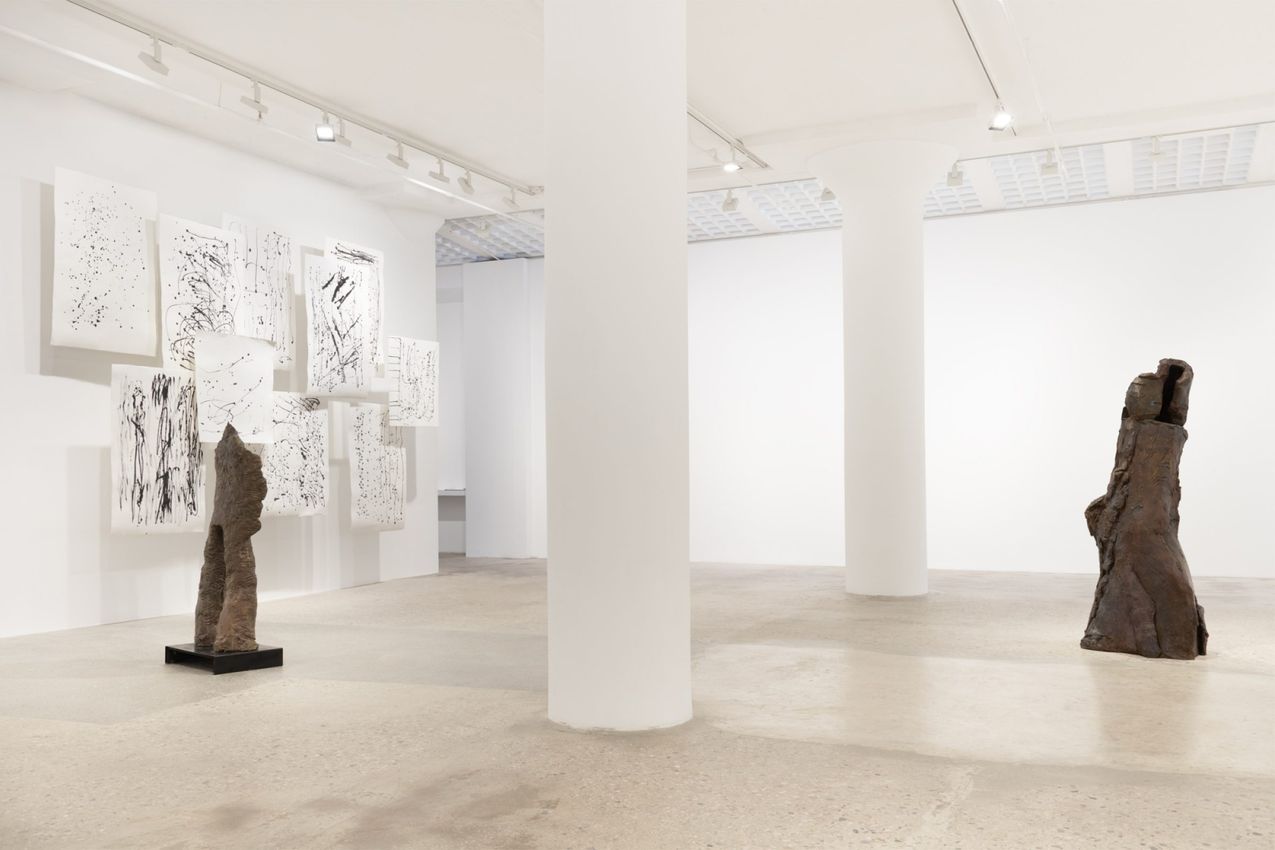
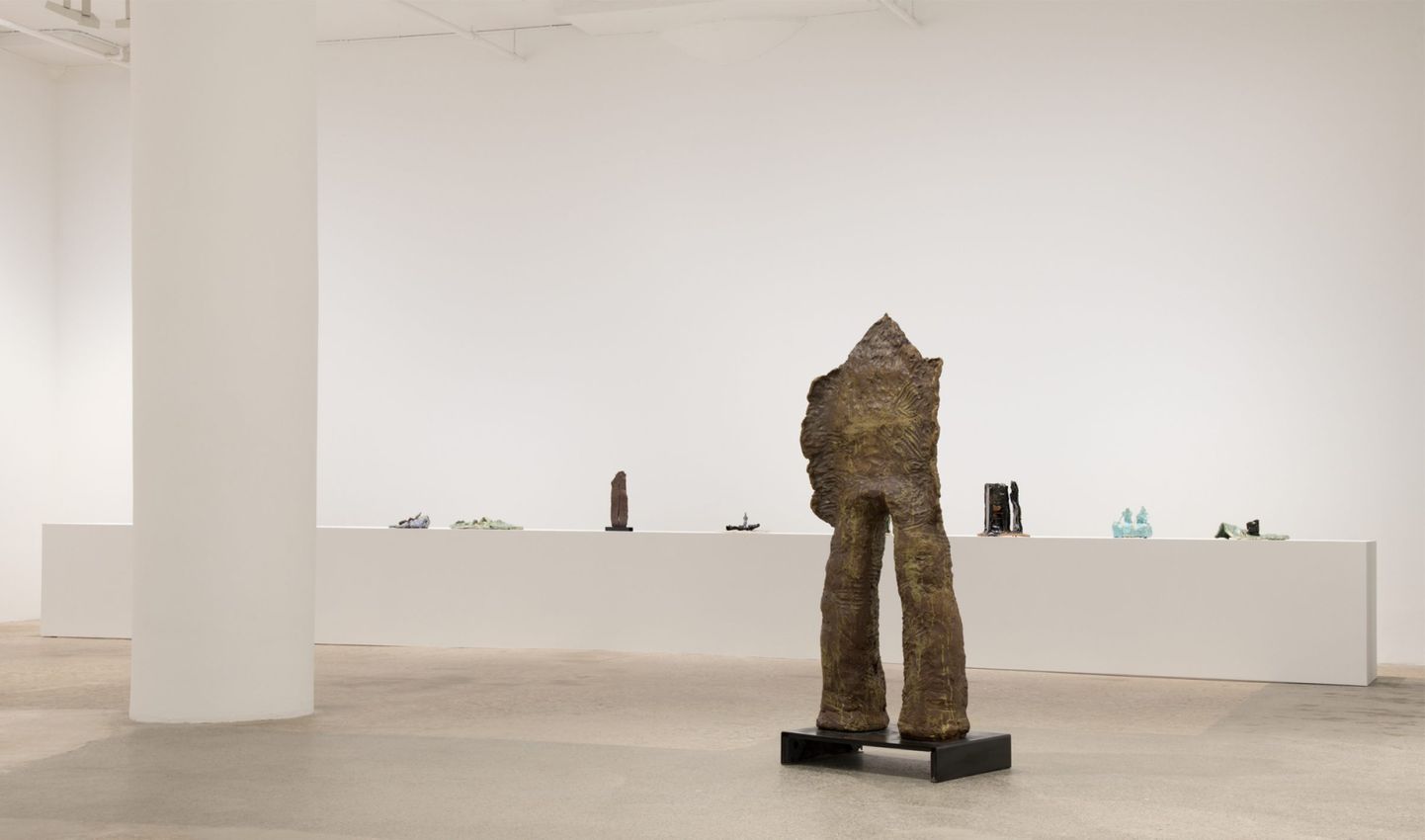
Time itself becomes pliant in the hands of Simone Fattal, who has spent six decades forging a singular project to bridge the ancient and modern. This joint presentation spans two linked exhibitions—The Primeval Forest, at Greene Naftali, and The Hearth, at kaufmann repetto—and marks the artist’s return to New York following her acclaimed 2019 survey at MoMA PS1. The works on view range from sculptures in clay, stoneware, and bronze to large-scale drawings and cut-paper collage, implying a ritual landscape suffused with belief in what can’t be seen.
Born in Damascus in 1942, Fattal was raised in Lebanon and educated in Beirut and Paris, where she studied archaeology at the École du Louvre and philosophy at the Sorbonne. In 1969 she returned to Beirut, where she began her career as an artist, exhibiting her paintings locally through the start of the Lebanese Civil War. She left the city in1980 and resettled in California. There she founded the Post-Apollo Press to publish avant-garde authors from around the world. By 1988 Fattal had resumed her visual art, enrolling at the San Francisco Art Institute where she discovered ceramics, coaxing a near-animistic quality from the supple medium of clay. As Negar Azimi has remarked, her “figures look as old as the earth and yet they breathe.” Fattal eventually returned to Paris where she still resides, making a body of work informed by poetry and myth that views the deep past through living eyes.
Known primarily as a sculptor of totemic works in clay and bronze, Fattal makes use of motifs that imply a cultural mix—from Sumerian tales to Sufi mysticism and pre-Islamic lore—that mirrors her own itinerant life, tapping into shared narratives of displacement and human resilience. Recurring forms include striding men on sturdy legs, suggesting archetypal heroes that endure through the ages. The bronze Walker, at kaufmann repetto, renders a life-size figure in motion, paired with a rock that trails it like a shadow. “Man is a standing animal,” Fattal has said of her prophets and wanderers. “Before he started thinking, he got up.” At Greene Naftali, Ghaylan and Mayya depicts seafaring lovers from Arabic literature, one splayed like a billowing sail—a material sleight-ofhand that uses the solidity of bronze to capture something as airy and impermanent as the wind. At the gallery’s center, the monumental bronze Tree likens organic growth to artistic creation, and the stoneware Humbaba from the Epic of Gilgamesh stands sentry, protecting a hand-drawn forest scrawled and dripped in skeins of ink.
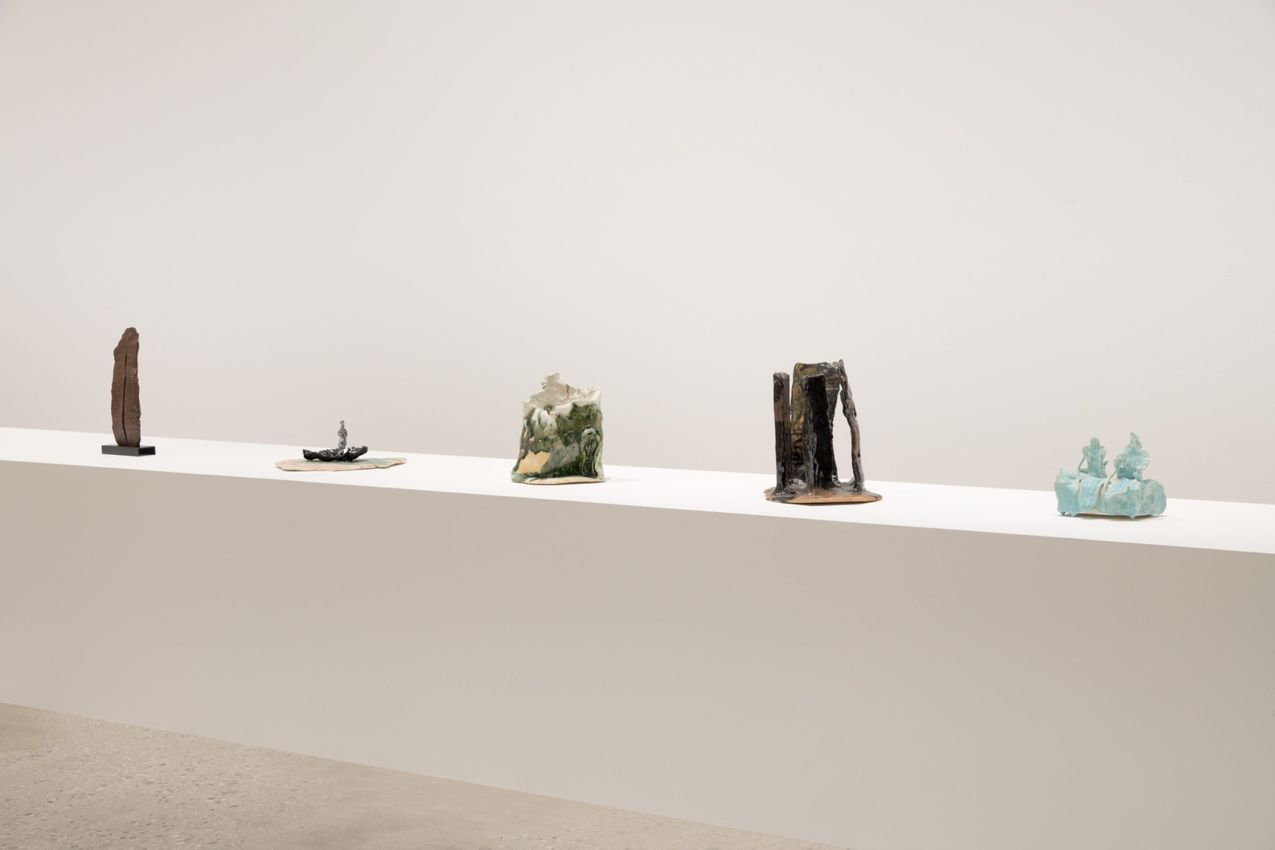
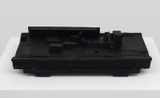
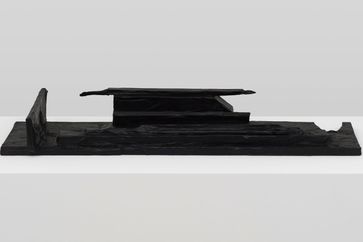
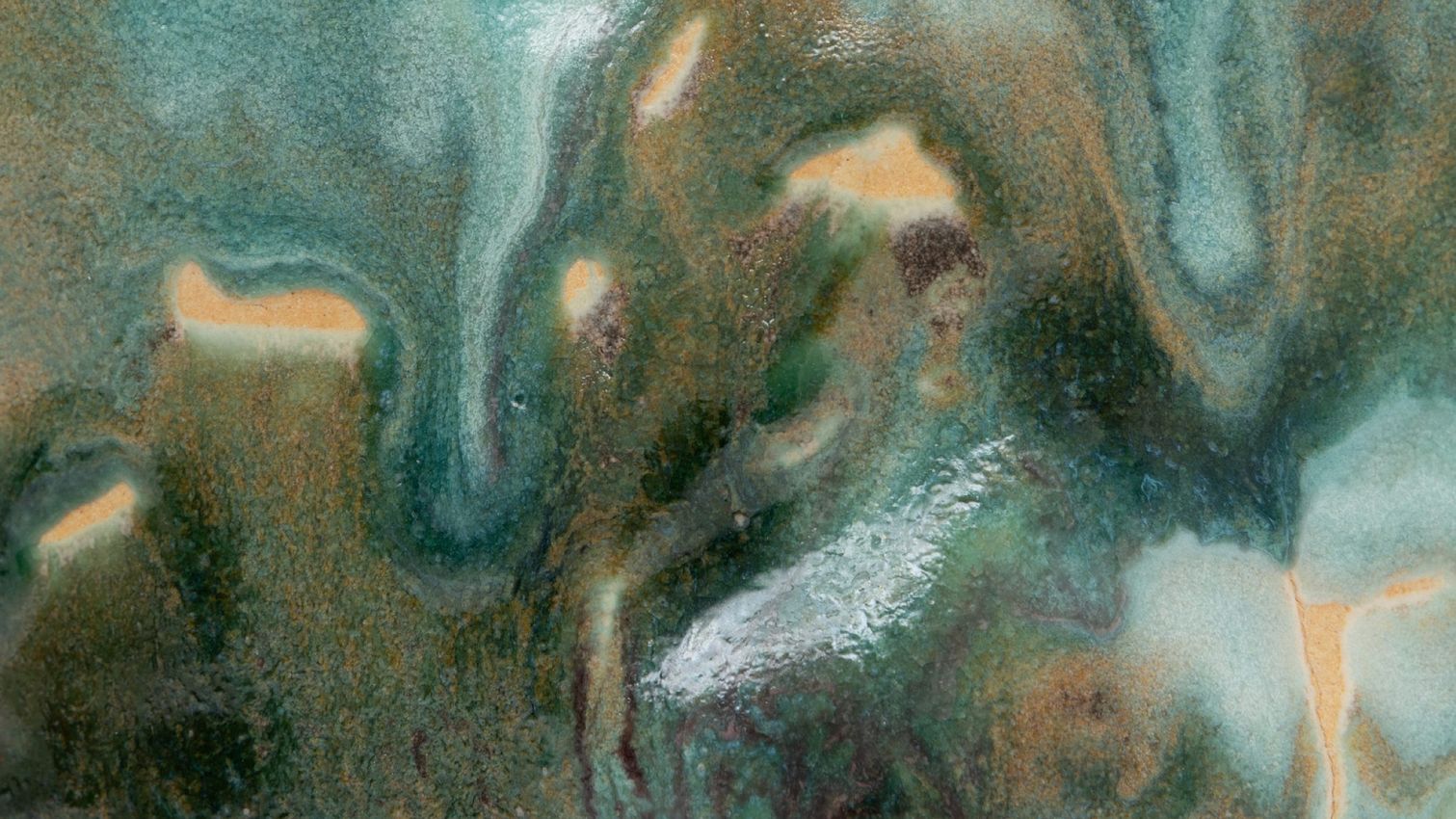
Both exhibitions feature an array of tabletop ceramics that pay homage to the natural world, with glazed vignettes of plants and animals, a sand dune or an ocean wave. Other clay structures resemble humble dwellings or architectural ruins. These rough-hewn objects portray elemental forces and our means of shelter from them: the fundamental drive to make a home, to preserve what might otherwise be lost. The Primeval Forest and The Hearth consider the environmental relations of humans to their surroundings, with the Mediterranean as an abiding source of inspiration. In Golden Sea, a tessellated path of Murano glass tiles evokes a space of fluid circulation, while a series of collages picture sun on water from remnants saved over time and pieced together. Layered and nonlinear, collage is ideally suited to the multiplicity Fattal favors, with truncated forms that convey history’s ruptures as well as its affinities. “We do not and cannot have any real knowledge of the past,” Fattal has said. “We only have fragments.”
Courtesy Greene Naftali.


Simone Fattal’s multi-disciplinary practice draws on a vast range of historical, poetic, and mythological sources, treating time itself as an elastic medium in which the past and present are one. Born in Damascus in 1942, Fattal was raised in Lebanon and educated in Beirut and Paris, where she studied archaeology at the École du Louvre and philosophy at the Sorbonne. She returned to Beirut in 1969 where she began her career as an artist, exhibiting her paintings locally through the start of the Lebanese Civil War. She left the city in 1980 and resettled in Sausalito, California. There she founded the Post-Apollo Press to publish avant-garde and experimental writing from around the world. By 1988, Fattal had resumed her visual art, adding work in collage and stone to her painting practice and taking up ceramics, coaxing a near-animistic quality from the living medium of clay. As Negar Azimi has remarked, her “figures look as old as the earth and yet they breathe.” Fattal eventually returned to Paris where she still resides, working in watercolor, etching, terra-cotta, and lately in bronze, which has granted her primordial forms a new monumental scale.


A respected voice in contemporary art discourse.
Focusing on ambitious storytelling and insightful art-world commentary. Ocula Magazine publishes in-depth interviews, critical essays and timely analysis on the artists, exhibitions and ideas driving the global art world.
Learn more about Ocula Magazine
Showcasing the best of the art world.
Ocula partners with galleries from around the world to highlight their artists, artworks and exhibitions. Gallery membership is by application and invitation, with each member vetted by an independent panel.
Learn more about Ocula Membership

Specialises in the sale of major artworks.
Led by a team with deep ties to the world’s leading auction houses, galleries and collectors. Ocula’s advisory team offers bespoke services to high-net-worth clients from around the world who are looking to acquire the best of contemporary and modern art.
Learn more about our team and services