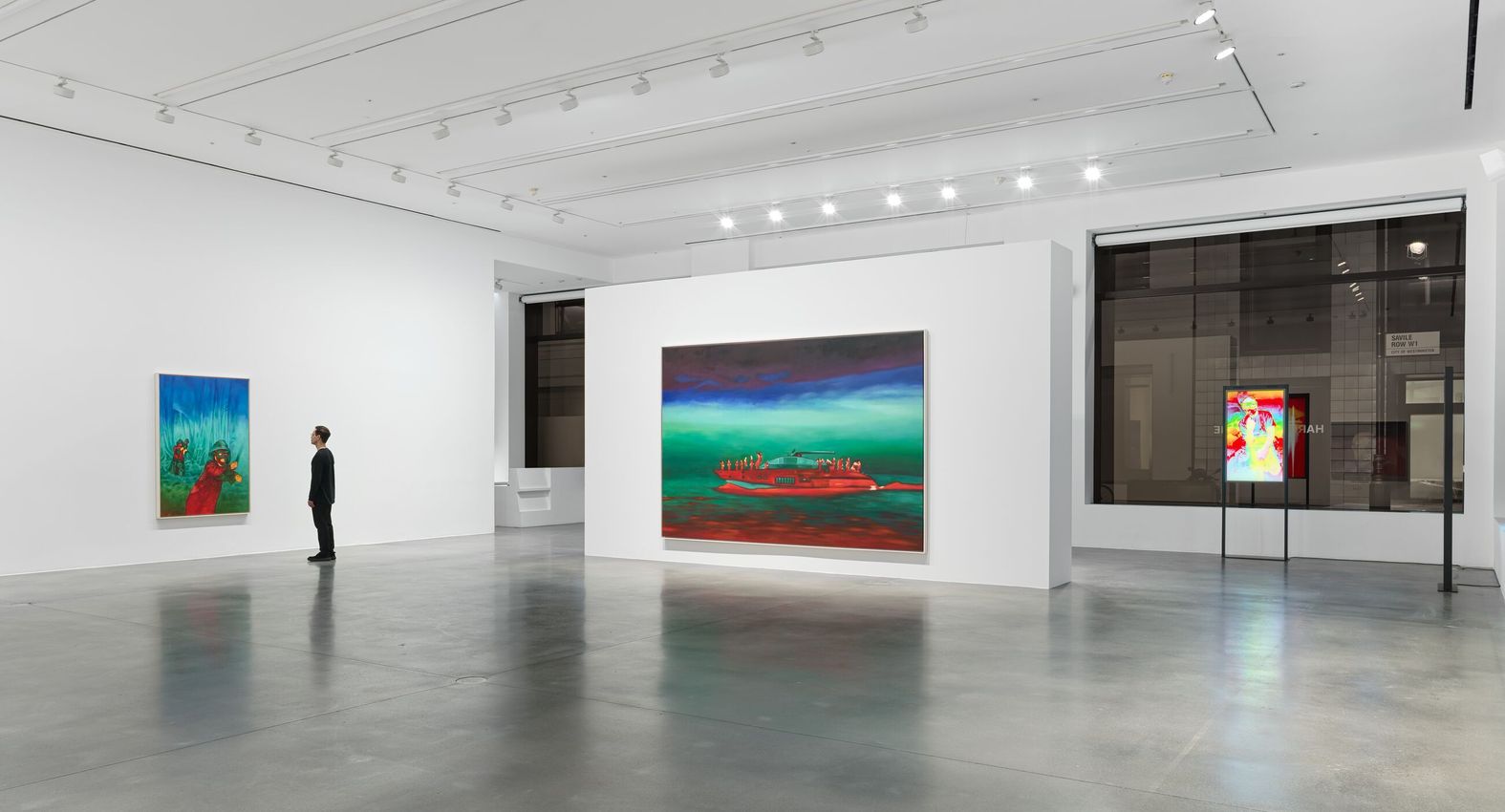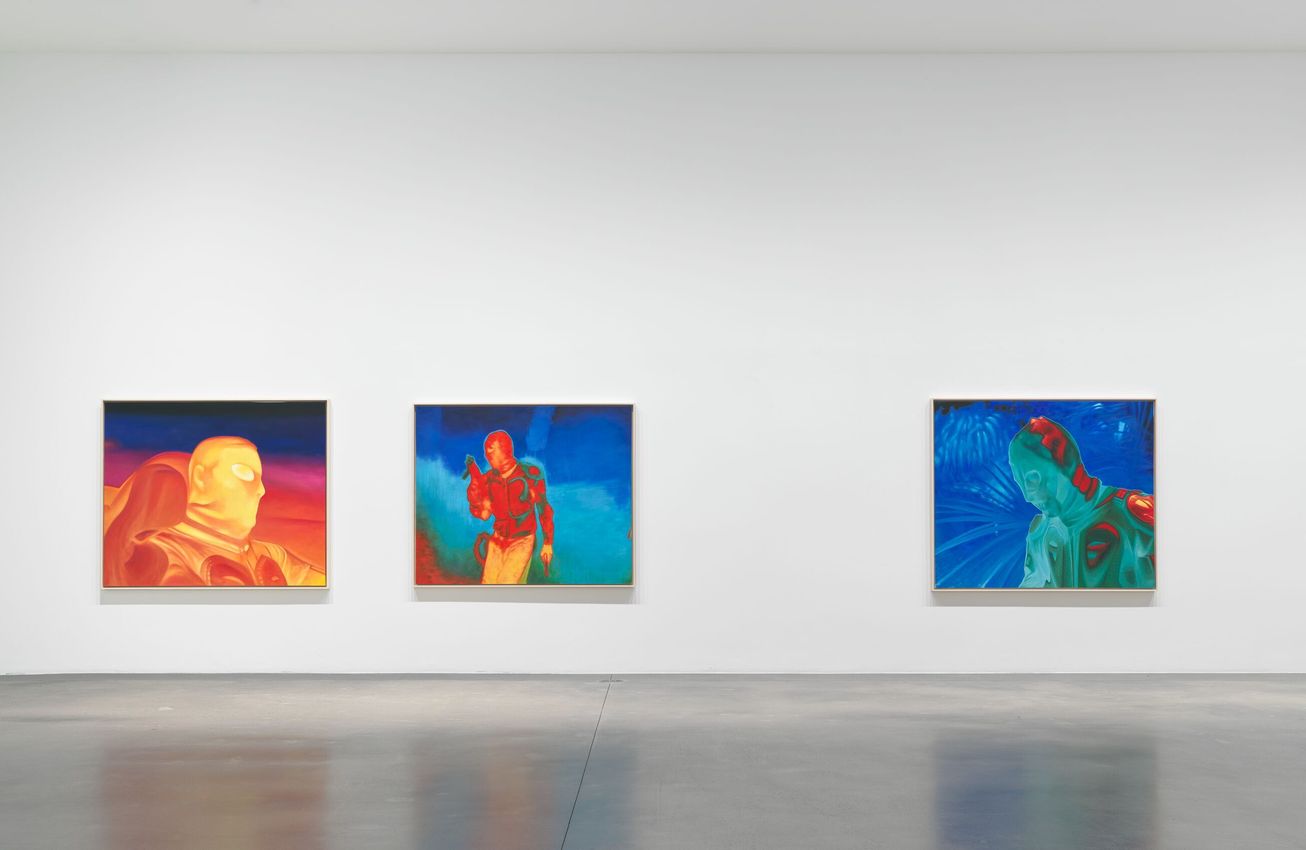




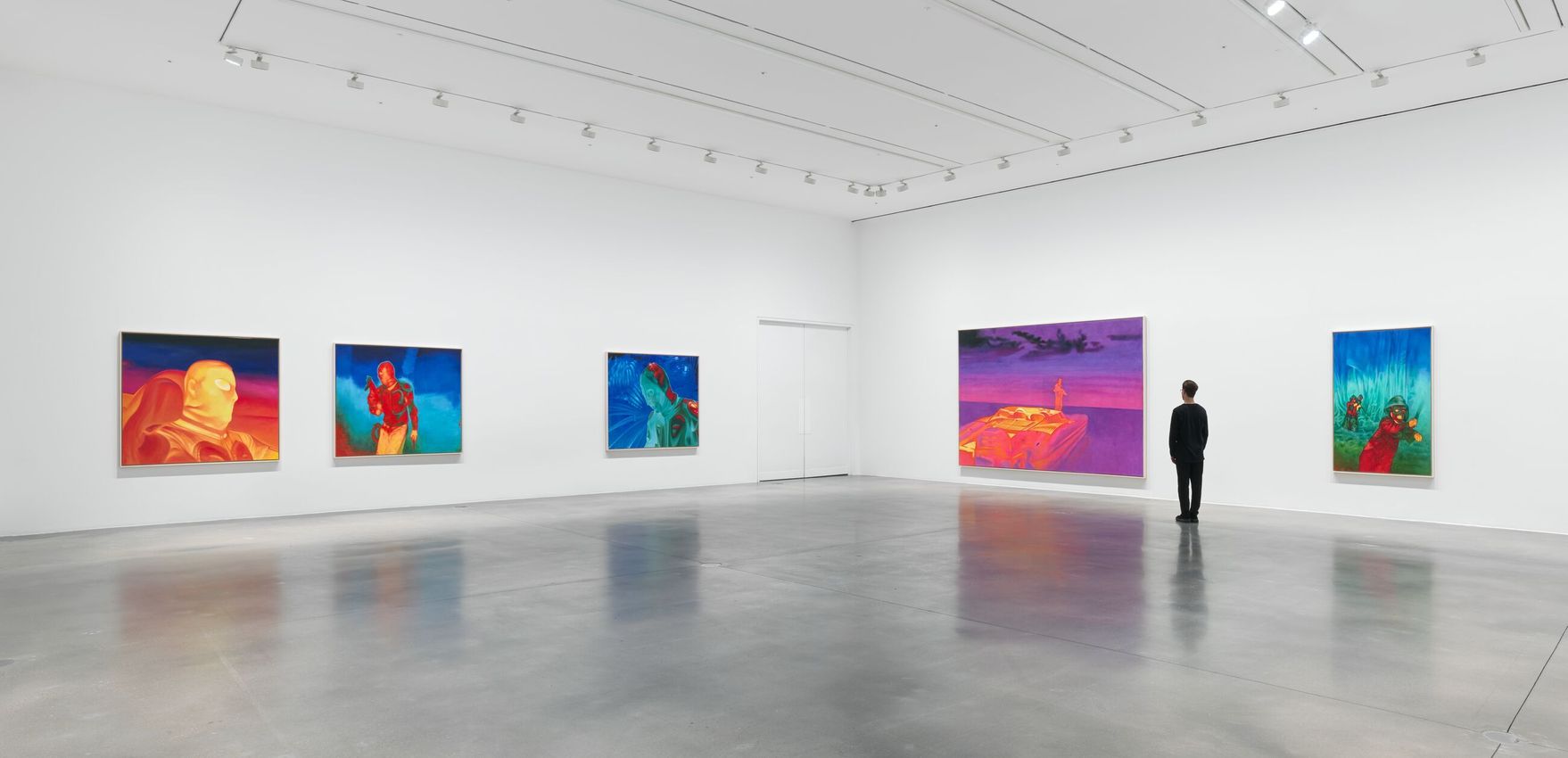
Over the last thirty years, American artist and filmmaker Harmony Korine has cultivated a multidisciplinary practice built upon tireless experimentation. A second chapter to Korine’s 2023 exhibition, AGGRESSIVE DR1FTER, at Hauser & Wirth Los Angeles, this exhibition in London features a series of paintings drawn from his newly released film ‘Aggro Dr1ft’, which premiered at the Venice Film Festival in 2023 and was notably shot using infrared cameras. The exhibition’s acid-hued oils display an unprecedented fusion of Korine’s painting and filmic practices. These hallucinatory works, like his films, blur the boundaries between ‘high’ and ‘low’ in ways that simultaneously attract and repel viewers with their hypnotic, otherworldly atmosphere.
About the exhibition
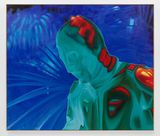
Within Korine’s creative output—from paintings to films and photography—the notion of a singularitybetween forms begins to emerge. As such, ‘every medium gets expanded and de-specified: a film canturn into a painting, a painting can become a film,’ as remarked by Isabelle Graw, German art historian,educator and publisher of the journal Texte zur Kunst, in a conversation with the artist. Wanting to gobeyond normal photography-based film, the infrared images capture a world consisting of colours andenergy. Translated onto canvas with oils, the resulting paintings capture both a stylised world and anessence, a feeling, as in STILTS ZOON X2 (2023). As relayed to Graw, Korine said, ‘I wanted to makepaintings that feel like they’re basically alive. I wondered if one can make works and imagery that look likenothing has preceded them? This project is almost closer to a futurist take on visuals, painting and film.’
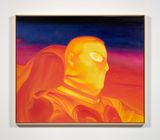
Some paintings, such as Drift XI (2023), focus on close-ups of heads, reflecting the importance of detailsfor the artist. In close to mid-range framing, the infrared camera is able to sensitively detect variationsin thermal energy, heat, which is then transformed into a more detailed image. Harnessing the aestheticpotential of infrared, Korine explains ‘the closer you get, the more heat is pulled from the image and themore alive it looks.’ The resulting paintings evoke a visceral reaction in which viewers can visualize andalmost feel heat from the body, an immersive experience that Korine describes as ‘close to the idea ofbeing inside of a video game’. The technological workings of the camera mean that, within wide shots,lines are softened and the figures’ features are de-emphasized. The further away from objects, the moreimpressionistic the image, producing an unearthly quality. Korine comments that ‘The colors and thegrain structure start to explode the whole idea of lines. They become more about depicting the vibrationof the energy.’
The artist spent time mixing paints to intensify the strength and luminosity of the pigments, seeing how farhe could push paint, the film and the idea of energy. With influences ranging from Martin Kippenberger’splayful paintings to William Eggleston’s vibrant photographs, Korine’s eccentric colour palette of blues,greens, pinks and oranges—dictated by the infrared imagery—not only heightens the sense of livelinessbut also the element of science fiction. REVELATOR MAXIMUS (2023) shows a walking figure, itssurroundings marked by overwhelming monochromatic hues. Variations in shade are important here,from teal to cobalt, forming an unnatural yet ethereal environment. For the artist, ‘the colours are so full oflife [...] At the same time the subject matter and the characters are so grim and dystopian so there’s thisinteresting discourse between the two.’ Compelled to tell a story with his films, Korine’s paintings offer amore immediate encounter with his fantastical world, their subject matter borne from colour and energy.
Press release courtesy Hauser & Wirth
Over the last thirty years, Harmony Korine has cultivated a multidisciplinary art practice that resists categorisation and is admired internationally for the improvisation, humour, repetition, nostalgia and poetry that unite the disparate aspects of his output.


Hauser & Wirth was founded in 1992 in Zurich by Iwan Wirth, Manuela Wirth and Ursula Hauser, who were joined in 2000 by Partner and Vice President Marc Payot. A family business with a global outlook, Hauser & Wirth has expanded over the past 26 years to include outposts in Hong Kong, London, New York, Los Angeles, Somerset and Gstaad. The gallery represents over 70 artists and estates who have been instrumental in shaping its identity over the past quarter century, and who are the inspiration for Hauser & Wirth’s diverse range of activities that engage with art, education, conservation and sustainability.
A respected voice in contemporary art discourse.
Focusing on ambitious storytelling and insightful art-world commentary. Ocula Magazine publishes in-depth interviews, critical essays and timely analysis on the artists, exhibitions and ideas driving the global art world.
Learn more about Ocula Magazine
Showcasing the best of the art world.
Ocula partners with galleries from around the world to highlight their artists, artworks and exhibitions. Gallery membership is by application and invitation, with each member vetted by an independent panel.
Learn more about Ocula Membership

Specialises in the sale of major artworks.
Led by a team with deep ties to the world’s leading auction houses, galleries and collectors. Ocula’s advisory team offers bespoke services to high-net-worth clients from around the world who are looking to acquire the best of contemporary and modern art.
Learn more about our team and services