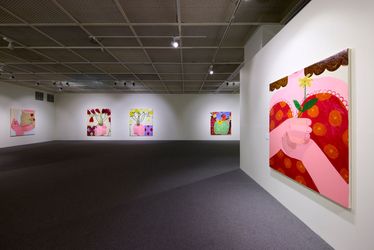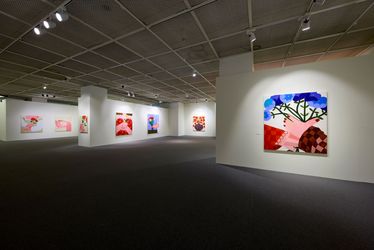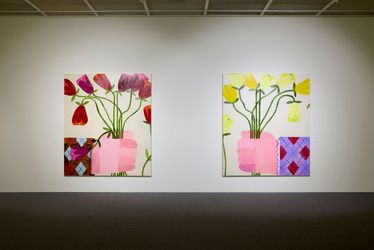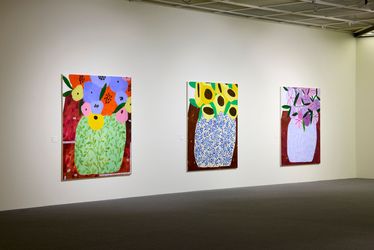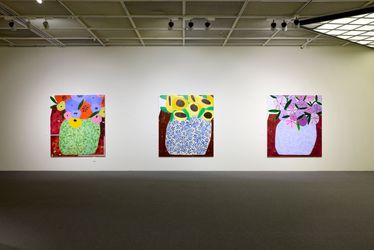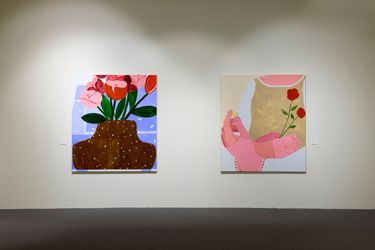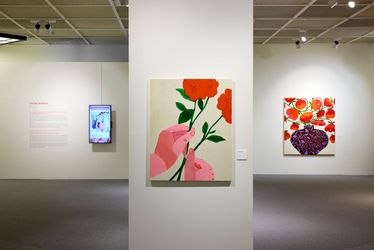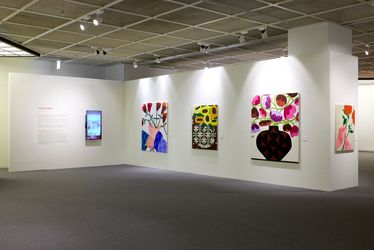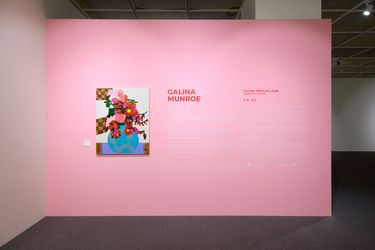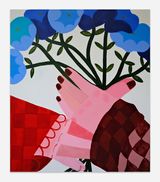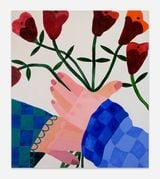
British-French painter Galina Munroe (b. 1993) has become known for her uniquely recognisable, colourful, and ebullient compositions of floral arrangements that at first glance appear aesthetically simplistic but, on closer inspection, are revealed to be subtle meditations on the nature of paint and the history of art made by women. In 2014, Munroe received her undergraduate degree from the European Academy of Art in Brittany, and two years later, she earned her graduate degree from Central Saint Martins in London. Her exuberant art pieces draw upon the ‘ghost’ of Western feminine and domestic art traditions, engaging with themes of decoration, beauty, sentimentality, empathy, and pleasure— elements decisively overshadowed by the dominant narrative of male painters and their more openly powerful subjects.
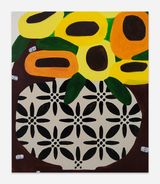
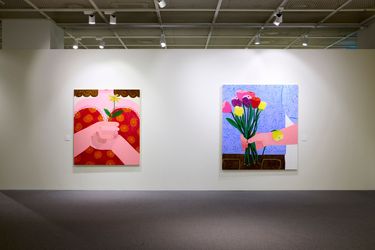
The strength of Munroe’s paintings is that they are not merely a testimony to the wrongs suffered by women artists throughout history. Her tale is about something much larger than grievance. There is a vein of optimistic rebellion that invites us to engage with alternative modes of being. Love me till i’m me again is an exhibition focusing on the small intentions of gifting flowers and their quiet power to communicate. At a time when there is a widespread hunger for new ways of inhabiting the planet, gestures of holding and sharing flowers not only bring long-overdue recognition to women’s craft and decorative art, but also encourage a different kind of atunement to the world and our place in it, one that is based on love, generosity, caring hands, and consideration.
Flowers are a motif that Munroe returns to time and again, drawn by their beauty and the pleasure she finds in painting them. However, a significant evolution can be observed from her earlier creations, where formal concerns about colour, composition, and movement were paramount, to the narrative approach seen in her current works. Now, she uses the symbolism of flowers to tell stories, to send out messages, to speak with her audience. The energy remains the same, but it has shifted outwards. ‘My paintings are love letters to the world,’ she says, ‘sometimes joyful, sometimes melancholic, written in blossomy colours and forms.’ She traffics in the language of flowers as if it were her own voice—uncontrived, gentle, yet perfectly expressive. Sunflowers whisper her brightest hopes; roses and tulips, her sanguine desires; bluebells, her daydreams.
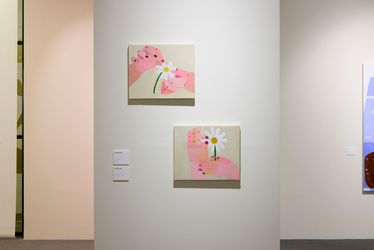
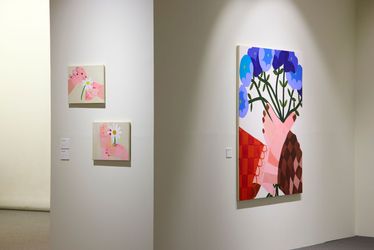
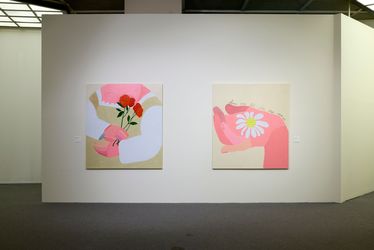
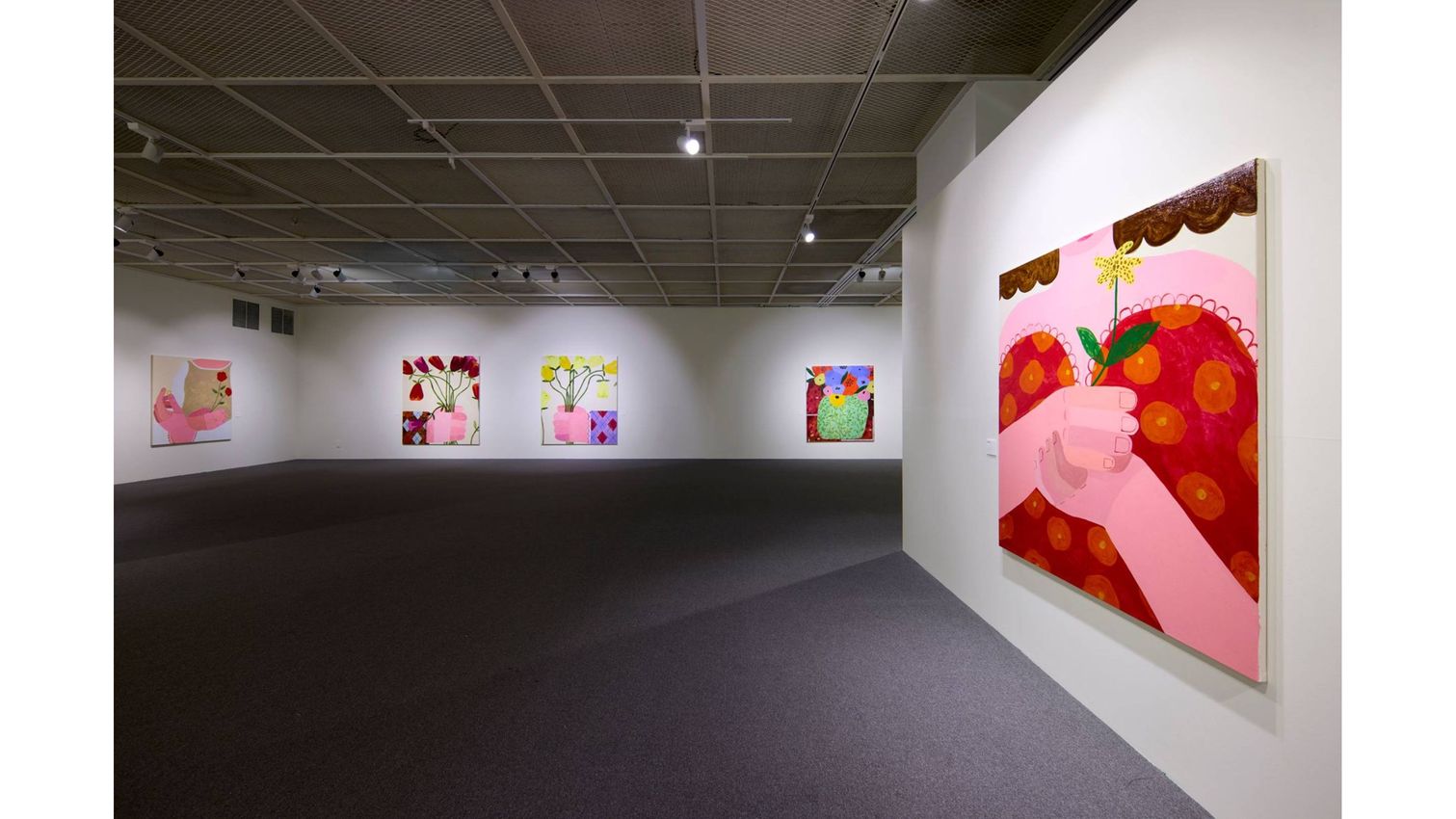
For all the art historical invocations in Munroe’s new work, from Artemisia Gentileschi and Mary Cassatt to Georgia O’Keefe and Hilma af Klimt, one of the precedents might be most resonant and haunting because working unconsciously: Lucas Cranach the Elder’s Eve. Munroe revealed that it was only after completing love me till i’m me again—the painting that lends its name to the exhibition – that she realised the hand in her canvas, tenderly open with a daisy in its palm, strikingly echoed the gesture of Eve offering the forbidden apple to Adam in Cranach’s 16th-century masterpiece. The hand is so soft and the gesture so immaculate that viewers might even reconsider the menacing reputation of Eve’s gift. Anyway, the centrality of the hand’s gesture here prompts a double consideration. First, hands, much like flowers, speak quietly, but powerfully; they can provide an artist with a rich and versatile visual vocabulary to display feelings, intentions, and secret meanings. Second, hands are likely to play an increasingly dominant role in Munroe’s work. It is easy to imagine her navigating through the language of gestures just as she mastered the language of flowers.
‘I have begun to look at my works as a form of protesting against the brutality we witness persistently in our daily life. The darker our life becomes, the lighter my paintings must appear,’ states Munroe. When everything seems to fall apart, we need more patience, more grace. We need more love letters—crafted with mastery, subtly scented with the fragrances of our inner garden. Is all of this inevitably feminine, after all? One thing is certain: Munroe suggests that what the world truly calls for is not another eulogy to power, but a new, life-affirming politics of softness.


Since its establishment in 2012, JARILAGER Gallery (Cologne/Seoul) has played a pivotal role as the holding company for UNION Gallery (London) and has expanded its reach with the recent opening of its doors in Seoul’s Gangnam district in 2023. Jari Lager serves as the director of both entities. Over the course of a decade, JARILAGER Gallery (Cologne/Seoul) has evolved into a distinct entity while maintaining collaborative ties with its sister gallery, UNION Gallery, located in London and managed by William Gustafsson.

A respected voice in contemporary art discourse.
Focusing on ambitious storytelling and insightful art-world commentary. Ocula Magazine publishes in-depth interviews, critical essays and timely analysis on the artists, exhibitions and ideas driving the global art world.
Learn more about Ocula Magazine
Showcasing the best of the art world.
Ocula partners with galleries from around the world to highlight their artists, artworks and exhibitions. Gallery membership is by application and invitation, with each member vetted by an independent panel.
Learn more about Ocula Membership

Specialises in the sale of major artworks.
Led by a team with deep ties to the world’s leading auction houses, galleries and collectors. Ocula’s advisory team offers bespoke services to high-net-worth clients from around the world who are looking to acquire the best of contemporary and modern art.
Learn more about our team and services