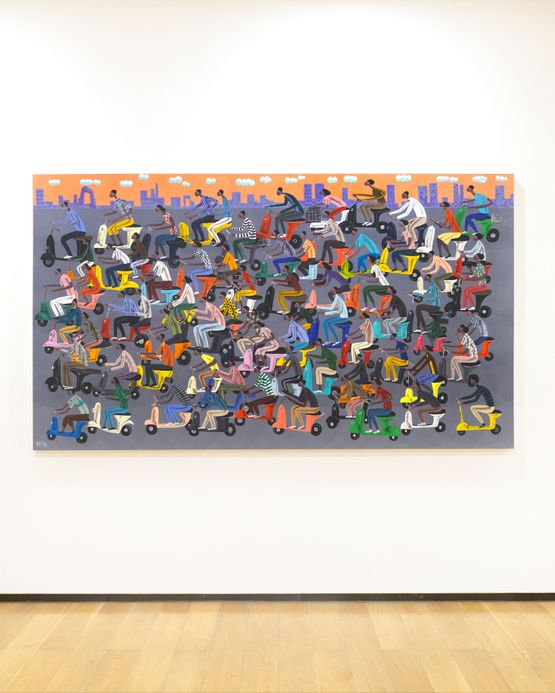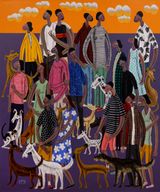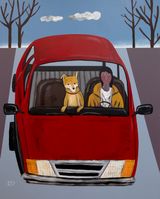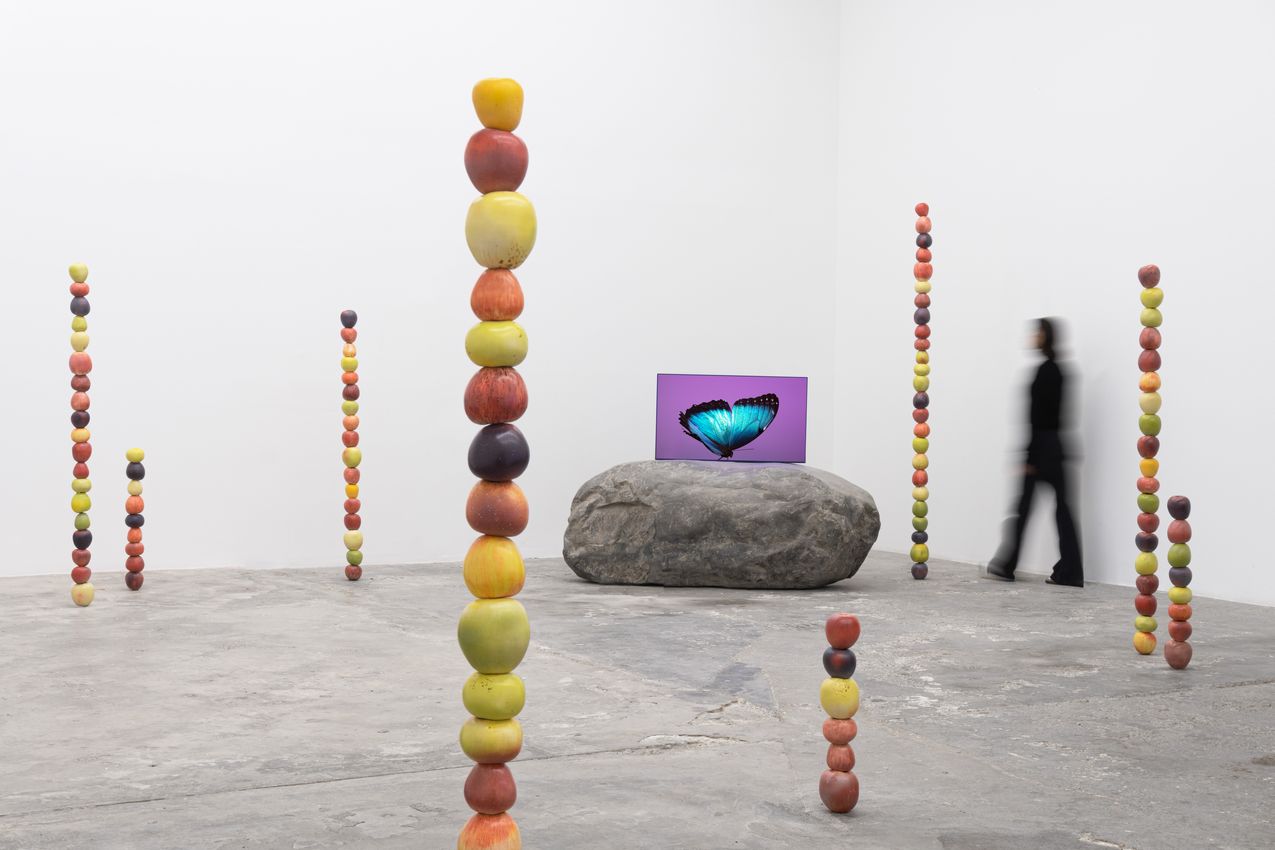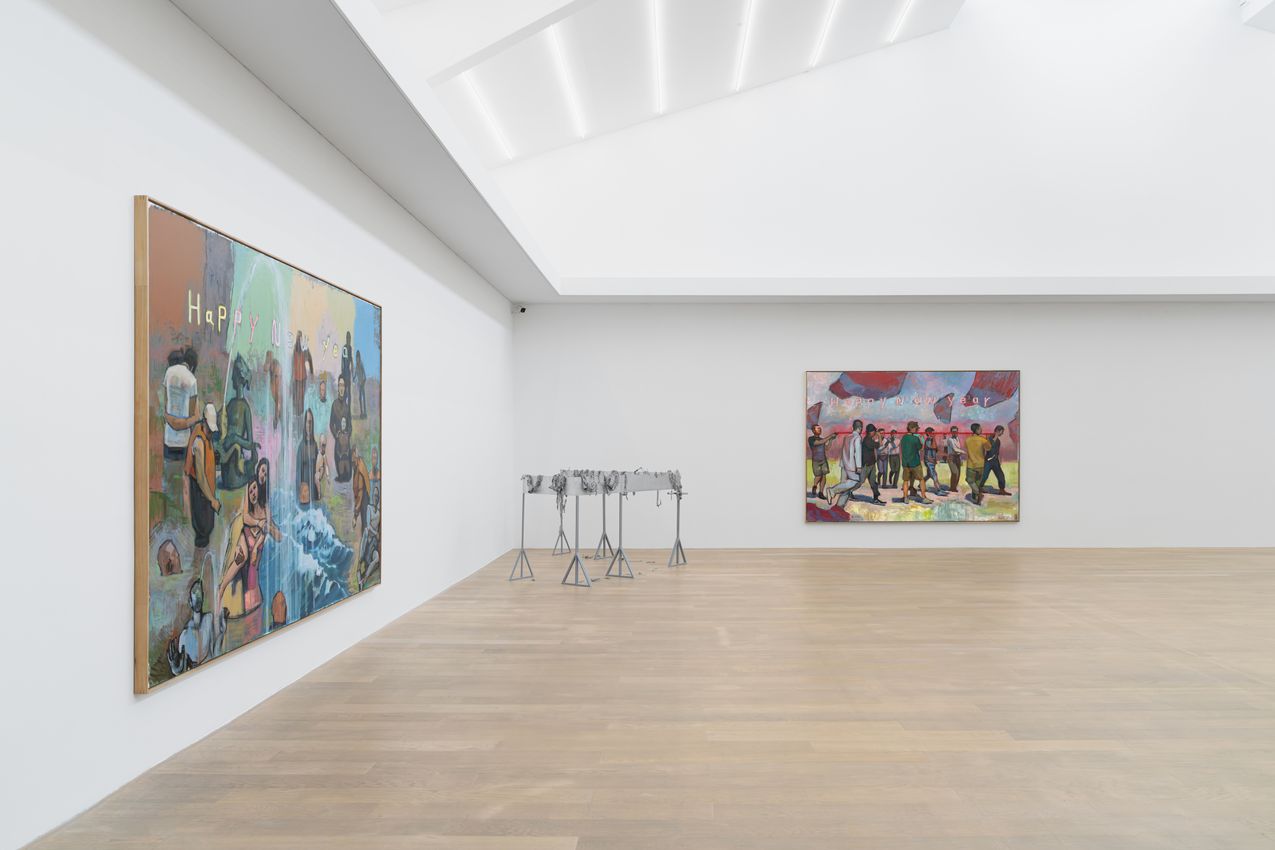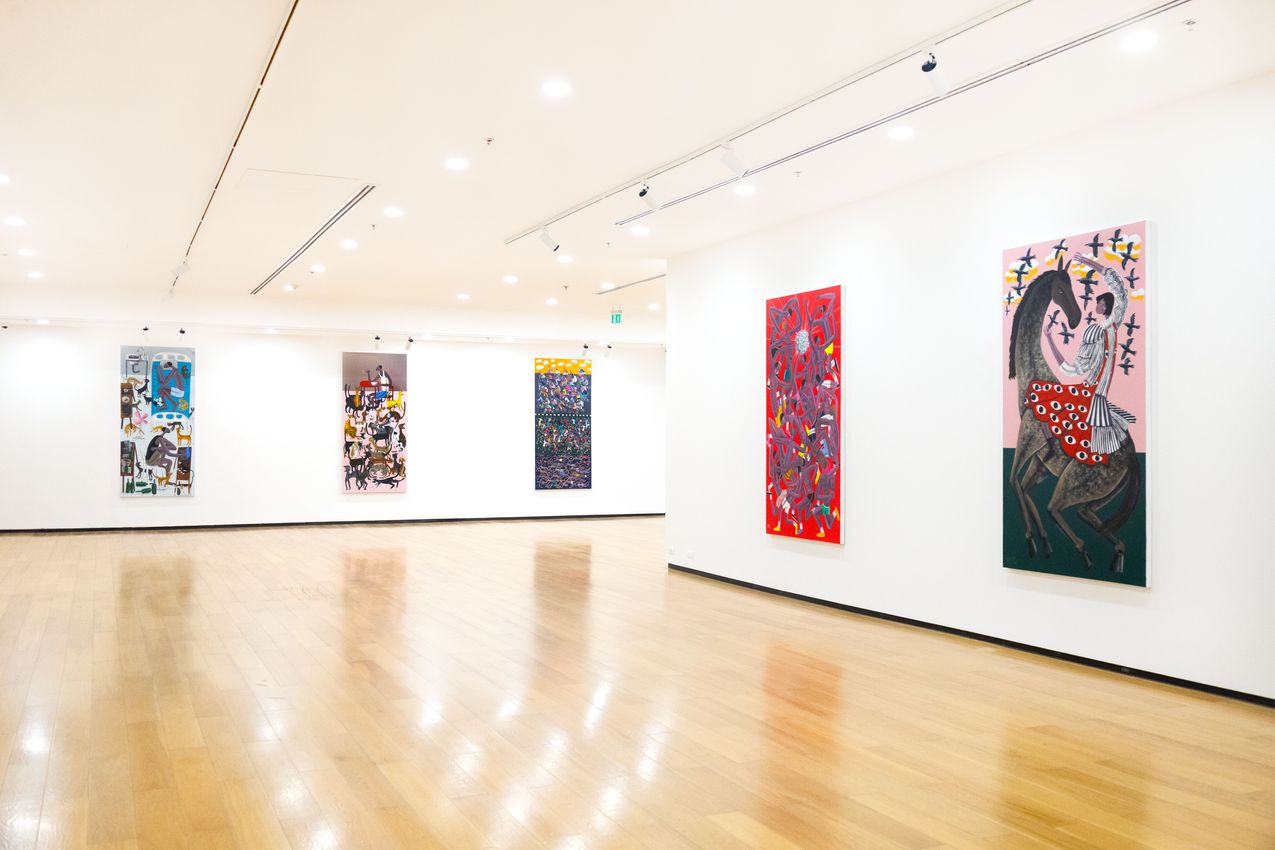
Tang Contemporary Art presents A Place We Share, the solo exhibition of Thai artist, Kitti Narod, in its Bangkok space, running from 12 September 2026 to 18 October 2026.
Returning to Thailand with a solo exhibition for the first time since Fragrant City in 2021, Narod looks closely at how our ways of living and seeing have changed. His new paintings draw from personal experience, contemporary news, social media, popular culture, history and mythology, bringing together seemingly disparate fragments of the present. What connects them is the artist’s continuing interest in how we understand ourselves in relation to others—and how, despite the divisions and uncertainties of contemporary society, we might continue to share the same world.
Kitti Narod’s paintings imagine a world in which difference and togetherness can coexist with ease. His figures inhabit shared spaces, embrace one another, move through nature, and participate in the ordinary rhythms of daily life. There is a sense of utopia in these scenes, but Narod’s optimism is not detached from reality. Rather, it emerges from his attention to the small moments, relationships and social changes that make everyday life meaningful.
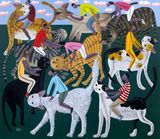
The relationship between the personal and the contemporary is particularly evident in one of the exhibition’s most intimate works, Room. Based directly on Narod’s experience of everyday life with his partner and cats, the painting is like a visual diary: a record of care, companionship and the routines of home. By elevating these seemingly mundane moments into a large-scale painting, Narod suggests that the everyday is itself worthy of attention. In a culture increasingly dominated by the speed and volume of images, simply noticing how we live can become an act of appreciation.
The majority of the paintings adopt an unusually tall 9:16 format, echoing the proportions of smartphone screens and the vertical reels of contemporary social-media platforms. Narod draws inspiration from the fragments encountered while scrolling—news, images, stories and fleeting moments that are absorbed almost unconsciously. By translating this digital dimension into physical paintings, he creates a tension between the immediacy of the screen and the slower, embodied experience of standing before an artwork. The familiar proportions of a phone become unfamiliar when encountered at human scale, prompting us to reconsider how we consume images and inevitably perceive the world around us.
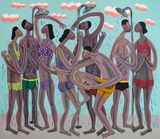
If the digital world has created new forms of connection, it has also created new forms of exposure. Another work, Embarassed, brings together a collective of figures who appear to withdraw into themselves, covering their bodies in response to the vulnerability of being seen. The painting reflects on the increasing tendency to share our lives, backgrounds and personal experiences online, while simultaneously confronting the criticism and judgment that can follow. Yet the figures are not isolated. Their shared gesture transforms individual embarrassment or insecurity into a collective experience, suggesting that vulnerability is something that connects rather than separates us.
The idea of a shared space becomes more expansive in another major work, In the Woods with No Context, where figures of different ages, bodies and identities occupy a colourful public landscape. Here, Narod shifts his attention away from the figures alone and gives equal importance to the surrounding trees, grass and sky. A small UFO appears almost playfully in the distance, reflecting the artist’s habit of absorbing contemporary news and unexpected images into his visual world. The landscape becomes a model of coexistence: a public space in which different people can participate freely and equally, without one way of living taking precedence over another.
Narod also revisits motifs from his earlier paintings to consider how their meanings can change over time. His recurring figures floating together in water, often dressed in stripes, once suggested confinement. In the new work, Bare in Water, however, the figures take on a greater variety of bodies and forms. The stripes remain, but what once appeared restrictive can now be understood as clothing, fashion and an expression of identity. The transformation reflects a broader social shift: difference is increasingly understood not as something to conceal, but as something to embrace.
This belief in change is also reflected in Ritual, expressing the celebration of the legalization of same-sex marriage in Thailand. Rather than presenting social progress as complete, the painting recognizes a significant step forward while acknowledging that there is still work to be done. For the artist, these moments matter precisely because progress is often incremental. To recognize and celebrate a small victory is not to ignore what remains unresolved, but to acknowledge the possibility of change.
Alongside these contemporary references, Narod continues to draw from culture, history and mythology. His reinterpretation of Phra Mae Thorani, the Thai manifestation of the Hindu goddess Prithvi Mata, transforms a familiar religious image into an intimate contemporary scene in the artwork of the same name, Prithvi Mata. Rather than painting the goddess in her Thai traditional depiction of wringing water from her hair, Narod portrays her embracing another figure, surrounded by nature. Myth becomes less a fixed historical narrative than a living source of imagery through which ideas of protection, care and human connection can be reconsidered.
Across this new body of work, Narod does not claim that society has arrived at the utopia his paintings suggest. Instead, he locates the possibility of such a world in the small acts and changes that happen around us: caring for those close to us, accepting difference, sharing public space, allowing ourselves to be vulnerable, and recognizing progress when it occurs.
In an era in which so much of life is experienced through rapidly moving images and increasingly divided forms of public discourse, Narod’s paintings invite us to pause. They ask us to look again at what might otherwise seem ordinary—and to consider whether joy, connection and equality may already be present in small, imperfect forms.
A Place We Share is ultimately less a picture of an ideal world than an invitation to imagine how we might make room for one another within the world we already inhabit.
Text by Cynthia Liu


Kitti Narod trained at the Wittayalai Poh Chang Art College, Bangkok from 1996-1998 and later obtained his Bachelor of Arts degree from the Rajamonkong Institute of Technology, Bangkok, Thailand in 2000. He has exhibited extensively in Bangkok and internationally, including London, Bath, Edinburgh, Manchester, Dublin, Cork, Montreal, Melbourne, and Shenzhen.


Tang Contemporary Art was established in 1997 in Bangkok, later establishing galleries in Beijing and Hong Kong. Tang Contemporary Art is fully committed to producing critical projects and exhibitions to promote Contemporary Chinese art regionally and worldwide, and encourage a dynamic exchange between Chinese artists and those abroad.

A respected voice in contemporary art discourse.
Focusing on ambitious storytelling and insightful art-world commentary. Ocula Magazine publishes in-depth interviews, critical essays and timely analysis on the artists, exhibitions and ideas driving the global art world.
Learn more about Ocula Magazine
Showcasing the best of the art world.
Ocula partners with galleries from around the world to highlight their artists, artworks and exhibitions. Gallery membership is by application and invitation, with each member vetted by an independent panel.
Learn more about Ocula Membership

Specialises in the sale of major artworks.
Led by a team with deep ties to the world’s leading auction houses, galleries and collectors. Ocula’s advisory team offers bespoke services to high-net-worth clients from around the world who are looking to acquire the best of contemporary and modern art.
Learn more about our team and services