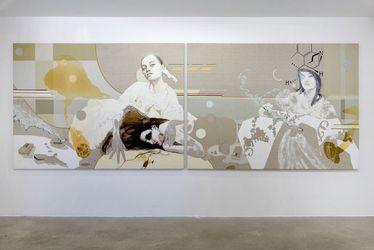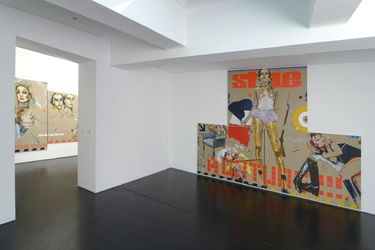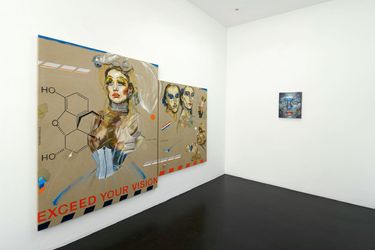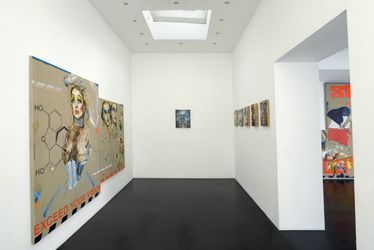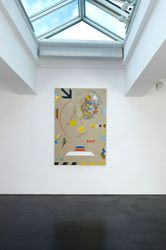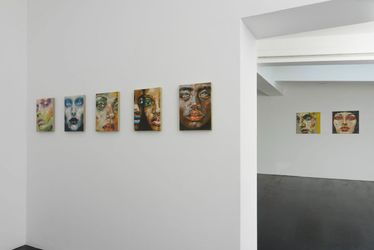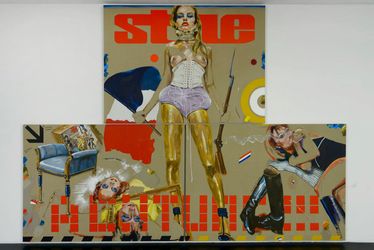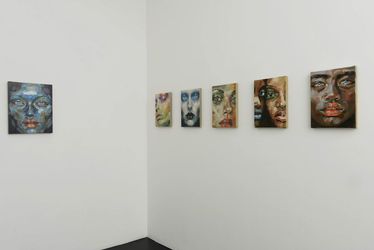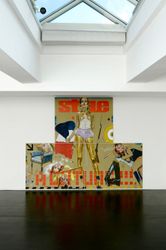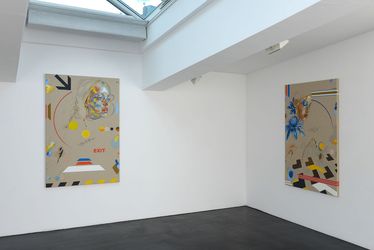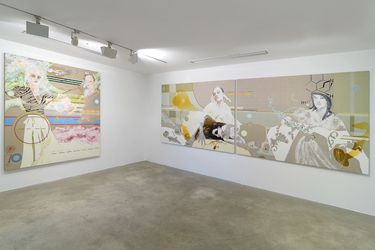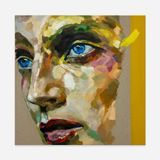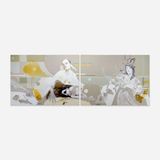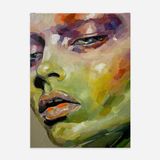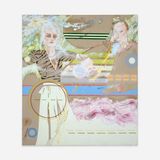




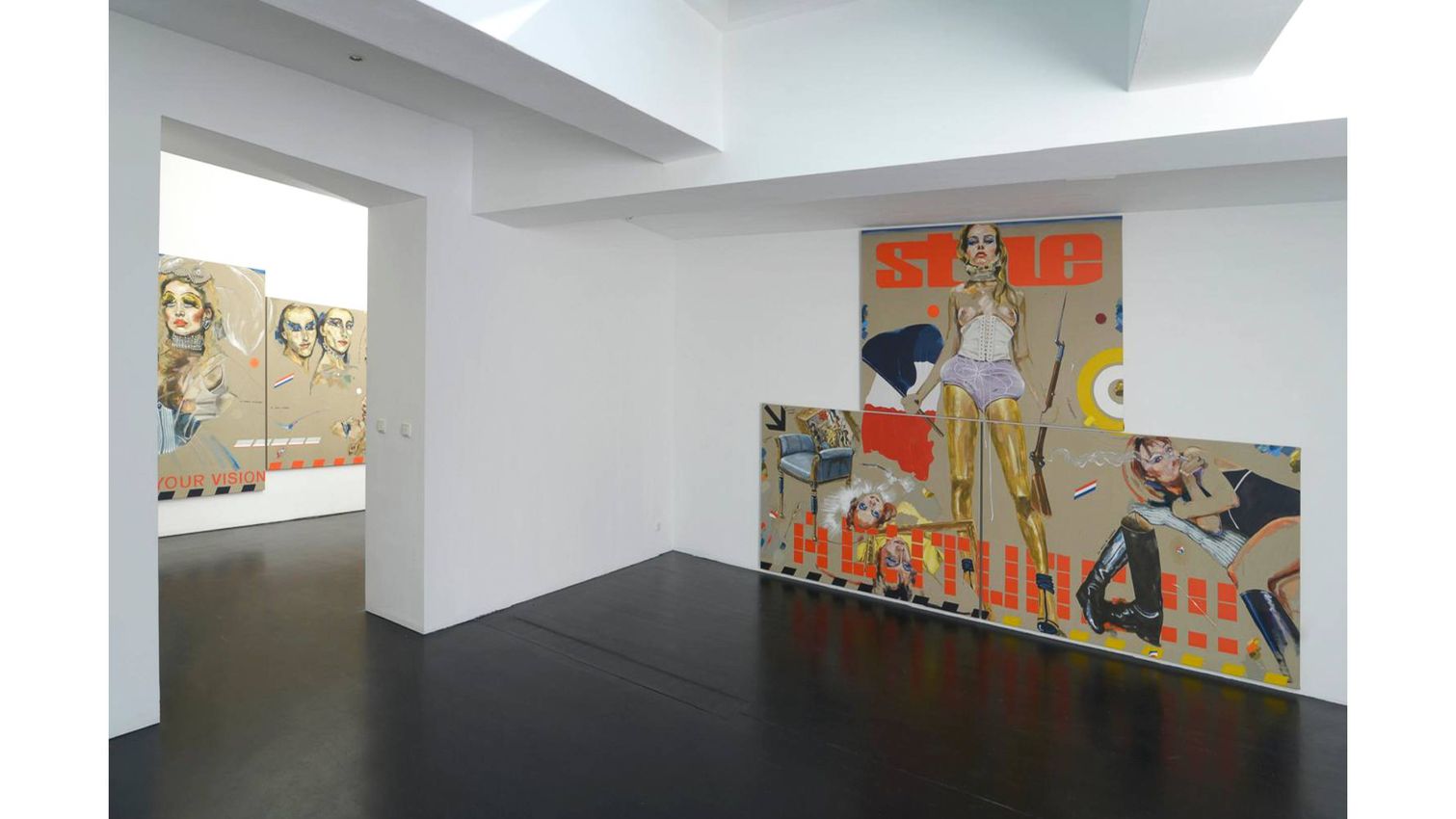
In a new series of large format paintings, characteristically divided into several parts, Parsey explores a fascination with history painting, starting with the largest and most significant of the French romantic movement, namely Delacroix and Géricault. Here she approaches the enigma of Delacroix’s vast and significant painting, ‘Liberty Leading the People’, with a triptych that combines both the landscape with the portrait format, as does Delacroix’s painting that looms large in the Louvre. These are paintings and histories so vast that few contemporary artists would dare to go near them. Here Parsey boldly grabs it by both hands, takes a pillar of painting history and does her own contemporary modern version.
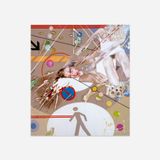
The painting is beset with signifiers of meaning, from the apparently guillotined heads rolling in libertine satisfaction on the floor, to the Louis XIV furniture or the inscriptions of text taken from Ravel’s ‘Shéhérazade’ with the constant repetition ‘je voudrais voir’- I want to see. With an almost cheeky sketch of the original painting hidden behind an antique stool, this is a playful and confident nod to art history with an adeptness and sleight of hand, and the warning ACHTUNG!!! across the bottom of the painting. The painted boots of Napoleon - signifiers of power are always to be found in her work and many of these are genderized- represent the male martial force that seems impotent against the female force of the central figure. Armed with a flag and a bayonet, her beauty and innocence disarming, her erotic power is only surpassed by the strength of her stance, the bare-chested Liberty; the mother of the nation.
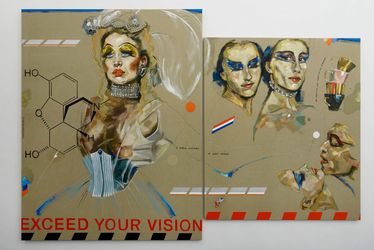
These paintings draw together an ongoing interest in the writers of the Enlightenment, like Voltaire and de Sade and an interest in the great French romantic painters. These can be seen in her diptych ‘Les Malheurs de la Vertu’ the subtitle of De Sade’s ‘Justine et Juliette’. It is not by accident she adds Ravel’s lines to the painting ‘Je voudrais voir des assassins souriants, du bourreau qui coupe un cou d’innocent’. – I long to see assassins smiling as the executioner cuts o[ an innocent head. In ‘Les Malheurs...’ we see a rare depiction of the male figure in the right canvas. Parsey says that these figures that began as female often hover between sexes. ‘There are very fine, almost insignificant diFerences in the painting that can push it in either direction’.
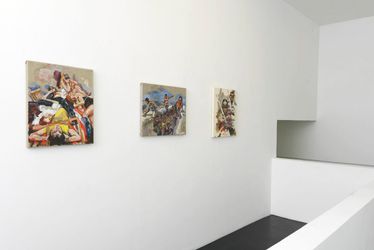
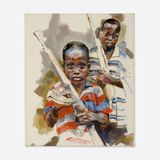
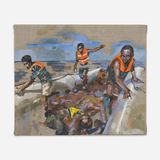
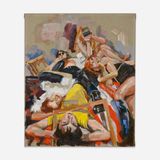
An important aspect of these new paintings is her absolute trust and confidence in her painting. ‘These paintings have come about very intuitively, they work almost like raw sketches as nothing has been taken away. I want you to be able to see the bare canvas, the drawing, its structure.’. This is clearly an attitude and intuition that has been honed after many years of painting. This is the first time she has painted small oil sketches in preparation. These are contemporary versions of ‘Liberty Leading the People (after Delacoix)’, which looks almost like a Libertines LP cover, ‘The Raft of the Medusa (after Géricault’), a sharp and shocking take on the current migration crisis and ‘The Execution of Maximilian (after Manet)’ with a couple of small boy soldiers deep in South Sudan.
An inherent violence in her work can be traced to her film work on Francis Bacon- she recently completed her film trilogy with BACON’S HISTORIES; Study for a Portrait, along with the publication with the Bacon Estate of the unedited interviews by David Sylvester, with whom she had an ongoing collaborative friendship. David Sylvester wrote: ‘I like Martha Parsey’s paintings for their electric charge, their bitter taste, their threat of erotic danger, by the way they make me think of films like ‘Wild at Heart’. The sexual threat in ‘Rip her to Shreds’ can be linked to Bacon’s seminal work ‘The Buggers’ although the dominance of female sexuality echoes back to the work of Helmut Newton who resonates throughout her oeuvre. A number of early works give greater depth to the genesis of these ideas. In one of these key works ‘Under the Influence’ we see the first use of the chemical opium symbol that re-emerges in ‘Les Malheurs de la Vertu’.
‘Liberty Leading the People’ is a timely critique of attacks on modern democracy and a call to arms to resist autocracy, but it is also an exhibition that celebrates painting and delivers it in abundance. It’s bold, it’s tough, and for a Londoner living in Cologne it o[ers a stark and refreshing take on modern painting.


The beginning of the JARILAGER Gallery traces back to 1998 when Jari Lager first opened his artist run space VTO in the East End of London, while also working at the LISSON Gallery, this was followed with the opening of UNION Gallery in 2003 on Union Street at Bankside near the Tate Gallery.

A respected voice in contemporary art discourse.
Focusing on ambitious storytelling and insightful art-world commentary. Ocula Magazine publishes in-depth interviews, critical essays and timely analysis on the artists, exhibitions and ideas driving the global art world.
Learn more about Ocula Magazine
Showcasing the best of the art world.
Ocula partners with galleries from around the world to highlight their artists, artworks and exhibitions. Gallery membership is by application and invitation, with each member vetted by an independent panel.
Learn more about Ocula Membership

Specialises in the sale of major artworks.
Led by a team with deep ties to the world’s leading auction houses, galleries and collectors. Ocula’s advisory team offers bespoke services to high-net-worth clients from around the world who are looking to acquire the best of contemporary and modern art.
Learn more about our team and services