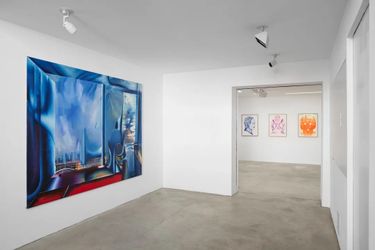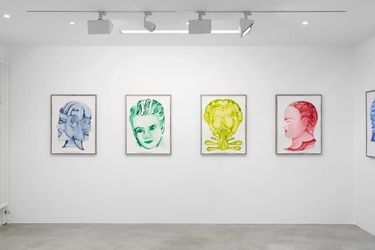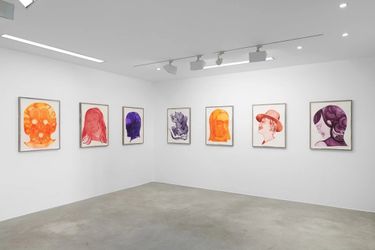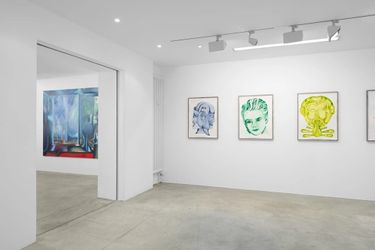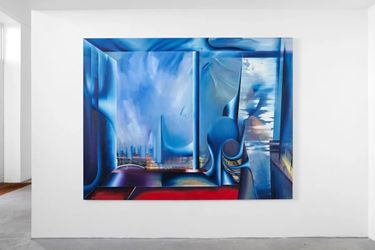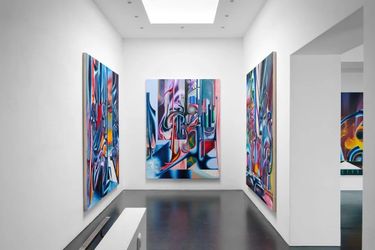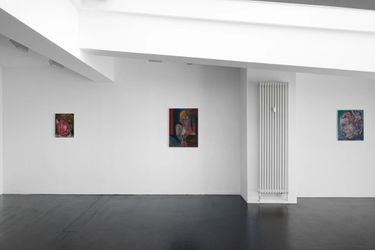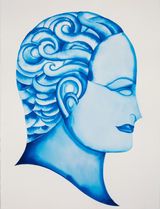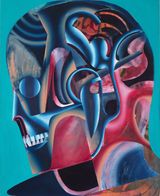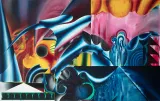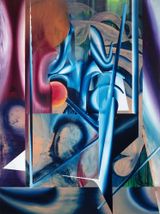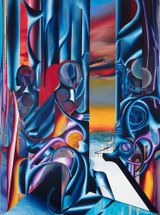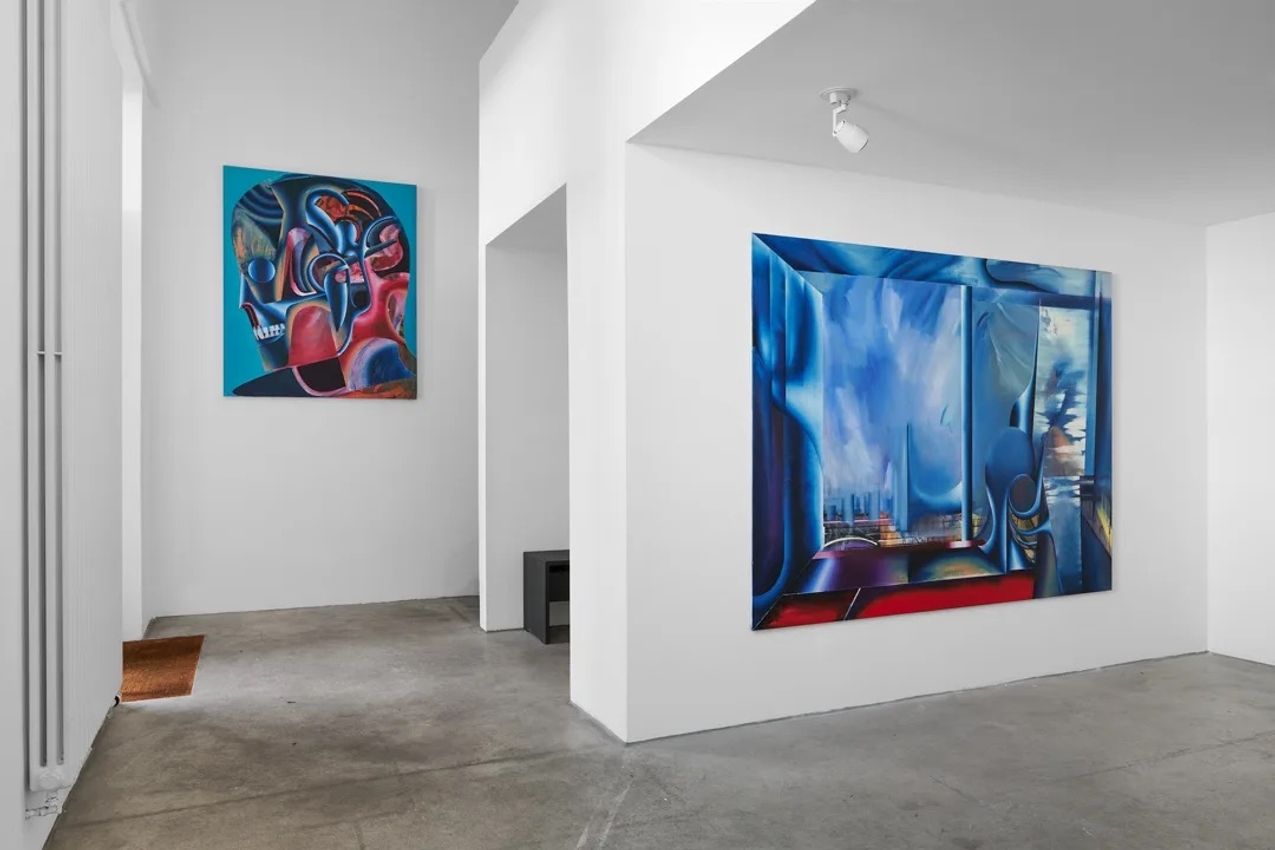
Sebastian Gögel (1978) is back at the JARILAGER Gallery after two years, this time with a majestic solo exhibition that questions the timeless restlessness of a humanity in search for its own form. Rohe Gestalt (Raw Form) is both an ancestral trip into the archetypes of our Psyche and Habitat and an utterly contemporary phenomenology of demons. Behind Gögel’s confident demeanour, lies a passionate minister of discomfort. His models are fallen creatures who have lost the key to the dream of infinite spirit and are now bound to a promise of redemption which is never to be achieved. Form is cruel: the world is a riddle. Gögel’s œuvre has a feeling of misplacement in the blood. We may scorn the violence of his portraits or abhor the infinite uncanny in his paintings; they are nonetheless our heritage, our capital of grimaces, the symbol of our spasms here on earth.
Gögel defines himself as an abstract surrealist and a demonic existentialist. As an abstractionist, he masters the secrets of metaphysical spatiality and the perpetuum sound of the ‘Harmony of the spheres’. As a surrealist, he fuses this sound with the materiality of naturalistic landscapes—industrial cities, mostly—which seem to be born out of the oneiric fantasies of a cruel God. His existentialism fraternises with the pages of Emil Cioran’s The Temptation to Exist. Cioran writes that humanity is ‘a race of Convulsionaries at the centre of a cosmic farce’. Similarly, the characters in Gögel’s charade are grotesque vampires who are tempted to exist, but never find their way to do so. They have imprinted on the universe the stigmata of their history and shall never be capable of that illumination which would let them die in peace. They can do nothing but glimpse it from the distance, peeking through the slits of a lock. Gögel’s universe is an inferno of shadows mutually devouring each other, only to be digested and evacuated by an Oracle who speaks on behalf of an evil God. Again, just as in Cioran’s ‘atheology’, God is a sinister Demiurge who mocks his creatures, and indeed takes sadistic pleasure in tormenting and torturing them. In such a world, every birth is a ‘misbirth’—perhaps, it would be better not to have been born at all.
Gögel’s paintings are a reverie of shapes and colours. He is thoroughly baroque. Multidirectional movement, bold perspective views, strong chiaroscuro contrasts, sudden lights, trompe-l’œil and polycentric figures—everything is about drama and ornamental energy. As a matter of fact, ornament has come to play a central role in Gögel’s cosmos. As he likes to stress, ornament condenses the effort of a cognitive process. Rohe Gestalt also means that knowledge is expression. Psyche is nothing but a redundance of extroverted signs that allow themselves to be read from the outside. In Gögel’s compositions, it’s hard to tell what happens on the inside and what happens on the outside. Every ‘inside’ is a fold of the outside, but every ‘outside’ is in turn a manifestation of the inside. The word ‘visage’ can, without twisting language, be used for Gögel’s portraits, but also for his suspenseful landscapes and their architecture of symbols. There is no difference here between the city of the mind and the city itself. With forensic precision, Gögel opens the doors of the brain in front of our eyes, and we witness an engulfed machine, which bears the same injuries wreaked on the urban organism.
The machinic is everywhere. Raw form is all in all the machine as human setting par excellence: a noisy, repetitive spinning of engines dynamised unto exhaustion. Gögel brings the progress of this machine into question. His painting turns out to be the diagnosis of a mechanics that has failed to fulfil its function. Overcharged body gears run in circles. They are clumsy demons. Form is cruel: it cannot be inhabited as such.


The beginning of the JARILAGER Gallery traces back to 1998 when Jari Lager first opened his artist run space VTO in the East End of London, while also working at the LISSON Gallery, this was followed with the opening of UNION Gallery in 2003 on Union Street at Bankside near the Tate Gallery.

A respected voice in contemporary art discourse.
Focusing on ambitious storytelling and insightful art-world commentary. Ocula Magazine publishes in-depth interviews, critical essays and timely analysis on the artists, exhibitions and ideas driving the global art world.
Learn more about Ocula Magazine
Showcasing the best of the art world.
Ocula partners with galleries from around the world to highlight their artists, artworks and exhibitions. Gallery membership is by application and invitation, with each member vetted by an independent panel.
Learn more about Ocula Membership

Specialises in the sale of major artworks.
Led by a team with deep ties to the world’s leading auction houses, galleries and collectors. Ocula’s advisory team offers bespoke services to high-net-worth clients from around the world who are looking to acquire the best of contemporary and modern art.
Learn more about our team and services