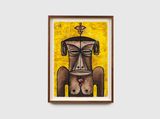
Crescent moons, ellipses and triangles with both concave and convex edges hover and collide to form the angular, mask-like faces that populate Anwar Jalal Shemza’s Head series (1956-1957). Marble-shaped eyes and bare torsos are sculpted in chalky gouache pigment; its subtle, velvety sheen, when caught in the light, ripples across each figure’s skin, revealing a muscular yet supple form.
This group of portraits, part of a larger series of 75 works last shown together in 1961 at the Pakistan National Council of the Arts Gallery, Karachi, displays a variety of geometric, chromatic and textural experimentations. Following his 1956 arrival in London, Shemza’s Head series marks a pivotal moment in his career, as he began to incorporate what he was learning from the Slade School of Fine Arts into his visual language. While these portraits precede the eventual crystallisation of Shemza’s abstract compositions, defined by a rhythmic arrangement of circles and squares, they suggest a transitional moment. By simplifying the human figure into a series of shapes and lines, Shemza could test and refine key formal expressions that would later be embodied in his entangled, linear forms.
During his time as a member of the Lahore Arts Circle, Shemza and his peers would experiment with abstraction, drawing influences from the rhythmic compositions of Cubism as well as the energetic spiritual forms of Mondrian, Kandinsky and Klee. The latter, in particular, was a constant reference for Shemza. Iftikhar Dadi notes, ‘among the lessons he learned from Klee was the importance of surface as the plane of modernist experimentation rather than a stress on modelling, and the freedom and ability to deploy abstraction, geometry and pattern - much of it derived from Islamic art - towards modernist exploration’. Similarly, the Head series was not defined by faithful representation but rather by an infinite experimentation with opacity and expressive lines. The fizzing surfaces of the series are evoked by the pairing of contrasting colours; in one instance, Shemza employs cobalt blue to accentuate the contours of a figure’s sandstone flesh, injecting the paper with a pearlescent luminosity.
Despite the works’ apparent flatness, a sense of agitation emerges through the dappled texture of each plane. Shemza’s early use of gouache (perhaps influenced by Klee) anticipates the restless surfaces that defined later paintings, such as C_ity Walls_ (1961). The works’ mottled backgrounds suggest fibrous carpet textures - Shemza’s family owned a carpet business, while the artist himself was known to be an avid collector of textiles. When devising his own approach to figuration, Shemza also considered, as his Slade tutor Andrew Forge observed, ‘applying [Klee’s] principles of growth and development to the sort of forms which he knows intimately himself. His paintings derive equally from the rhythmical space, filling patterns of the rug and from the ‘growing line’ of modern Western art. His pictures are not mere patterns and images, and their forms, whether painted or drawn, invest the surface with a mysterious life’.
Shemza’s sensuous melding of figurative and abstracted forms would continue to permeate even the most sparing of his linear compositions. The 1959 etching Women demonstrates how a simple undulating line emerging from a woman’s body can produce a complex geometric system of bisecting half-circles and tubular protrusions, as well as the familiar B and D letter motifs. Before the later 1970 silkscreen women series, this print indicates how the corporeal can be considered as one of Shemza’s primary references, shaping his botanical, architectural and calligraphic expressions.
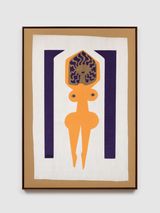
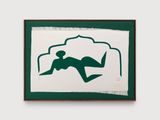
A more structural exploration of female forms is central to the figurative silkscreens produced while Shemza was teaching at Ounsdale High School, Wolverhampton, during the 1970s. In Female Form Emerging (1972) the artist establishes a porosity between architectural and bodily forms. Here, a slanted grid of individual scenes depicts silhouettes of pointed Mughal arches that shapeshift into a dancing female body. Unfolding like a series of animated vignettes, the composition begins with the arch formed around a woman’s shoulders, which eventually stretches to reveal her body’s full ecstatic frame. The work echoes Amna Malik’s assertion that Shemza’s lines reveal ‘an organic rhythmic movement that shifts and changes all the way [...] reminiscent of a dancing body, however with no sense of the hand meandering’.
In the series Girl with Curly Hair (1971), bodies are similarly carved out of an architectural frame that struggles to contain them. Once more, Shemza depicts female forms through a number of exaggerated bulbous forms, while layered blocks of opposing colours evoke elements of land, sea and flesh. Combinations of lemon yellow and olive green, alongside ultramarine and blush pink, create a structural tension that ripples outwards along the figure’s individual strands of wiry hair. The smooth, tubular arrangements seemingly anticipate the blossoming flower heads that would proliferate in Shemza’s later botanical drawings - these would eventually lead towards his final Roots series. Drawings such as Plant Forms (1977) and Poppy Heads (1977) mirror a similar rotund physicality with the silkscreen prints, suggesting an intertwinement of both land and bodies through shared fertile forms. Through various figurative interludes, we can appreciate Shemza’s career-long commitment to the sensuous line, one that imbues all his works with radiant life force.
Text by Amrita Dhallu, 2026. Courtesy Jhaveri Contemporary


A respected voice in contemporary art discourse.
Focusing on ambitious storytelling and insightful art-world commentary. Ocula Magazine publishes in-depth interviews, critical essays and timely analysis on the artists, exhibitions and ideas driving the global art world.
Learn more about Ocula Magazine
Showcasing the best of the art world.
Ocula partners with galleries from around the world to highlight their artists, artworks and exhibitions. Gallery membership is by application and invitation, with each member vetted by an independent panel.
Learn more about Ocula Membership

Specialises in the sale of major artworks.
Led by a team with deep ties to the world’s leading auction houses, galleries and collectors. Ocula’s advisory team offers bespoke services to high-net-worth clients from around the world who are looking to acquire the best of contemporary and modern art.
Learn more about our team and services