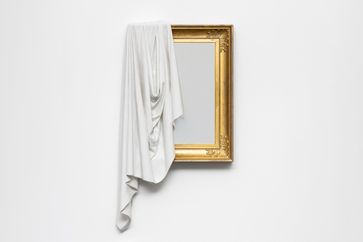




For his first exhibition at Mennour, Ryan Gander invites us to view a “3 in 1” exhibition, like those augmented products with a high acceleration coefficient. Between reality and fiction, the artist appears as three avatars, three young American artists showing their (his) works in the three rooms of the gallery. Paradoxically he undoubtedly also presents his most autobiographical exhibition, leaning against the wall an animated soft toy in his own image, falls in and out of sleep, lazy, lethargic, idle... looking like a bohemian resting on a rubbish bag after a raucous party. On the ceiling, three editions of the same work –a book– produced in 1979, 2024 and 2041 – float above the visitors.
Proceeding with echoes and repetitions, each room is built on a similar principle, combining a date, in a font created the same year, three works from the same series and finally a disruptive element used as a counterpoint acting like a time-related signifier. Playing on the mechanisms of perception, the artist proposes to interfere with our relationship with time and space by immersing the visitor in the recent past (1981), the remote past (1513) or, on the opposite, by projecting them into the future (2026).
‘The difference between past, present and future is only an illusion’, Albert Einstein said. Time is said to be only a matter of point of view. The Italian theoretician, physicist and scientific philosopher Carlo Rovelli pushes that argument even further, arguing that time doesn’t exist on a fundamental level, but is only the perception of an experience of the ‘here and now’.
Gander invites us to experience that general relativity by associating each date with a ‘representation’ of sites and by opening onto imaginary spaces. The paintings of the names of cities and places like Nice, Basel or Sunset, made from slides scratched by his father — used as intertitles in the slideshows of their family holidays — are both the intimate and personal traces of his childhood memories and the reminder, with its transmutation in painting, of the places where he lived as an adult and an artist.
The _Temporal Departures _works refer to bas-relief sculptures in the shape of stainless-steel doors placed on the gallery walls like so many promises of an elsewhere or an off screen. They are portals to other places, the artist having cast a magic spell on them. Removed from the heart of New York, London and Paris — a few steps from the gallery, rue Saint-André-des-Arts —, those doors combine official signs for bans and dangers with wild tags, characteristic of an art practice belonging to the street, often amateurish and autodidactic.
Finally, for his third series, Gander plays with the signs of actions, here those imagined by Hergé in his _The Adventurous of Tintin _comic books, to allude to movements, gestures and emotions, using a non-verbal visual language immediately understandable by everyone. Gathered under the title Irresistible Force Paradox, these paintings in high gloss automotive paint matching the colours of Porsche car represent a circular energy evoking the cosmos and the movement of stars in a permanent rotation, reminding us that on another scale, time is a matter of cycles and that each day returns, always slightly the same and slightly different. In physics, no energy ever disappears, it moves from one shape to another, from one state to another in a perpetual movement of transformation.
Like the double images of the mannerists, taken up later by the surrealists, Ryan Gander endeavours to deceive the gaze through repetition, to disturb our vision. In the centre of the last room, a huge double clock, maybe provoked by the vibration of the impact, takes centre stage like a meteorite planted in the ground, tirelessly showing a series of 8, showing every outcome of its potential, as to remind us that sometimes we need to reset the counter to zero in order to start all over again.
— Christian Alandete
Ryan Gander’s diverse practice includes sculpture, photography, print, design, film and installation, resulting in a unique portfolio of work best characterised by a love of storytelling through an ever-changing variety of materials and forms. Born in Chester in the northwest of England in 1976, Gander attended Manchester Metropolitan University where he studied interactive art: an art form that relies on the participation of its viewers. Upon graduating in 1999 with a first-class honours degree, he started work in a carpet shop in Chester until he travelled to Maastricht in the Netherlands to spend a year as a Post-Graduate Fine Art Research Participant at the Jan van Eyck Academie. He went on to take part in the artist residency programme of the Rijksakademie van beeldende kunsten in Amsterdam until 2004.

Mennour is an art gallery founded in Paris in 1999. Through its exhibitions, its projects developed in partnership with cultural institutions, its presence in major international art fairs, and its network of collaborators throughout the world, the gallery is present from Asia to the Americas, and from Africa to the Middle East. Today, it is one of the key actors in contemporary art and the art market.

A respected voice in contemporary art discourse.
Focusing on ambitious storytelling and insightful art-world commentary. Ocula Magazine publishes in-depth interviews, critical essays and timely analysis on the artists, exhibitions and ideas driving the global art world.
Learn more about Ocula Magazine
Showcasing the best of the art world.
Ocula partners with galleries from around the world to highlight their artists, artworks and exhibitions. Gallery membership is by application and invitation, with each member vetted by an independent panel.
Learn more about Ocula Membership

Specialises in the sale of major artworks.
Led by a team with deep ties to the world’s leading auction houses, galleries and collectors. Ocula’s advisory team offers bespoke services to high-net-worth clients from around the world who are looking to acquire the best of contemporary and modern art.
Learn more about our team and services