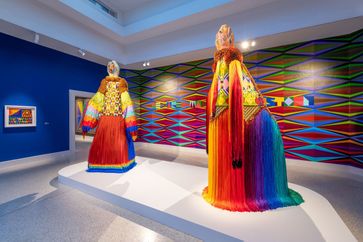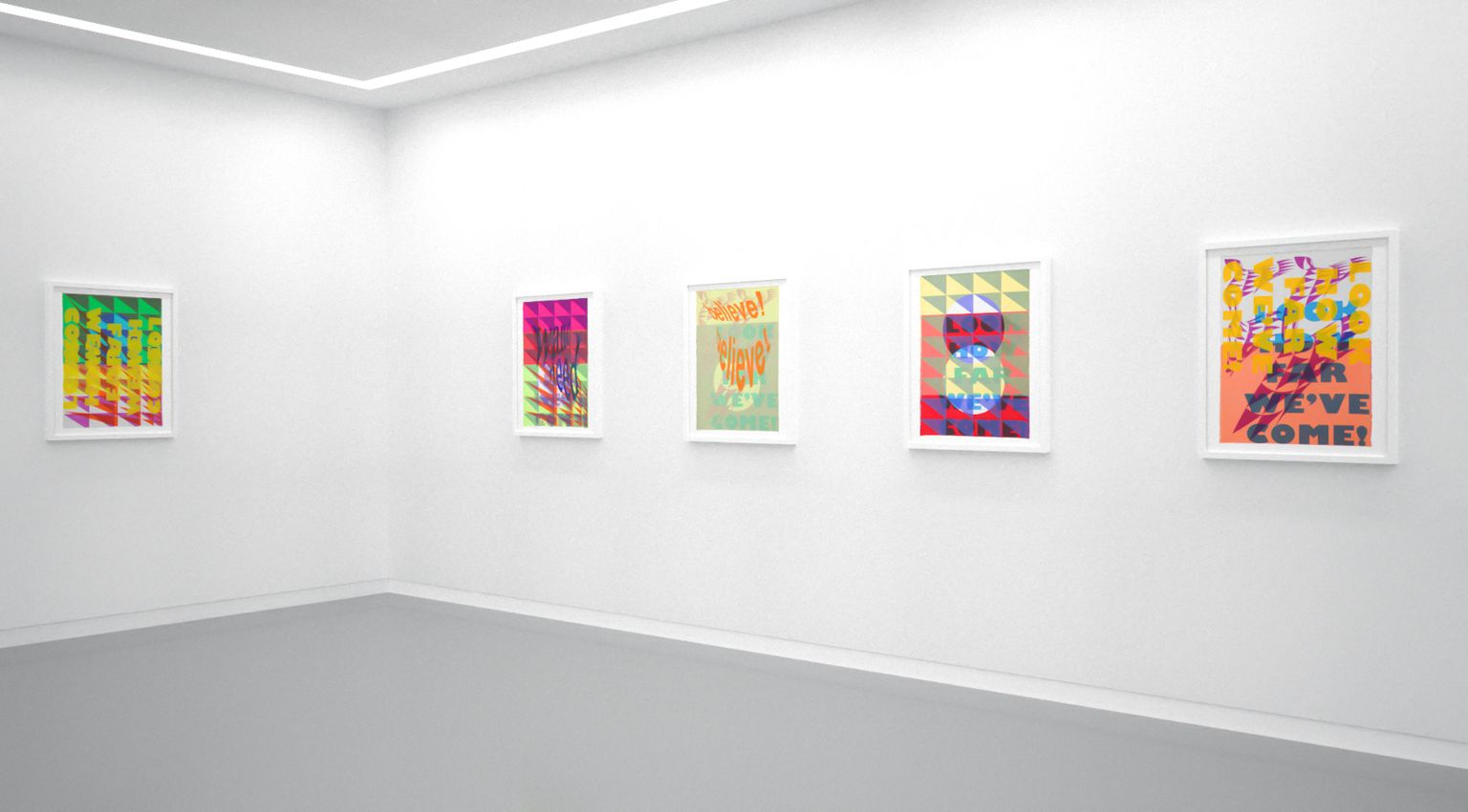
Kavi Gupta proudly presents the digital exhibition BELIEVE! BELIEVE!, Jeffrey Gibson’s first show of works on paper. Gibson is best known for his beaded works, paintings, reclaimed punching bags, and his long running series examining transformational, performative garments. These prints extend his exploration of the contemporary confluence of Native American traditions with the visual languages of Modernism, personal identity, culture, history, and international social narratives.
The works in this exhibition had their genesis back in 2017, halfway through the first year of the Trump administration. Jeffrey Gibson had just opened a solo show at the Haggerty Museum of Art in Milwaukee called LOOK HOW FAR WE’VE COME!
‘At the time I remember feeling that the phrase was fraught,’ Gibson says. ‘I felt like we were stepping back in time in terms of civil rights and equal justice.’ He kept the title nonetheless, because it reminded him of something his father taught him: that real change takes time. ‘Acknowledging how much progress has been made doesn’t mean you accept things as they are,’ Gibson says.
In conjunction with the exhibition, Gibson led a screen-printing workshop with students from the Milwaukee Institute of Art and Design (MIAD). He modelled the workshop after the teaching practices of Corita Kent, a 20th century Roman Catholic religious sister who revolutionised the medium. Kent’s social activism caused her to be labelled ‘blasphemous’ by the church. She persisted anyway, offering popular free screenprinting courses in Los Angeles that were attended by everyone from homeless people to college students to cultural icons, like Buckminster Fuller, John Cage, and Alfred Hitchcock.
Gibson filled one gallery at the Haggerty with Kent’s screenprints, using them to teach the MIAD students about her use of appropriated text and her methods of reversing images, tagging elements to be out of focus, and layering colours so they interfere with each other. Then Gibson designed ten unique screens so the students could learn firsthand how the screenprinting process works.
In addition to the phrase ‘LOOK HOW FAR WE’VE COME!’, Gibson chose two other phrases to utilise in the prints: BELIEVE! BELIEVE!, and WANT NEED.
’BELIEVE! BELIEVE! was the first punching bag I did with beaded text,’ Gibson explains. ‘At that point I was talking to myself about being an artist, questioning whether this was viable to do.’
WANT NEED came from the first beaded wall hanging Gibson ever made, WHAT WE WANT WHAT WE NEED (2013), which invoked a line from the Public Enemy song Fight the Power.
‘The difference between want and need can be confused in a time of trauma and panic,’ Gibson says, ‘but it’s crucially important as we move forward to focus on that difference.’
Gibson added in various patterns he was working with at the time, along with a negative space circle that repeats throughout the prints. ‘I’ve thought about that circle in terms of indigenous architectural structures, moving from one space to another,’ he says. ‘Those portals, circles, act as places of transition, going inside and outside. They overlap. They make a third space. I was integrating design into content, that’s where the circle comes from.’
Over a period of four days, Gibson and the MIAD students collaborated to mix the colours and pull about 80 prints. Some were given to the Haggerty Museum; others were given to the students. The remaining prints went back to the studio with Gibson.
‘Since I didn’t have a relationship with printmaking, I was sheepish about showing them,’ Gibson says. ‘Now when I look at them, I see how they grew into other artworks, and how the text became more significant. They make sense within the broader view of my practice.’
Reflecting upon their messaging, Gibson felt now is the perfect time to show the prints publicly for the first time.
‘People have asked if I identify as an activist, and I say, “No,”’ says Gibson. ‘I feel like activism is on the front line, in the marches. I’ve known about racism and homophobia my whole life. I’ve worked to carve out a space to propose a different kind of future for myself, for Indigenous people, for Indigenous queer folks, to have a space beyond the narrow space that we’re offered—a space where I can think about community based reconciliation. That’s what I see in the work.’
Twenty-five percent of proceeds from the sale of each print will be donated to Black Lives Matter, a global network building power to bring justice, healing, and freedom to Black people across the globe, and NDN collective, an Indigenous-led organisation dedicated to building Indigenous power and creating sustainable solutions on Indigenous terms through organising, activism, philanthropy, grant-making, capacity-building, and narrative change.
Press release courtesy Kavi Gupta.


In 2024, Jeffrey Gibson became the first Indigenous artist to represent the United States with a solo exhibition at the Venice Biennale. Drawing on his Cherokee and Choctaw heritage, Gibson fuses pop culture, queer iconography, commercial objects, and Indigenous motifs to examine identity and cultural hybridity. His works frequently transform everyday items—such as punching bags—through the formal languages of modernism, recontextualising familiar forms to challenge the boundaries of modern art. This approach, combined with intricate beadwork and vibrant references to both tradition and contemporary culture, allows Gibson to offer a powerful reflection on individual and collective narratives in a global context.

Kavi Gupta is a leading contemporary art gallery specialising in the representation of international emerging and mid-career artists. The gallery amplifies voices of diverse and underrepresented artists to expand the canon of art history. Through innovative and ambitious exhibitions, multimedia programming, and rigorous publications, Kavi Gupta fosters an evolving conversation among international communities about art and ideas.

A respected voice in contemporary art discourse.
Focusing on ambitious storytelling and insightful art-world commentary. Ocula Magazine publishes in-depth interviews, critical essays and timely analysis on the artists, exhibitions and ideas driving the global art world.
Learn more about Ocula Magazine
Showcasing the best of the art world.
Ocula partners with galleries from around the world to highlight their artists, artworks and exhibitions. Gallery membership is by application and invitation, with each member vetted by an independent panel.
Learn more about Ocula Membership

Specialises in the sale of major artworks.
Led by a team with deep ties to the world’s leading auction houses, galleries and collectors. Ocula’s advisory team offers bespoke services to high-net-worth clients from around the world who are looking to acquire the best of contemporary and modern art.
Learn more about our team and services