



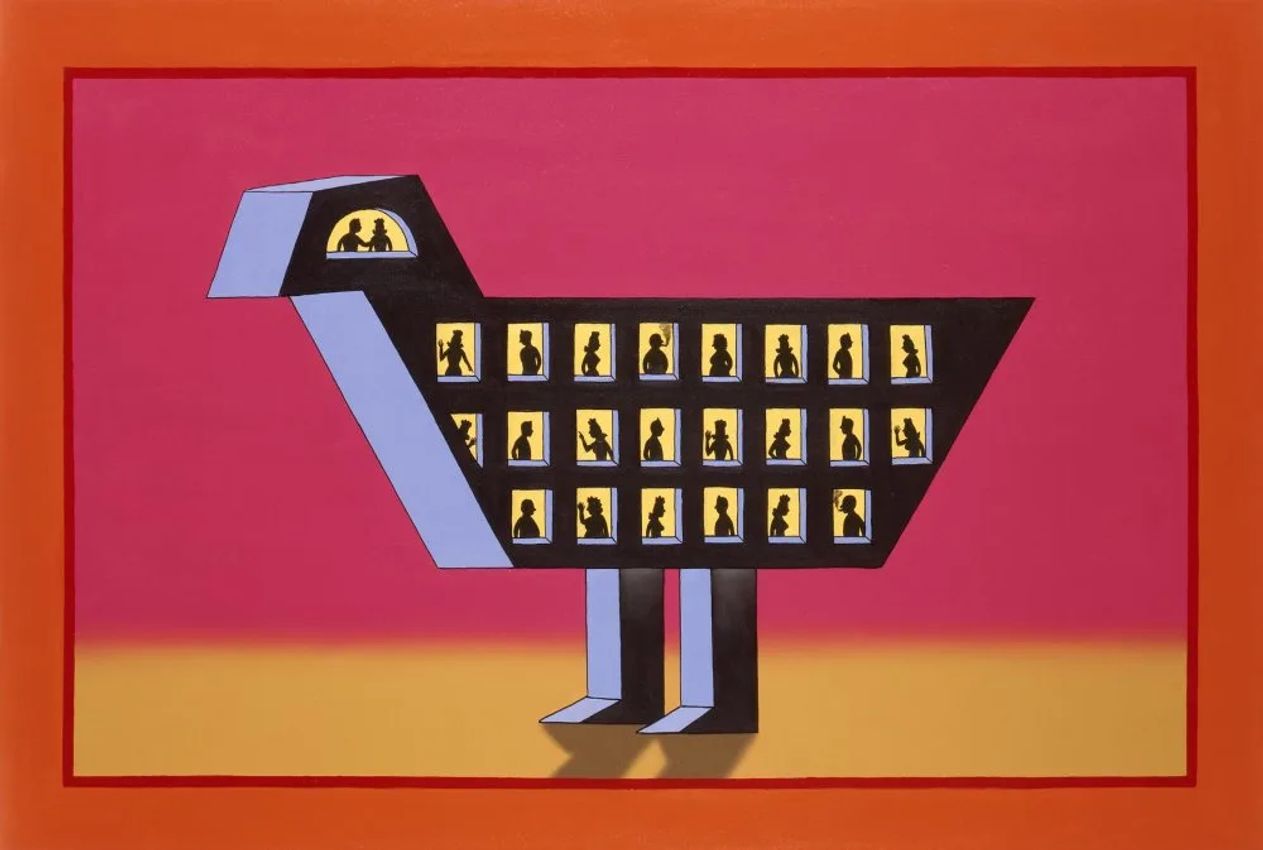
Kavi Gupta presents Roger Brown, Palace of Wonders,an exhibition celebrating Roger Brown’s late-careerseries of paintings based on the visual language ofcircus sideshow banners.
Brown was an avid student of American visual culture.He trained and taught in arguably the best art schoolof his time, but also sought knowledge from self-taughtartists, craftspeople, cartoonists, and the aestheticstrategies of advertising and pop culture. His range ofinfluences suggests he had a universal artistic consciousness that acknowledged no concrete separationbetween the so-called genres of fine art and outsiderart.
In 1990, when he was already an established artist,Brown attended Palace of Wonders: Sideshow Bannersof the Circus and Carnival at the Krannert Art Museumin Champaign, Illinois, an exhibition of historic sideshowbanners curated by circus artists Glen C. Davis andRandy Johnson. It was one of the first serious museumexaminations of the art form since sideshows cameinto existence in the late 18th century, when travelingcircuses themselves first appeared in America.
No official relationship existed between early circusesand sideshow promoters, who were mainly hustlerslooking to cash in on the circus crowds. Unlike the athletic, choreographed spectacles and trained animals featured in the main circus tents, sideshows includeda mix of unusual creatures; performers defying deathby swallowing swords, walking across fire, and climbing ladders made of knives: and ‘freaks of nature’ whowere purported to have, for example, the head of ahuman but the body of a spider or a snake.
As more circus owners formed official relationshipswith the increasingly popular sideshows, a vivid artistic tradition took shape. Blending rough ‘freak show’ imagery with the glamor and flash of the big top, theaesthetic grew to include bombastic visuals, brightcolours, and sizzling language designed to entice peopleinto the shows.
The Palace of Wonders exhibition at the Krannert ArtMuseum left an indelible impact on Brown’s artisticpractice. He produced at least a dozen sideshow paintings that same year, and continued revisiting the format for years to come. Brown’s paintings not only paidhomage to the visual language of the sideshow banners: they embraced the tangled relationship betweenthe so-called main events and ‘outside attractions.’
All of Brown’s interests are on display in his sideshowpaintings, including artworld satire, political controversy, current news, queer culture, American history,nature’s fury, architecture, and bad drivers. Invokingthe sideshow ethos, Brown brought into focus thetopics he saw as being outside the spotlight, or beyondpolite conversation: lurid scandals, ugly controversies,lowbrow entertainment, and the opaque art world.
Museum of What’s Happening Now shows Brown’s trivialising opinion of Abstract Expressionism, a powerfulinfluence in the art market of his time. In one fell swoopthe work satirises artists who blindly follow trends, collectors who artificially puff up the value of popularart, and institutions that glorify whatever happens tobe at the top of the art world pyramid scheme at themoment.
Similar satires of supposedly separate interests thatare actually in cahoots, and sideshows that are actuallymain attractions, underlie several of Brown’s sideshowbanner paintings, including Government Smokescreen,which targets the savings and loan scandals of the1990s: And Everybody Listens, a commentary on thefatwa that was placed on the author Salman Rushdieafter he published his book ‘Satanic Verses’; and ‘Aha!Heterosexuals Fuck Too’, which addresses hypocritical political and social attitudes surrounding the AIDSpandemic.
Some of Brown’s other sideshow banner paintings drawon more personal content, such as Kissin’ Cousins,which traces Browns true-life ancestral connectionto Elvis Presley, and Hank Williams, Honky Tonk Man,which reads like a frank tribute to the country musicstar, who grew up in Georgiana, Alabama, just downstate from Roger Brown’s home town of Hamilton.These paintings again seem to ask what the mainattractions are: the famous singers, or the artist whoimmortalises their images after they’re gone?
Equal parts sincere and sardonic, Brown’s explorationof sideshow banners feels less like a singular thesisabout the ‘freak show’ of modern living and more likean intimate snapshot of his own creative interests.Titled in honour of the presentation that inspired him,Roger Brown, Palace of Wonders is a dedicated exploration of this unique body of work within the artist’s latecareer.
Roger Brown was born on December 10, 1941, and was raised in Hamilton and Opelika, Alabama. A number of early experiences and observations in his formative years made deep impressions on Brown. By nature he was creative, and his parents encouraged his artistic bent. Brown’s interest in art emerged in grade school; he took art classes from second to ninth grade, and won first prize in a statewide poster competition in tenth grade. During childhood Brown grew especially close to his grand and great-grandparents, instilling an early interest in his family’s origins, which later flowered in extensive research into his family’s genealogy. Brown developed a deep interest in the material culture of the South, especially for folk art and hand made, functional objects. In adolescent and teen years he was influenced by the aesthetic of the comics, theatre architecture and interiors, and streamlined Art Deco and machine-age design. His religious upbringing in the independent, fundamentalist Church of Christ, was formative and lasting. In later years Brown became an astute and intuitive collector. Memories of his early experiences can be seen as his first, and perhaps most important collection. He retained them, distilled them into their essential aspects, and they became the visual and psychological engine for much of his work throughout his career.

Kavi Gupta is a leading contemporary art gallery specialising in the representation of international emerging and mid-career artists. The gallery amplifies voices of diverse and underrepresented artists to expand the canon of art history. Through innovative and ambitious exhibitions, multimedia programming, and rigorous publications, Kavi Gupta fosters an evolving conversation among international communities about art and ideas.

A respected voice in contemporary art discourse.
Focusing on ambitious storytelling and insightful art-world commentary. Ocula Magazine publishes in-depth interviews, critical essays and timely analysis on the artists, exhibitions and ideas driving the global art world.
Learn more about Ocula Magazine
Showcasing the best of the art world.
Ocula partners with galleries from around the world to highlight their artists, artworks and exhibitions. Gallery membership is by application and invitation, with each member vetted by an independent panel.
Learn more about Ocula Membership

Specialises in the sale of major artworks.
Led by a team with deep ties to the world’s leading auction houses, galleries and collectors. Ocula’s advisory team offers bespoke services to high-net-worth clients from around the world who are looking to acquire the best of contemporary and modern art.
Learn more about our team and services
