Press Release

With FROM THE FOAM’S FUDGED EDGE, KÖNIG SEOUL presents Katharina Grosse‘s first solo exhibition in Seoul. On display are her new works on paper made with either watercolour or acrylic paint in which the dynamics of her renowned, installative paintings give way to a quasi-meditative stillness.

At the centre of Katharina Grosse’s artistic practice has always been the desire to expand the potential of non-representational painting and to plunder its collective-historical unconscious. Grosse pursues such critical explorations, regardless of the medium, regardless of the ground on which she paints, with a pronounced opulence of colour. She spells out the vocabulary of visual experience with great aplomb, and in so doing, she breaks through the boundaries of the pictorial. Her work impresses upon us the question of what painting, of what a painted image can be.

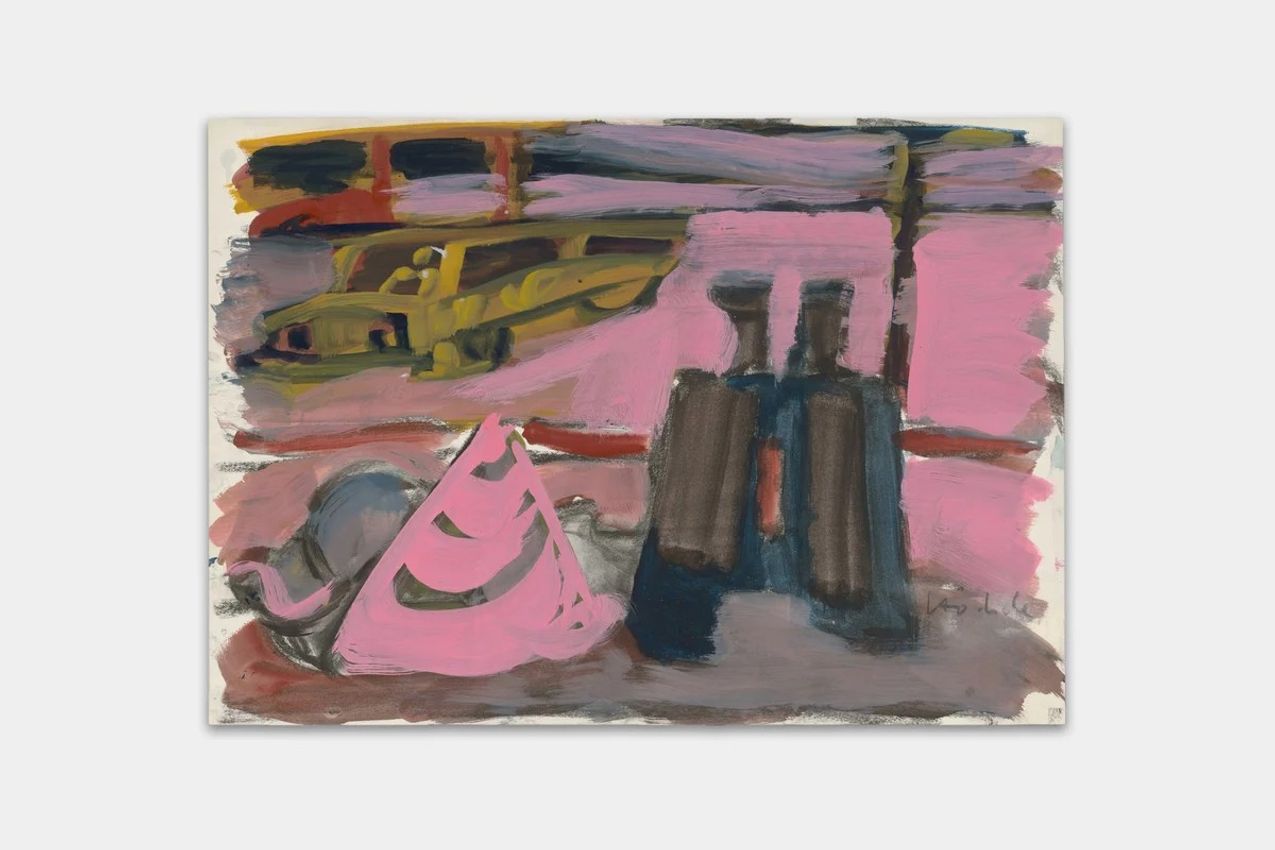
Public perception of Grosse’s multi-layered oeuvre often focuses on her spectacular large-scale canvas works and her expansive on-site paintings. The new works on paper shown here, measuring either 101 by 67 cm or 120 by 89 cm, reveal another aspect of her continually evolving work. The dramatics of epic pictorial space yields to a more direct communication between artist and spectator, to a more intimate grappling with the means of painting.

The works on paper are created by applying watercolour or highly diluted acrylic paints to the damp painting surface. Her brushstrokes pursue less the goal of drawing than serving to guide the path of the fluid colours, suggestive of dynamic impulses and the need to create channels for the flow. The works are structured by nothing less than what could be called a cartographic desire. As topographies of both accidental and intended signs, individual structures become briefly visible only to disappear and reappear again elsewhere; they are compositions of intuitive colour that can take on exhilarating, uplifting, melancholic, and disturbing features likewise. Her detailed painterly space encompasses capillaries and branches, geological-looking waterways or amniotic whirls. One might catch a flash of some primordial slime in them, and often they teeter on the evolutionary threshold between organic and inorganic. They are characterized by something liminal.

While Grosse’s large-format paintings and installations—in their intrepid explorations of painterly space—are aimed at the bodily experience of the viewer, confronting us with a determined phenomenological haptic, the works on paper pursue a different, though no less intense, perceptual strategy. They are unconfined by the theatricality of epic spaces of colour; rather, they approach an almost internal staging of colour and movement. For the most part, they are produced without stencils or other aids. The gestural mechanics of the spray gun—a painting tool that Grosse almost always employs—is set off by the movements of water, the directed flight of aerosols by the flow of diluted colours with its logic of chance and sign-finding. The immersive experience surrenders to a sustained, almost meditative stillness, from the dynamics of the expansive, overwhelming atmospheres to a concentrated fleetingness. Again and again, the works seem to ask how much clarity we need in order to see order—or if order is meaningful in the first place. Again and again, they confront the viewer with a sense of liberation.

In her works on paper, Grosse finds a new way of asking what painting can still be today. They are like chromatic meditations whose emotional probing is imparted to the viewers. Perhaps they can be understood as quasi-geological layers—layers of the artistic process, layers of aesthetic experience. They evidence Grosse’s unceasing endeavour to reconfigure her artistic practice.

BIOGRAPHY

Katharina Grosse (born in 1961, in Freiburg im Breisgau, Germany) has exhibited internationally for more than 25 years. Her most recent exhibitions and site-related works include psychylustro as part of the Philadelphia Mural Arts Program (2014); yes no why later at the Garage Museum of Contemporary Art, Moscow (2015); Seven Hours, Eight Voices, Three Trees at the Museum Wiesbaden, Germany (2015); Untitled Trumpet as part of the All the World’s Futures at the 56th Biennale di Venezia (2015); Katharina Grosse at the Museum Frieder Burda, Baden-Baden, Germany (2016); Rockaway as a part of the MoMA PS1-Program Rockaway! in Fort Tilden, New York (2016); Asphalt Air and Hair as part of the ARoS Triennale, Aarhus, Denmark (2017); This Drove My Mother up the Wall at the South London Gallery (2017); The Horse Trotted Another Couple of Metres, Then It Stopped at Carriageworks, Sydney (2018); Wunderbild at the National Gallery Prague (2018/2019); Mumbling Mud at the chi K11 art museum in Shanghai (2018/2019) as well as the chi K11 art space in Guangzhou, China (2019); Mural: Jackson Pollock I Katharina Grosse at the Museum of Fine Arts, Boston (2019/2020); Is It You? at the Baltimore Museum of Art (2020/2021), and It Wasn’t Us at the Hamburger Bahnhof – Museum for Contemporary Art – Berlin (2020/2021). Currently, her exhibition Chill Seeping from the Wall Gets between Us is on view at the Helsinki Art Museum. She lives and works in Berlin and New Zealand.

Text by Daniel Schreiber. Courtesy KÖNIG GALERIE.

Read More
About the Artist

In Katharina Grosse’s practice, there is no distinction between painting, architecture, and sculpture. Paint explodes beyond the traditional canvas onto walls, building exteriors, stretches of folded or draped fabric, objects, and even the landscape itself. Noted for her use of the spray gun to apply paint onto surfaces, often in big sweeps that recall graffiti art, Grosse creates a sensorial encounter with colour, scale, and dimensionality.

View Artist Profile

Also Exhibiting at König Galerie

Address
MCM Haus
412, Apgujeong-ro
Gangnam-gu
Seoul
South Korea
Opening Hours
Tuesday – Sunday
11am – 7pm
(1)
Seoul MCM Haus, 412, Apgujeong-ro
KÖNIG GALERIE
MCM Haus, 412, Apgujeong-ro, Gangnam-gu, Seoul, South Korea

Opening hours
Tuesday – Sunday
11am – 7pm
The art world in focus