



Press Release

KÖNIG GALERIE is proud to present a solo exhibition by Stephan Balkenhol in the NAVE of ST. AGNES. Balkenhol is one of the most renowned German sculptors of our time and famous for his coloured wood sculptures. He also creates reliefs, drawings and prints. His public bronze sculptures, some of which are of monumental dimensions, often entail an element of surprise, appearing in unusual places such as at the top of the tower of the church of St. Elisabeth in Kassel.

Back in the early 1980s, Balkenhol resolutely turned his back on prevailing trends to embrace figuration. Working at the intersection between minimalism and concretion on the one hand and the rise of the Neue Wilde on the other, he has since made the human figure and fundamental questions around human existence the consistent focus of his art.

Balkenhol developed the current exhibition in ST. AGNES specially for this space. It comprises 18 sculptures and wall reliefs in total, crafted from wood. They work with the central subjects of his art: men and women in everyday clothes, animals and ‘hybrid’ creatures, and architectural elements.

For the first time, one of the works also includes a personal item of his: the bicycle on which he twice rode across the Alps to Italy in younger years. The seat is now occupied by one of his wooden sculptures, whose posture leaves open the question of whether they are just about to set off somewhere or have just arrived. This openness and ambivalence is as central to Balkenhol’s work as its involvement of the exhibition space.

Another figure – a woman with a plait and robed in white – has her back to the entrance. Together with the other works, she forms an ensemble of prayer. She stands elevated, on two slices of wood, dominating the room. She is a reminder of the original purpose of the building. Like a high priestess, she leads the observer’s gaze towards the altar wall at the far end of the nave of the former church.In that part of the church hangs a huge, eye-catching relief of a male face with Mickey Mouse ears, a work in which Balkenhol processes the early influence on him of pop art and his fascination for Claes Oldenburg’s Mouse Museum (1965-77) in particular. In Balkenhol’s Mickey Mouse, the cheerfulness of western entertainment culture is interrupted by a melancholy-looking human face.

Balkenhol sculpts and carves his free-standing sculptures in a single piece, from complete tree trunks. This is apparent from the solid plinths, which are conceived as integral to the sculpture. His materials of choice are easily workable soft woods, such as poplar, obeche and cedar. Their roughly worked surfaces and coloured finishes lend them Balkenhol’s unmistakable signature style.

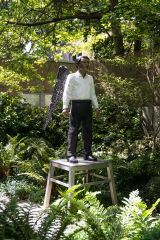
The artist’s most prominent hallmark piece is a man in black trousers and a white shirt. The same motif makes up a group of six free-standing sculptures made of poplar wood that have an almost film-like quality. Stood in a line, the plinth heights and figure sizes vary in proportion and play with perspective and perceptions. Whether a sequence of movements by a single person or a line-up of six different men is for the observer to decide.

Although he works figuratively, Balkenhol works without conveying clear messages and leaves plenty of scope for interpretation. His figures are dressed inconspicuously and have no individual characteristics. Neither their posture nor their facial expressions reveal anything clear about their emotions, giving them an air of mystery and aloofness. They gaze into the distance, into the unknown, perhaps, or maybe inwards, into themselves, the special ambivalence of their expressions suggesting they could be about to burst out laughing – or crying. And so the sculptures become screens onto which the observer can project their own emotions, for universal ideas and reflections on human existence.Balkenhol’s wall reliefs depict a panopticon of creatures. The artist carves owls and other animals, portrayals of young men, but also a chimpanzee in a pullover, whose human-like facial features come to the fore all the more for being depicted in a classic bust portrait. Humorously unnerving, these works break up the stringency of the row of males opposite.

Stephan Balkenhol (born 1957) lives and works in Kassel, Karlsruhe and Berlin, and in the French village of Meisenthal. In 2022 he was honoured by the American Friends of Museums in Israel. In 2016 he became an honorary member of the Russian Academy of Arts, and in 2014 France honoured his work with the Ordre des Art et des Lettres.

His works are owned by private and public collections such as the Staatliche Museen zu Berlin, Berlin; the Kunsthalle Hamburg, Hamburg; the Neue Pinakothek, Munich; the Broad Art Foundation, Santa Monica; the Scottish National Gallery of Modern Art, Edinburgh; the Museum für Gegenwartskunst (Museum of Contemporary Art), Basel; the Museum Africa, Johannesburg; the National Museum of Art, Osaka and the Peggy Guggenheim Collection, Venice. Various institutions of international repute have presented solo shows of the artist’s work, such as the Lehmbruck Museum, Duisburg (2020); the Centro de arte contemporáneo de Málaga, Málaga (2018); the Moscow Museum of Modern Art, Palais Gogolevski, Moscow (2016); the Kunstmuseum Ravensburg, Ravensburg (2014); the Skulpturenpark Waldfrieden, Wuppertal (2014); the Peggy Guggenheim Collection, Venice (2013); the Deichtorhallen, Hamburg (2008) and many more.Balkenhol’s works can also be found in public spaces including der Mann mit Möwenkopf (Man with a Seagull Head) , Le Havre (2020); Mann mit Hochhaus (Man with Tower Block), Toronto (2019); Mann mit Füllhorn (Man with Cornucopia), Sneek (2018); Mann auf Seepferdchen (Man on a Seahorse), Waiblingen (2018); Mann mit Rose (Man with a Rose), Neuss (2017); Denkmal für Jean Moulin (Monument to Jean Moulin), Metz (2014); Denkmal für Richard Wagner (Monument to Richard Wagner), Leipzig (2013); Mann im Turm (Man in the Tower), Church of St. Elisabeth, Kassel (2012); Balanceakt (Balancing Act), Berlin (2009) and Sempre più …, Forum Romanum, Rome (2009); Sphaera, Salzburg (2007), Giraffenmann (Giraffe Man), Strasburg (2006); Four Large Figures, San Francisco (2005) and Man with Fish, Chicago (2000).

Read More
About the Artist

Stephan Balkenhol is known not only for his technical mastery of the woodcarving medium, but also for his exploration of the role of the figure in contemporary sculpture. Throughout his practice, Balkenhol has explored the concept of the figure, alluding to and drawing from art history to create his suite of characters, albeit each is stripped of any specific personality.

View Artist Profile

Also Exhibiting at König Galerie

About the Gallery

KÖNIG GALERIE, founded in 2002, has evolved into a dynamic platform for contemporary art in Berlin and beyond. The gallery specializes in showcasing the work of both emerging and established international artists, with a particular emphasis on younger generations. Its program is characterized by interdisciplinary, concept-driven approaches, encompassing a wide array of artistic media, from sculpture and painting to video, installation, printmaking, photography, and performance.

View Gallery Profile
Address
St. Agnes
Alexandrinenstrasse 118-121
Berlin
Germany
Opening Hours
Tuesday - Sunday
11am - 6pm

or by appointment
(1)
Berlin St. Agnes, Alexandrinenstrasse 118-121
König Galerie
St. Agnes, Alexandrinenstrasse 118-121, Berlin, Germany
+49 30 261 030 80
https://www.koeniggalerie.com/

Opening hours
Tuesday - Sunday
11am - 6pm

or by appointment
The art world in focus
