



HANS ARP
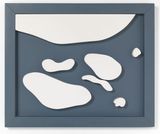
1886-1966, FranceHans Arp is a familiar figure of classical Modernism and was a key contributor in the development of Dada and Surrealism in the early twentieth century. Focusing his attention on everyday objects, Arp created his own unique ‘object language’ using a nonsensical vocabulary: plate, fork, knife, clock, tie, moustache, lips, breasts. With a playful hand he juggled the dominant art currents of the early twentieth century, combining seemingly contradictory geometric and organic formal idioms with the artistic ’-isms’ of his epoch.
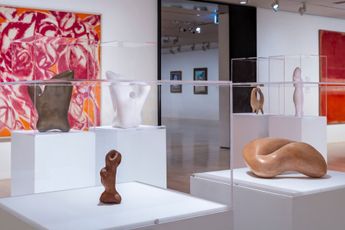
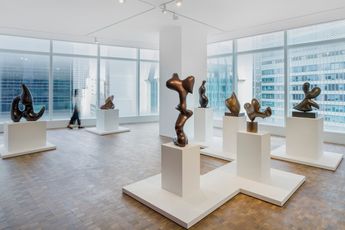
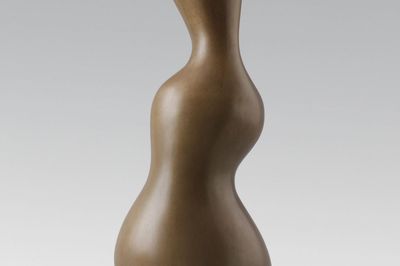
Turning his back on the increasingly modernised turn-of-the-century society, Arp created biomorphic works whose organic, amoeboid forms highlighted his fascination with the physiological processes of procreation, growth and death, and counteracted the rectilinear structures of Cubism. Arp studied the mineral, vegetable, and animal worlds for inspiration, documenting the evolution of an imaginary world. Combined with his late bronze sculptures from the 1950s, these works sought to give form to natural forces - clotting, hardening, congealing and fusing - all of which were symbols of eternal cycles in nature for Arp.
Born in Strasbourg, France in 1886 Arp was raised bilingual, French and German, and additionally Alsatian, which was fundamental for his work. After studying at Ecole des Arts et Metiers, Kunstschule Weimar and Académie Julian, Paris he co-founded the Swiss Artists association ‘Der Moderne Bund’ and the Dada movement in Zurich. Arp participated the first Surrealist exhibition in 1925 in Paris alongside Klee, Picasso and many others. In the 1930s, the Zurich-based art historian Carola Giedion-Welcker recognised the relevance of Arp’s vision of nature, and saw in his works the ‘invisible made visible, the search for a visual language capable of capturing the spiritual realms beyond the world of appearances.’ Arp’s innovative and influential practice prefigured the Fluxus movement, inspired artists such as Anthony Caro and Joan Miró, and made way for the great contemporary performance artists.
His first major solo exhibition in the USA was shown in 1949. Arp was awarded the Grand Prize for Sculpture at the Venice Biennale in 1954. In the 1960s he received the Stephan Lochner Medal, the GrandPrix National des Arts and the German Federal Cross of Merit. The first Arp retrospective was shown at the Museum of Modern Art in New York in 1958. Although his later practice is often overlooked, Arp continued producing sculpture and poetry in a continuation of the Dada tradition until his death in 1966, during which time he built up an incredible body of work.
Text courtesy Hauser & Wirth.







Explore and Follow Artists Shaping Contemporary Art
A respected voice in contemporary art discourse.
Focusing on ambitious storytelling and insightful art-world commentary. Ocula Magazine publishes in-depth interviews, critical essays and timely analysis on the artists, exhibitions and ideas driving the global art world.
Learn more about Ocula Magazine
Showcasing the best of the art world.
Ocula partners with galleries from around the world to highlight their artists, artworks and exhibitions. Gallery membership is by application and invitation, with each member vetted by an independent panel.
Learn more about Ocula Membership
Specialises in the sale of major artworks.
Led by a team with deep ties to the world’s leading auction houses, galleries and collectors. Ocula’s advisory team offers bespoke services to high-net-worth clients from around the world who are looking to acquire the best of contemporary and modern art.
Learn more about our team and services