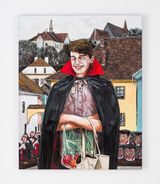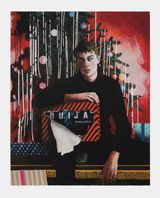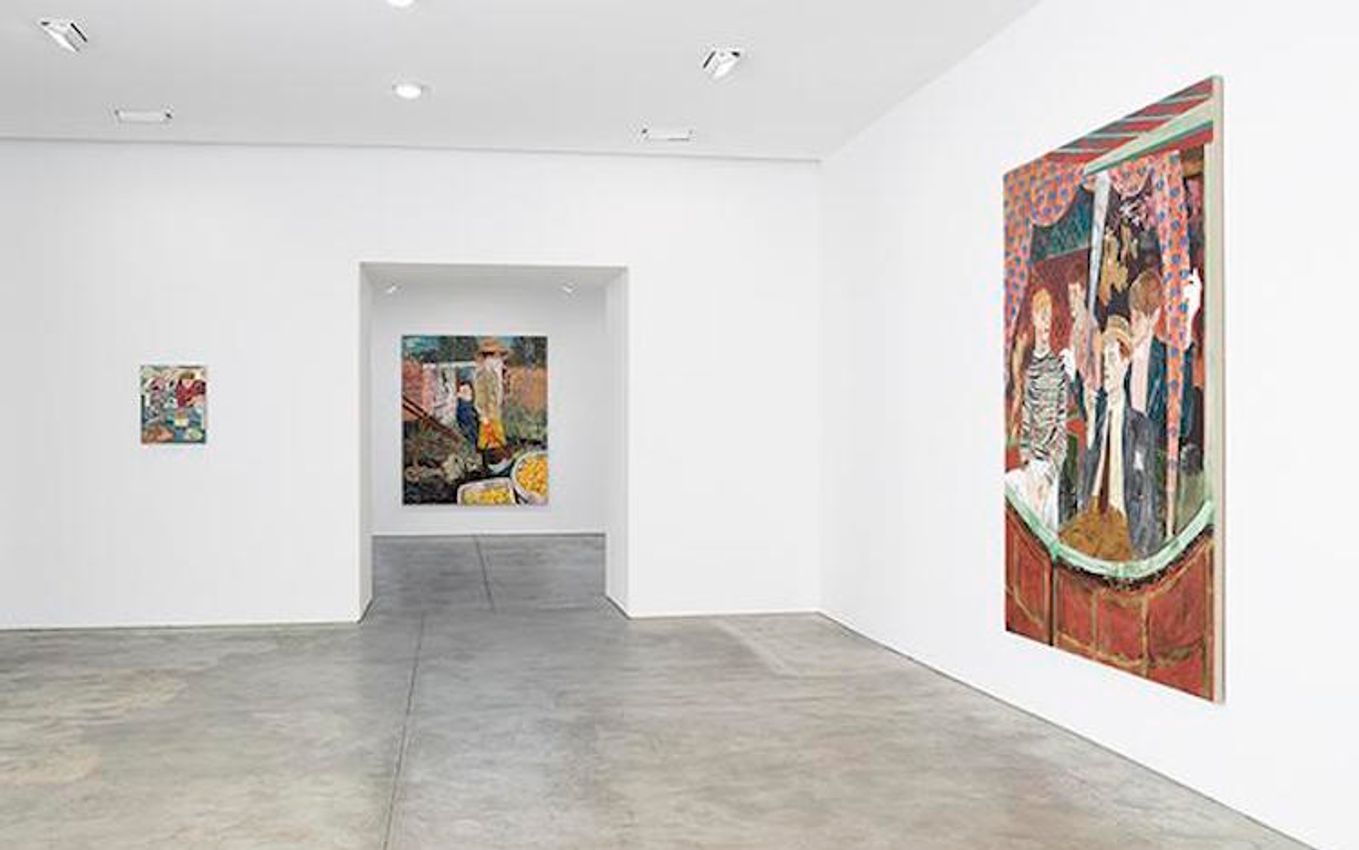
Dubbed “bright young people” or “bright young things” by the media that sensationalized their antics and lavish lifestyle, and later in books such as Bright Young People: The Lost Generation of London’s Jazz Age by D.J. Taylor, the high society group was extensively documented by photographer Cecil Beaton, whose images were a primary influence of Bas’ works. For the artist, who has long examined queer male themes found throughout modern history in his work, the characters and settings exemplify the recent past when queerness became a bourgeois privilege—accepted as charming affect rather than criminal act—for a class of young men coming of age following the loss of an older, more “masculine” generation in the war.
Ranging in scale from small, intimate works on paper to large canvases in muted colors with pops of pastel hues, this body of work focuses on general scenes of leisure: the day-to-day of society life, debauched nights, and intimate exchanges between imagined players. Formally, Bas distorts the conventional pictorial field by compressing the foreground and background, and by altering the perceived depth of the spaces in which his figures exist. The paintings are a blend of figuration and abstraction that incorporate classical genres including landscape and portraiture, and, for the first time, nod to early 20th century American still lifes and Art Deco motifs. Bas is equally prodigious in his experimentation with various techniques and materials—such as airbrush, wood block, acrylic, gold leaf, and house paint—as he is with his reference points.
Although well-read on these subjects, Bas prefers to focus on enduring myths as well as his own internalized interpretations, rather than the factual components. The resulting works in Bright Young Things depict a decade-long span where eccentricities were not repressed but rather celebrated, however superficially, for their entertainment value.
Prior to his gallery exhibition Bright Young Things, Lehmann Maupin (booth B9) will also show artworks by Bas in a solo presentation at ADAA’s The Art Show 2016, running from March 2-6. Additionally, the artist has forthcoming museum solo exhibitions scheduled at the Nanjing Sifang Art Museum, China in fall 2016 and at the San Antonio Museum of Art in summer 2017.
About the artist
Born in 1978 in Miami, Florida, Hernan Bas’ work has been exhibited in numerous solo exhibitions around the world, including the installation TIME, Hernan Bas: a queer and curious cabinet at the Bass Museum of Art, Miami (2013); a retrospective exhibition at the Kunstverein Hannover, Germany (2012); and a major presentation at the Rubell Family Collection, Miami (2007), which subsequently traveled to the Brooklyn Museum of Art (2008). In 2014, Rizzoli published a monograph on the artist, the most comprehensive book of his work to date. Bas has participated in a number of important group exhibitions including The Collectors curated by Elmgreen & Dragset for the Nordic and Danish Pavilions at the 53rd Venice Biennale (2009); Triumph of Painting: Part III, Saatchi Gallery, London (2005); Ideal Worlds—New Romanticism in Contemporary Art, Schirn Kunsthalle, Frankfurt (2005); and the 2004 Whitney Biennial. His work is included in the permanent collections of Brooklyn Museum of Art; The Museum of Modern Art, New York; Whitney Museum of American Art, New York; Hirshhorn Museum and Sculpture Garden, Washington, D.C.; Museum of Contemporary Art, Los Angeles; Museum of Contemporary Art, North Miami; and San Francisco Museum of Modern Art, among others. The artist lives and works in Detroit and Miami.
Born in 1978 in Miami, Florida, Hernan Bas creates works born of literary intrigue and tinged with nihilistic romanticism and old world imagery. Influenced by the Aesthetic and Decadent writers of the 19th century, in particular Oscar Wilde, Charles Baudelaire and Joris-Karl Huysman, Bas’s works weave together stories of adolescent adventures and the paranormal with classical poetry, religious stories, mythology and literature. His varied influences also include classic horror films, comics, television, art history, the occult and fairy tales. His paintings are a patchwork of figuration and abstraction; they feature classical subjects like interiors, landscapes and portraits. He experiments with various techniques and materials such as airbrush, wood block, acrylic, gold leaf and house paint. Before embarking on a new series, Bas does general, rather than in-depth, research into a subject. Furthermore, Bas feels that he doesn’t depict actual individuals or events in history but invents scenes inspired by various historical periods. Bas has typically depicted his figures as young men in a period of life change—specifically the transitional moment between boyhood and manhood. His subjects often appear unsettled, timid and insecure. While the male figure features prominently in Bas’ paintings, he does not view these as self-portraits. Bas divides his time between Detroit and Miami, cities that lie outside of major established art centres, yet have strong emerging art communities. The influence of these cities on Bas’ work can be seen in atmospheric and thematic cues.


Rachel Lehmann and David Maupin founded Lehmann Maupin in 1996. The gallery represents a diverse range of American artists, as well as artists and estates from across Europe, Asia, Africa, South America, and the Middle East. It has been instrumental in introducing numerous artists from around the world in their first New York exhibitions.

A respected voice in contemporary art discourse.
Focusing on ambitious storytelling and insightful art-world commentary. Ocula Magazine publishes in-depth interviews, critical essays and timely analysis on the artists, exhibitions and ideas driving the global art world.
Learn more about Ocula Magazine
Showcasing the best of the art world.
Ocula partners with galleries from around the world to highlight their artists, artworks and exhibitions. Gallery membership is by application and invitation, with each member vetted by an independent panel.
Learn more about Ocula Membership

Specialises in the sale of major artworks.
Led by a team with deep ties to the world’s leading auction houses, galleries and collectors. Ocula’s advisory team offers bespoke services to high-net-worth clients from around the world who are looking to acquire the best of contemporary and modern art.
Learn more about our team and services