Lehmann Maupin is pleased to present The Body Shimmer, a solo exhibition of new paintings by Dominic Chambers and the artist’s first solo presentation in Korea. Based in New Haven, Connecticut, Chambers is a painter and a writer who creates vibrant paintings that engage both art historical models and contemporary concerns surrounding race, identity, and the need for leisure and reflection. This exhibition serves as the visual counterpart to the fourth chapter of the artist’s ongoing anthology series, The Color of Heaven, which chronicles the meditations and influences that inform Chambers’ artistic trajectory. In tandem with the Seoul exhibition, Chambers also presents a collection of essays and poems that further articulate the ideas informing this new body of work, foregrounding the inextricable connection between painting and literary expression.
Chambers’ work draws on literature, mythology, magical realism, and African American history to construct contemplative and poetic scenes that challenge reductive narratives surrounding Black life. His compositions frequently depict figures in moments of leisure, introspection, and communion with nature, proposing imaginative spaces where joy, stillness, and interiority take precedence over spectacle or conflict. Literary and philosophical texts serve as a vital source of inspiration for the artist, who has long drawn from writers and thinkers such as the Roman philosopher Seneca, who described leisure as an investment in one’s inner life, and the American poet Mary Oliver, whose work celebrates attentive observation of the natural world. Literary traditions such as magical realism lie at the heart of his exploration of race, personal and imagined narratives, and the complexities of interior life, informing his interest in poetry as a bridge between the natural and the surreal.
In a new body of work entitled The Body Shimmer, Chambers continues his exploration of Black life, surrealism, and the poetics of leisure while deepening his belief in painting as a medium capable of materialising poetry. The series was inspired by the scientific discovery that the human body emits an extremely faint bioluminescent light—an imperceptible glow produced through metabolic processes. This revelation led him to reflect on another cosmic fact: most of the elements in the human body were forged in stars and supernovae billions of years ago. Framing humans as ‘earthbound stars,’ he ponders upon how communities might be understood as constellations.
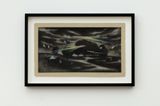
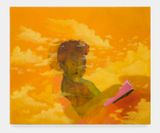
Alongside the artist’s rich literary inspirations, colour emerges as a central protagonist in Chambers’ paintings. In selecting his palette especially for this body of work, the artist considered the material qualities of colour—its mineral associations and varying degrees of opacity. Graphite Gray, Iridescent Pewter and Silver, Cobalt Yellow, and a range of luminous yellows were among the hues Chambers found particularly compelling. Carefully orchestrated relationships between these contrasting and shimmering tones generate subtle energy and psychological resonance across the canvas. These chromatic tensions animate otherwise tranquil scenes, imbuing the works with a quietly electric presence. Through luminous surfaces, the bodies that encapsulate this subtle ‘shimmer’ unfold as a poetic meditation on the body, the cosmos, and collective existence.
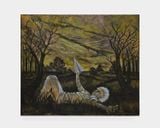
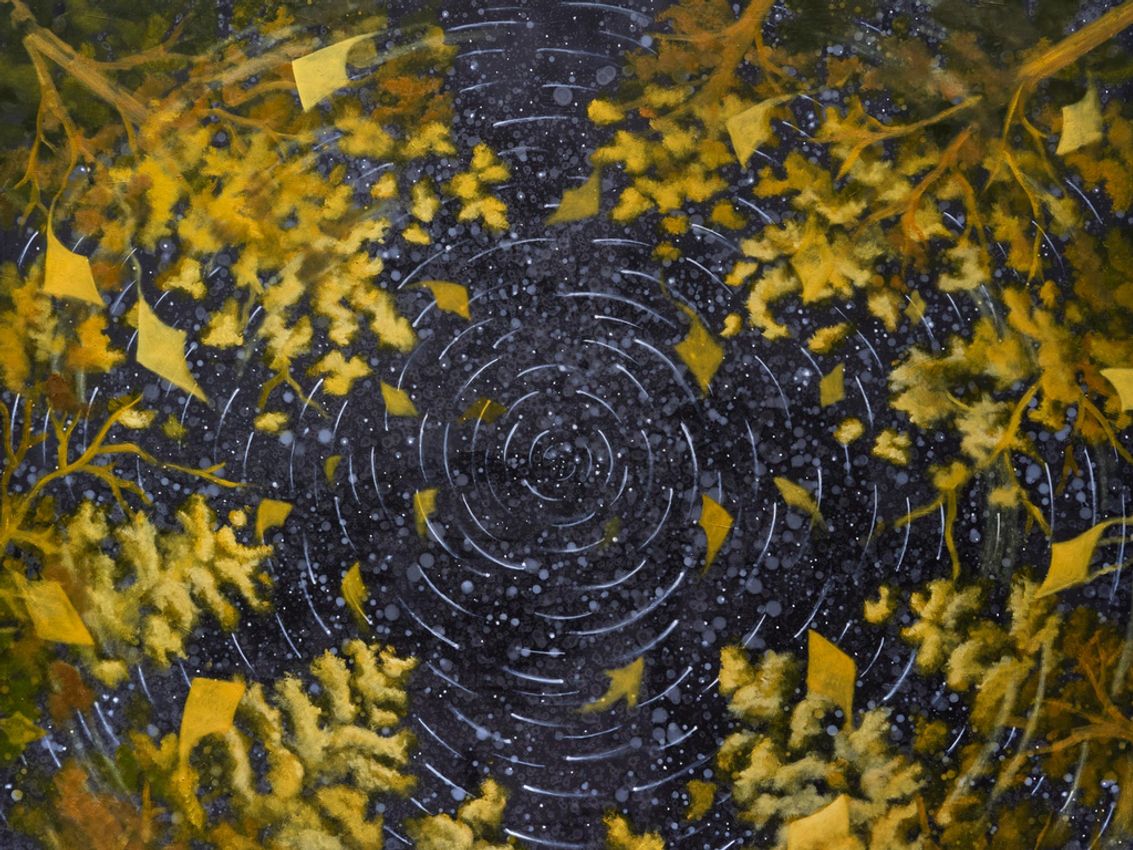
Perspective also plays an important role in the artist’s dreamscapes. This becomes especially apparent in Sightings: Forest Rorschach (2026), where what first appears to be a view from the forest floor looking up at a star-filled night sky gradually begins to shift. On closer inspection, the stars swirl at an impossible speed, drawing nearby kites into their motion while the surrounding trees remain uncannily still. The work ultimately destabilises orientation, suggesting that what seems to be the sky above may instead be a disturbed reflection—collapsing the distinction between looking up, down, or forward.
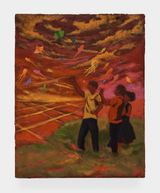
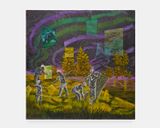
Chambers situates figures within expansive, star-filled landscapes that feel at once natural and dreamlike. In The Body Shimmer (Bright Thoughts #3) (2026), young adolescents, absorbed in the simple pleasure of the moment, fly kites and play with paper airplanes that drift through the aurora borealis. In the background, a subtle reference to Kerry James Marshall’s monumental piece Our Town (1995), evoking an idyllic scene of two children at play in a neighborhood housing project, appears as a ‘painted thought’ of the artist. Through such moments, Chambers suggests that leisure and recreation can function as vital sites of personal renewal, where inner lives take shape. Moving beyond strictly figurative representation, these works reflect on the relationship between artistic practice and the psyche, engaging spiritual, intellectual, and embodied dimensions of devotion.
In The Body Shimmer, Chambers proposes that contemplation, imagination, and leisure are not passive states but generative forces. Through dreamlike landscapes and quietly charged moments of reflection, his paintings invite viewers to consider how joy, wonder, and interior life can expand our understanding of both the everyday and the extraordinary.
Dominic Chambers (b. 1993 St. Louis, MO; lives and works in New Haven, CT) creates vibrant paintings that simultaneously engage art historical models, such as color-field painting and gestural abstraction, and contemporary concerns around race, identity, and the necessity for leisure and reflection. Interested in how art can function as a mode for understanding, recontextualizing, or renegotiating one’s relationship to the world, the artist sees painting as a critical and intellectual endeavour, as much as an aesthetic one. A writer himself, Chambers draws inspiration from literature, especially Magical Realism and the writing of W.E.B. Du Bois, particularly Du Bois’ The Souls of Black Folk, and one of its central themes―the veil. A product of racial injustice that is a metaphorical lens through which Black bodies are observed and experienced, references to the veil appear throughout the artist’s work, whether in the large swaths of color that obscure the figures in his Wash Paintings series, or in his recurring use of a raindrop motif as both an active and passive element in his paintings. Many of Chambers’ compositions incorporate Fabulist elements, including ghostly silhouettes meant to be stand-ins for the artist and surreal landscapes that feel both familiar yet unplaceable.


Rachel Lehmann and David Maupin founded Lehmann Maupin in 1996. The gallery represents a diverse range of American artists, as well as artists and estates from across Europe, Asia, Africa, South America, and the Middle East. It has been instrumental in introducing numerous artists from around the world in their first New York exhibitions.

A respected voice in contemporary art discourse.
Focusing on ambitious storytelling and insightful art-world commentary. Ocula Magazine publishes in-depth interviews, critical essays and timely analysis on the artists, exhibitions and ideas driving the global art world.
Learn more about Ocula Magazine
Showcasing the best of the art world.
Ocula partners with galleries from around the world to highlight their artists, artworks and exhibitions. Gallery membership is by application and invitation, with each member vetted by an independent panel.
Learn more about Ocula Membership

Specialises in the sale of major artworks.
Led by a team with deep ties to the world’s leading auction houses, galleries and collectors. Ocula’s advisory team offers bespoke services to high-net-worth clients from around the world who are looking to acquire the best of contemporary and modern art.
Learn more about our team and services