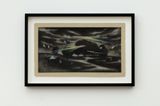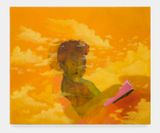
When the sprites of ideas enter the studio and marry themselves to resolve of the artist committed to fully realising them, one enters the summoning world—a state of creative immersion, that inner greenfield home to those things that shimmer: ideas, memory, dreams, and bodies without form or language, and perhaps angels live there too.—Dominic Chambers
Lehmann Maupin is pleased to announce Meraki, an exhibition of new work by American artist Dominic Chambers, opening October 8th in the gallery’s permanent space at Cromwell Place in London’s South Kensington neighbourhood. Marking the artist’s first solo presentation in the United Kingdom, Meraki spans two floors and includes expansive paintings, brightly coloured studies, and several works on paper. Chambers, born in St. Louis, MO and currently based in New Haven, CT, is best known for his vivid, colourful paintings that frequently depict scenes of leisure and contemplation as a mode for exploring ideas of personal interiority. In this exhibition, the artist expands his lens to the realm of devotion, engaging themes of inspired connection to work, art, and the natural world. The opening of _Meraki _coincides with London’s Frieze week; a reception will be held on October 8th with the artist in attendance. Elsewhere in Europe, Chambers’ work is included in the group exhibition When We See Us: A Century of Black Figuration in Painting at the Kunstmusuem Basel, on view through October 27th.
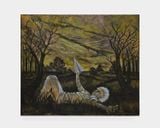
In creating his latest body of work, Chambers took the idea of meraki, a Greek word meaning “to pour one’s soul into one’s work,” as an origin point. As the title of the exhibition, Chambers uses this concept as a frame of inquiry, contemplating what it might mean to pour oneself into a creative endeavour and how the concept of the soul, or one’s own interiority, can intersect with ideas of devotion. These themes are poetically illustrated in _The Summoning World (Studio Angel) _(2024), a large-scale painting that blends the artist’s studio with a serene landscape, populated by a single, reclining angel. Chambers identifies this angel as Gabriel, of the Annunciation to the Virgin Mary, referencing the long tradition of angels functioning as messengers. Often acting as divine intermediaries bearing important news or a spark of inspiration, the figure of the angel has appeared for centuries across religious texts, literature, and art history—from the work of Leonardo Da Vinci to that of Kerry James Marshall. While Chambers’ warm, yellow-orange tones in The Summoning World (Studio Angel) suggest the golden settings of Fra Angelico, the scene, which is hung with artworks in various states of completion, also recalls Henri Matisse’s The Red Studio (1911). Astute viewers will note that some of the paintings depicted can be found hanging in the gallery exhibition. Here, Chambers places the painter in the role of the summoner, bringing images and objects into the material world from another realm.
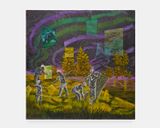
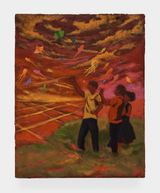
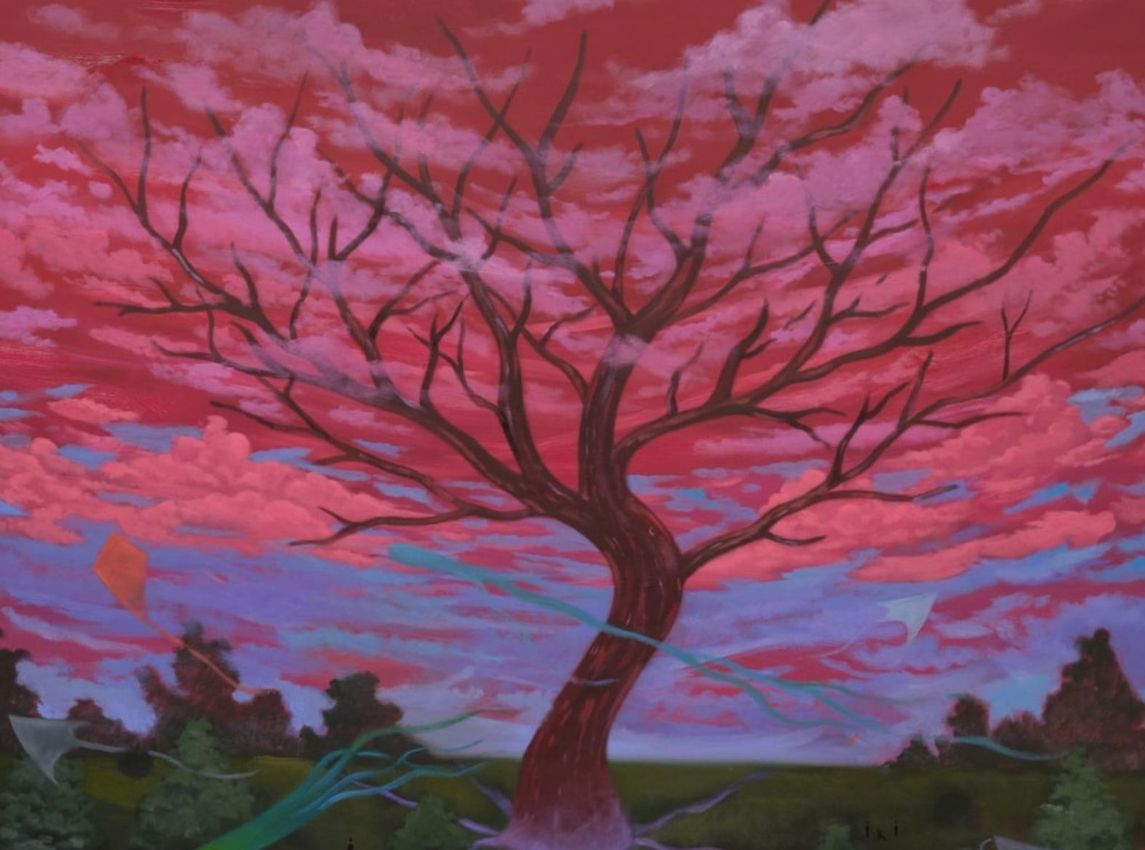
Chambers also looks to the natural world as a space of devotion and replenishment. In his new Thunderscape (2024) series, the artist depicts minute figures amidst landscapes of rolling hills and colossal trees, with each canvas drenched in rich, vibrant colour. These works in particular reveal the influence of Magical Realism in Chambers’ practice—in naming the series, he envisioned a surreal vista, where the shadows from tree branches became lightning bolts. In this world, the electrified landscape comes alive with sound, creating the titular thunderscape.
Chambers’ Thunderscapes also feature flying kites, some tethered, others autonomous, racing through the skies. These kites recall those in the paintings in his exhibition Leave Room for the Wind, which opened at Lehmann Maupin New York in early 2024. Their presence in the Thunderscapes series suggests they have escaped those picture planes to enter new canvases; they function as avatars, for either the artist or the creative spirit, time traveling across exhibitions and bodies of work.
Throughout Meraki, Chambers expands his explorations of leisure and interiority begun in earlier exhibitions—from the mental and physical leisure seen in Soft Shadows (2022) to the kinetic leisure in Leave Room for the Wind. In Meraki, he finds a new site for the replenishment of personal interiority in devotion, considering the spiritual as well as the bodily and intellectual, painting beyond the figurative and capturing the psyche.
Dominic Chambers (b. 1993 St. Louis, MO; lives and works in New Haven, CT) creates vibrant paintings that simultaneously engage art historical models, such as color-field painting and gestural abstraction, and contemporary concerns around race, identity, and the necessity for leisure and reflection. Interested in how art can function as a mode for understanding, recontextualizing, or renegotiating one’s relationship to the world, the artist sees painting as a critical and intellectual endeavour, as much as an aesthetic one. A writer himself, Chambers draws inspiration from literature, especially Magical Realism and the writing of W.E.B. Du Bois, particularly Du Bois’ The Souls of Black Folk, and one of its central themes―the veil. A product of racial injustice that is a metaphorical lens through which Black bodies are observed and experienced, references to the veil appear throughout the artist’s work, whether in the large swaths of color that obscure the figures in his Wash Paintings series, or in his recurring use of a raindrop motif as both an active and passive element in his paintings. Many of Chambers’ compositions incorporate Fabulist elements, including ghostly silhouettes meant to be stand-ins for the artist and surreal landscapes that feel both familiar yet unplaceable.


Rachel Lehmann and David Maupin founded Lehmann Maupin in 1996. The gallery represents a diverse range of American artists, as well as artists and estates from across Europe, Asia, Africa, South America, and the Middle East. It has been instrumental in introducing numerous artists from around the world in their first New York exhibitions.
A respected voice in contemporary art discourse.
Focusing on ambitious storytelling and insightful art-world commentary. Ocula Magazine publishes in-depth interviews, critical essays and timely analysis on the artists, exhibitions and ideas driving the global art world.
Learn more about Ocula Magazine
Showcasing the best of the art world.
Ocula partners with galleries from around the world to highlight their artists, artworks and exhibitions. Gallery membership is by application and invitation, with each member vetted by an independent panel.
Learn more about Ocula Membership

Specialises in the sale of major artworks.
Led by a team with deep ties to the world’s leading auction houses, galleries and collectors. Ocula’s advisory team offers bespoke services to high-net-worth clients from around the world who are looking to acquire the best of contemporary and modern art.
Learn more about our team and services