Press Release

Lehmann Maupin Seoul is pleased to present Los Angeles–based artist Lari Pittman’s solo exhibition Caprichos and Nocturnes on the heels of his recent museum surveys Mirror & Metaphor at the Jeonnam Museum of Art in Gwangyang, South Korea, and Magic Realism at the Long Museum in Shanghai, China, both curated by Rochelle Steiner. While these retrospectives traced the past decade of Pittman’s career, this presentation focuses on his Nocturne and Capricho series. Created in 2015, both series share a visual language of symbolic text and art historical references as Pittman interweaves literature, history, craft, and decorative arts into intricate compositions.

Pittman is known for his densely layered painting style, marked by a personal lexicon of signs and symbols such as bells, eggs, and ropes. Often working on a large scale, Pittman has an innate ability to compose works in which every element holds equal space and significance. In his Capricho series, he depicts violence and decay alongside utopian fantasy, drawing on references to Francisco Goya (1764–1828; Spain) and Emily Dickinson (1830–1886; United States of America). The Nocturne series, by contrast, envisions a suite of musical nocturnes translated into paintings. Together, this particular body of work creates an interwoven narrative that reveals the artist’s exploration of beauty, violence, and the complex interplay between fantasy and reality.

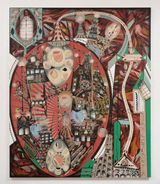
The Nocturne series unfolds as a visual analogue to the musical form, offering romantic, dreamlike reflections on the mysteries of night. Against dark, star-strewn grounds, Pittman layers recurring motifs of eggs and hybrid robotic creatures, conjuring scenes that feel at once ancient and futuristic. His restrained palette of mauves, earthy yellows, greens, and browns imbues the works with a quiet intensity, while the recurring egg motif suggests regeneration. Departing from his long-standing engagement with horror vacui, these works introduce a sense of visual openness, allowing the compositions to breathe. In Nocturne #9 (2015), a white, intricately patterned figure floats upside down against a black ground with glowing orbs and misty, galaxy-like forms. Fine lines and geometric markings give the figure a human-mechanical quality, while web-like threads and bright halos suggest drifting weightlessness and tranquil mystery, exploring night as a threshold between clarity and obscurity and balancing apparent chaos with meticulous structural order to suggest a cosmos where past and future share equal footing.

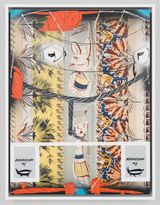
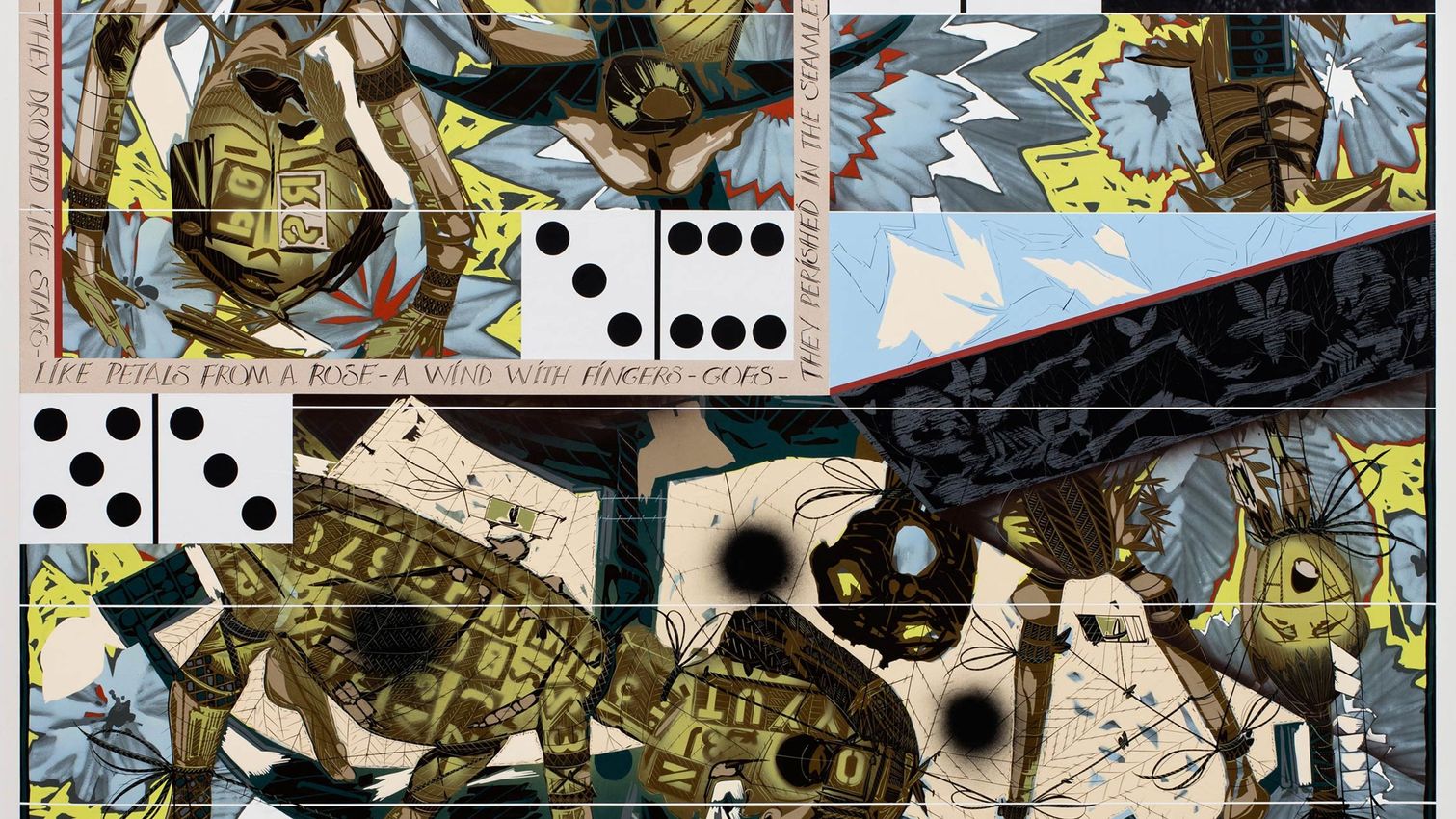
By contrast, the Capricho series adopts a more somber register, juxtaposing violence and decay with utopian fantasy to investigate trauma and power as culturally and historically transmitted structures. Here, Pittman pays homage to Los Caprichos, the late-18th-century etchings by Francisco Goya that exposed the brutality of human behavior and the oppressive social conditions of his time. He also embeds the works with excerpts from Emily Dickinson’s poetry—specifically regarding the body, pain, and death. Pittman’s visual juxtaposition of the Spanish painter with the American poet, whose sensibility was marked by the austerity of Puritan New England, can be read as a reflection of his own complex cultural formation as the child of a Catholic Colombian mother and an Atheist American father. In Capricho #8 (2015), jagged lightning forms, fragmented figures, and night-sky specks collide with oversized domino tiles, while angular, mask-like faces and contorted bodies emerge in bursts of electric blue, yellow, and earthy green. Hand-painted lines from Dickinson’s poem on the atrocities of the Civil War, “They Dropped Like Flakes” (1862), trace the borders of the composition, infusing the work with poetic resonance and apocalyptic intensity.

Through these two series, Pittman combines symbolism, literary references, and art historical sources into compositions that balance structure and emotion. By translating the nocturne into a meditation on night and regeneration, and by revisiting Goya’s Caprichos through Dickinson’s reflections on mortality, Pittman situates painting as a space where history, imagination, and the present intersect.

Read More
About the Artist

Lari Pittman, (b. 1952, Los Angeles, CA, lives and works in Los Angeles, CA). Over the course of his decades-long career, Lari Pittman has developed a unique visual aesthetic that has established him as one of the most significant painters of his generation. Pittman’s signature, densely-layered painting style includes a lexicon of signs and symbols (such as bells, eggs, animals, ropes), a compilation of varied painting techniques, and a clear homage to the handmade, craft, and the decorative. Pittman creates complex compositions that mediate the tension between colour, text and imagery; landscape and decoration; and chaos and order with remarkable dexterity and often on a large scale, and he has an innate ability to create compositions in which each element within a painting is given equal space and significance.

View Artist Profile

Also Exhibiting at Lehmann Maupin

About the Gallery

Rachel Lehmann and David Maupin founded Lehmann Maupin in 1996. The gallery represents a diverse range of American artists, as well as artists and estates from across Europe, Asia, Africa, South America, and the Middle East. It has been instrumental in introducing numerous artists from around the world in their first New York exhibitions.

View Gallery Profile
Address
213, Itaewon-ro
Yongsan-gu
Seoul
South Korea
Opening Hours
Tuesday – Saturday
11am – 7pm
(1)
Seoul 213, Itaewon-ro
Lehmann Maupin
213, Itaewon-ro, Yongsan-gu, Seoul, South Korea

Opening hours
Tuesday – Saturday
11am – 7pm
The art world in focus